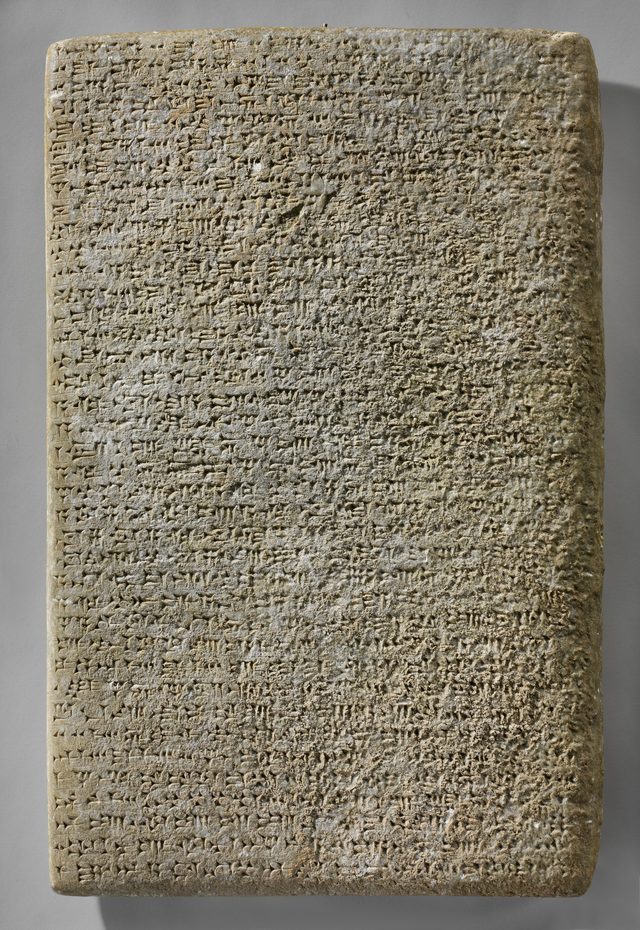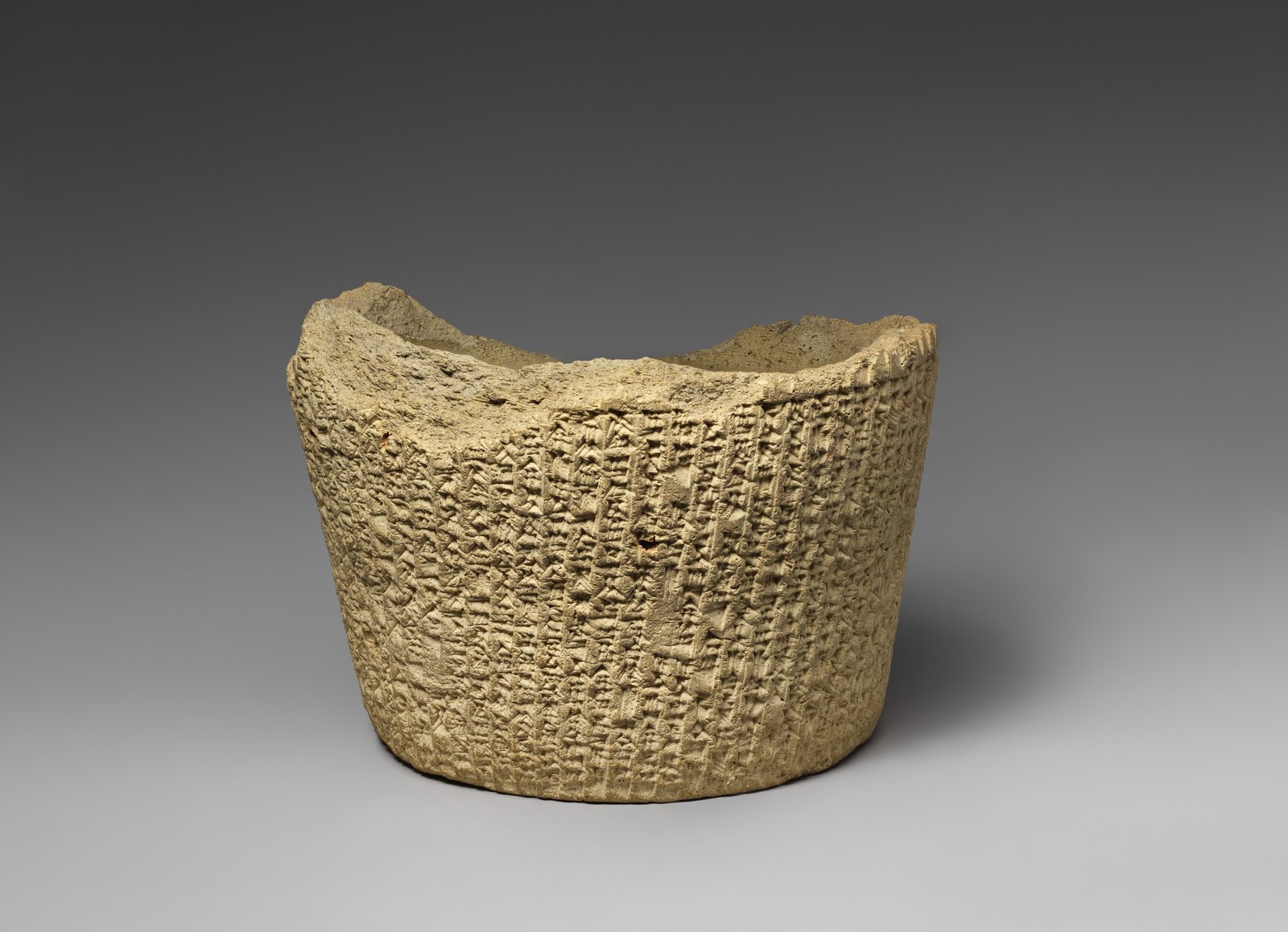
Clay cylinder with the Ehulhul inscription of Nabonidus, king of Babylon, describing work on three temples
A broken clay barrel cylinder closely written in cuneiform, a foundation-deposit type of royal building text. The king's own account presents his temple work as service to the gods, which is the Babylonian side of the text contrast with the Persian-side Cyrus Cylinder.
A broken clay barrel cylinder from the royal court of Nabonidus, king of Babylon, closely written in cuneiform and of the foundation-deposit type used for royal building texts. The Met dates it to about 555 to 539 BCE and gives the findspot as probably Babylon or Sippar. The inscription is the king's own account of work on three temples, and the archive treats it as the Babylonian side of a text contrast with the Persian-side Cyrus Cylinder. The tagged technique is transfer: the king presents his temple work as service to the gods, borrowing their standing for his rule. The text itself was not read or translated in this entry.
Propaganda techniques used in this object
- Date
- 0000
- Period
- Pre-1914
- Made by
- Royal court of Nabonidus, king of Babylon
Full record
Region, Country, Medium, Issuer type, Regime, Leader, Audience, Purpose, Theme, Source, Rights
- Region
- Middle East and North Africa
- Country
- Neo Babylonian Empire
- Medium
- Object
- Issuer type
- State
- Regime
- Neo Babylonian Empire
- Leader
- Nabonidus
- Audience
- Mixed
- Purpose
- Commemorate
- Theme
- Religion
- Leader
- Ashurnasirpal II
- Source
- Identified Openly sourced: the speaker is who they say they are
- Source
- The Metropolitan Museum of Art (Open Access), retrieved October 2, 2026
- Rights
- Public domain (The Met Open Access, CC0; isPublicDomain true in the Met API; object about 2,500 years old)
The Metropolitan Museum of Art, Purchase, 1886 (86.11.281), Open Access
Text on the object
Original (Akkadian (Neo-Babylonian cuneiform)) · read from the image, not independently checked
[illegible: the cuneiform on this cylinder was not transcribed in this entry]
Not translated: the text was not read in this entry.
No signs were read from the image; the Met's title is the only identification of the text.