Beat the Boll Weevil: Get a Good Cotton Crop
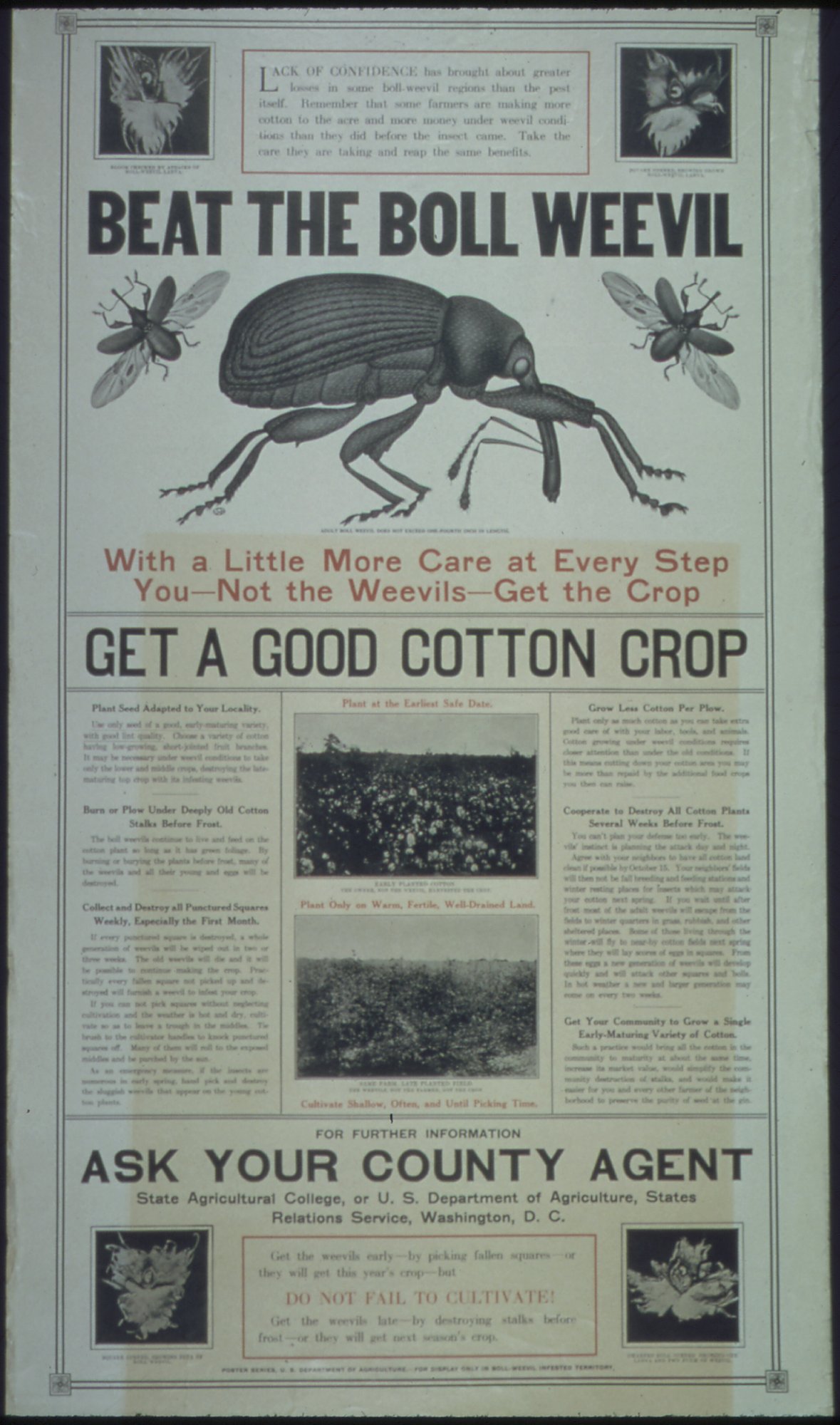
A tall instruction sheet shows an enlarged boll weevil under a bold headline, with photographs of cotton fields and corner insets of damaged bolls, then lists practical steps in columns. It closes by telling farmers to ask their County Agent. The tell is the mix of a pest-as-enemy image with plain farm-practice advice presented as the single way to a good crop.
Propaganda techniques used in this poster
- Date
- 1917
- Period
- First World War
- Made by
- U.S. Department of Agriculture, States Relations Service, with state agricultural colleges
- Region
- North America
- Country
- United States
- Medium
- Poster
- Issuer type
- State
- Regime
- Wilson Administration
- Leader
- Woodrow Wilson
- Audience
- Domestic public
- Purpose
- Mobilize or secure compliance
- Themes
- Home front, Economy and finance, Science and technology
- Event
- World War I
- Regime
- Wilson administration
- Leader
- Woodrow Wilson
- Source
- Identified Openly sourced: the speaker is who they say they are
- Source
- U.S. National Archives (NARA), RG 4 (U.S. Food Administration), World War I Posters (NAID 512439), retrieved October 3, 2026
- Rights
- NARA Unrestricted; hosted by owner decision
U.S. Department of Agriculture, States Relations Service, with state agricultural colleges. National Archives and Records Administration, 4-P-133.
Text on the object
[photo caption, upper left: illegible]
LACK OF CONFIDENCE has brought about greater losses in some boll-weevil regions than the pest itself. Remember that some farmers are making more cotton to the acre and more money under weevil conditions than they did before the insect came. Take the care they are taking and reap the same benefits.
[photo caption, upper right: illegible]

BEAT THE BOLL WEEVIL

[caption: ADULT BOLL WEEVIL. DOES NOT EXCEED ONE-FOURTH INCH IN LENGTH.]

With a Little More Care at Every Step
You—Not the Weevils—Get the Crop

GET A GOOD COTTON CROP

Plant Seed Adapted to Your Locality.
Use only seed of a good, early-maturing variety, with good lint quality. Choose a variety of cotton having low-growing, short-jointed fruit branches. It may be necessary under weevil conditions to take only the lower and middle crops, destroying the late-maturing top crop with its infesting weevils.

Burn or Plow Under Deeply Old Cotton Stalks Before Frost.
The boll weevils continue to live and feed on the cotton plant so long as it has green foliage. By burning or burying the plants before frost, many of the weevils and all their young and eggs will be destroyed.

Collect and Destroy all Punctured Squares Weekly, Especially the First Month.
If every punctured square is destroyed, a whole generation of weevils will be wiped out in two or three weeks. The old weevils will die and it will be possible to continue making the crop. Practically every fallen square not picked up and destroyed will furnish a weevil to infest your crop.
[… remaining text omitted: two further paragraphs of this column on cultivating to leave a trough and on hand-picking weevils in early spring]

Plant at the Earliest Safe Date.
[photograph caption: EARLY PLANTED COTTON. THE OWNER, NOT THE WEEVIL, HARVESTED THE CROP.]
Plant Only on Warm, Fertile, Well-Drained Land.
[photograph caption: SAME FARM, LATE PLANTED FIELD. THE WEEVILS, NOT THE FARMER, GOT THE CROP.]
Cultivate Shallow, Often, and Until Picking Time.

Grow Less Cotton Per Plow.
Plant only as much cotton as you can take extra good care of with your labor, tools, and animals. Cotton growing under weevil conditions requires closer attention than under the old conditions. If this means cutting down your cotton area you may be more than repaid by the additional food crops you then can raise.

Cooperate to Destroy All Cotton Plants Several Weeks Before Frost.
[… remaining text omitted: the long paragraph of this column urging neighbours to clean up cotton land by October 15]

Get Your Community to Grow a Single Early-Maturing Variety of Cotton.
Such a practice would bring all the cotton in the community to maturity at about the same time, increase its market value, would simplify the community destruction of stalks, and would make it easier for you and every other farmer of the neighborhood to preserve the purity of seed at the gin.

FOR FURTHER INFORMATION
ASK YOUR COUNTY AGENT
State Agricultural College, or U. S. Department of Agriculture, States Relations Service, Washington, D. C.

[photo captions, lower corners: illegible]

Get the weevils early—by picking fallen squares—or they will get this year's crop—but
DO NOT FAIL TO CULTIVATE!
Get the weevils late—by destroying stalks before frost—or they will get next season's crop.

POSTER SERIES, U. S. DEPARTMENT OF AGRICULTURE.—FOR DISPLAY ONLY IN BOLL-WEEVIL INFESTED TERRITORY.
Read from the 2000 px scan. Body columns are small and slightly soft, so a few words may be misread; the tiny captions under the four corner photographs are not legible and are marked [illegible]. To stay within the 4000-character limit, two paragraphs of the left column and the long paragraph of the right column are omitted where marked (their headings are kept); the rest is transcribed block by block in reading order.