Content note: Grotesque caricature of a Red Army soldier, shown being cut down by a cavalryman (Polish poster, 1920). This object is shown as it was published. Why
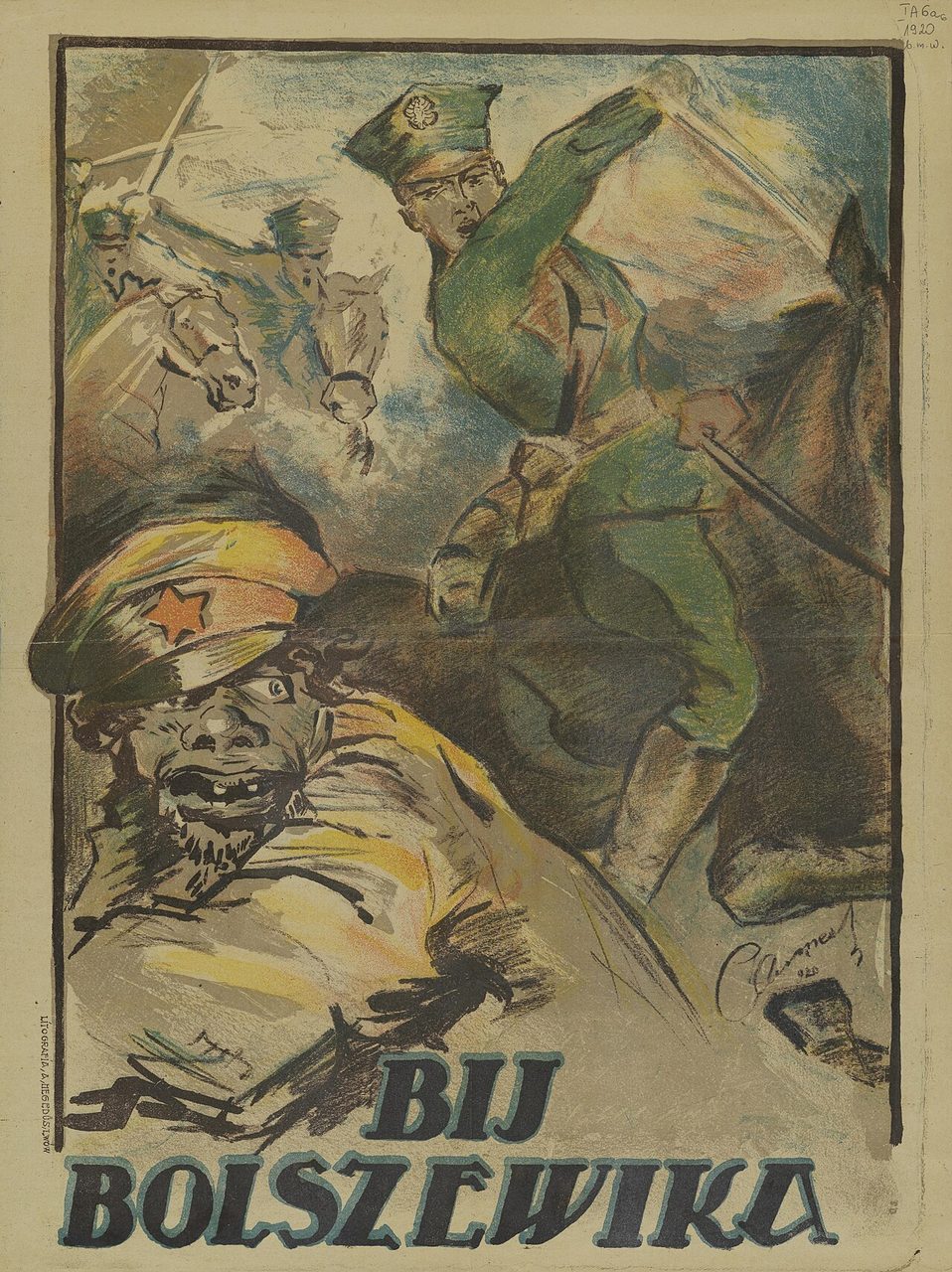
Bij bolszewika (Strike the Bolshevik): Polish lithograph poster
A colour lithograph shows a Polish cavalryman with raised sabre riding down a grotesque, wide-eyed, gap-toothed face in a cap with a red star, under the order 'Strike the Bolshevik'. The enemy soldier is drawn as a leering, bestial head rather than a person, so the label 'Bolshevik' arrives already attached to the caricature.
Propaganda techniques used in this poster
- Date
- July 1920
- Period
- Interwar
- Made by
- Polish Polish-Soviet War poster (sponsor not named on the sheet); signed lithograph printed in Lwów (artist signature and printer's name only partly legible)
Full record
Region, Country, Medium, Issuer type, Regime, Leader, Audience, Purpose, Theme, Event, Source, Rights
- Region
- Eastern Europe and Eurasia
- Country
- Poland
- Medium
- Poster
- Issuer type
- Mixed
- Regime
- Second Polish Republic
- Leader
- Jozef Pilsudski
- Audience
- Domestic public
- Purpose
- Demonize
- Theme
- War and the military
- Event
- Polish Soviet War
- Source
- Identified Openly sourced: the speaker is who they say they are
- Source
- Wikimedia Commons (item from Polona, National Library of Poland), retrieved October 2, 2026
- Rights
- Public domain (Polish poster of July 1920, published before 1931; Commons: PD-old-100-expired, Public Domain Mark)
Unknown artist; Polona (National Library of Poland), via Wikimedia Commons.
Text on the object
Original (Polish) · read from the image, not independently checked
BIJ
BOLSZEWIKA

[signature, illegible] 1920

LITOGRAFIA A. [illegible], LWÓW
STRIKE
THE BOLSHEVIK

[signature, illegible] 1920

LITHOGRAPHY A. [illegible], LWÓW
Imprint is printed vertically at lower left in very small type and was read at low resolution; the surname after 'A.' is not reliably legible. Shelf mark at top right (library annotation) omitted.