Content note: Text uses animal and bloodshed imagery ('wounded wild beast', 'sea of blood and tears') for the North Vietnamese side. This object is shown as it was published. Why
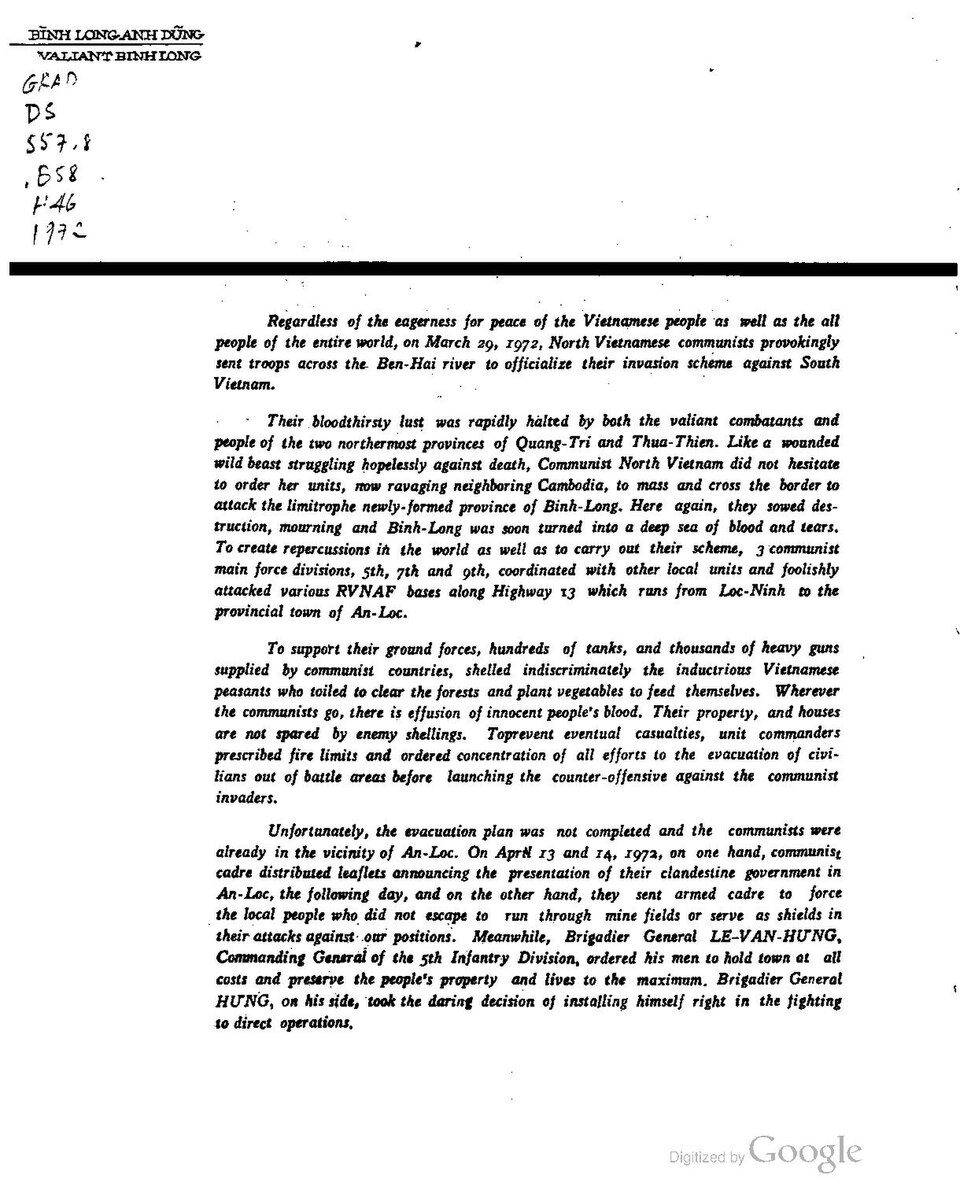
Valiant Binh Long (booklet text page: the March 1972 crossing and the road to An Lộc)
An English-language text page of the booklet gives the booklet's account of the opening of the 1972 offensive in Bình Long. It labels the North Vietnamese 'bloodthirsty', likens them to a 'wounded wild beast', and says the province was 'turned into a deep sea of blood and tears'. The tell is the animal and bloodshed imagery attached to the whole opposing side.
- Date
- 1972
- Period
- Cold War
- Made by
- Psychological Warfare Department (Cục Tâm-lý-chiến), Republic of Vietnam Armed Forces
- Region
- Southeast Asia
- Country
- South Vietnam
- Medium
- Books and pamphlets
- Issuer type
- Military
- Regime
- Thieu Government
- Leader
- Nguyen van Thieu
- Audience
- Foreign public
- Purpose
- Persuade or win support
- Theme
- War and the military
- Event
- Vietnam War
- Techniques
- Name-callingFear appeal
- Source
- Identified Openly sourced: the speaker is who they say they are
- Source
- Wikimedia Commons, retrieved October 2, 2026
- Rights
- Public domain (Commons: PD-South VietnamGov, PD-Layout)
Psychological Warfare Department (Cục Tâm-lý-chiến), Republic of Vietnam, 1972; scan from Google Books (digitized by Google) via Wikimedia Commons.
Text on the object
BÌNH LONG ANH DŨNG
VALIANT BINH LONG

Regardless of the eagerness for peace of the Vietnamese people as well as the all people of the entire world, on March 29, 1972, North Vietnamese communists provokingly sent troops across the Ben-Hai river to officialize their invasion scheme against South Vietnam.

Their bloodthirsty lust was rapidly halted by both the valiant combatants and people of the two northermost provinces of Quang-Tri and Thua-Thien. Like a wounded wild beast struggling hopelessly against death, Communist North Vietnam did not hesitate to order her units, now ravaging neighboring Cambodia, to mass and cross the border to attack the limitrophe newly-formed province of Binh-Long. Here again, they sowed destruction, mourning and Binh-Long was soon turned into a deep sea of blood and tears. To create repercussions in the world as well as to carry out their scheme, 3 communist main force divisions, 5th, 7th and 9th, coordinated with other local units and foolishly attacked various RVNAF bases along Highway 13 which runs from Loc-Ninh to the provincial town of An-Loc.

To support their ground forces, hundreds of tanks, and thousands of heavy guns supplied by communist countries, shelled indiscriminately the inductrious Vietnamese peasants who toiled to clear the forests and plant vegetables to feed themselves. Wherever the communists go, there is effusion of innocent people's blood. Their property, and houses are not spared by enemy shellings. Toprevent eventual casualties, unit commanders prescribed fire limits and ordered concentration of all efforts to the evacuation of civilians out of battle areas before launching the counter-offensive against the communist invaders.

Unfortunately, the evacuation plan was not completed and the communists were already in the vicinity of An-Loc. On April 13 and 14, 1972, on one hand, communist cadre distributed leaflets announcing the presentation of their clandestine government in An-Loc, the following day, and on the other hand, they sent armed cadre to force the local people who did not escape to run through mine fields or serve as shields in their attacks against our positions. Meanwhile, Brigadier General LE-VAN-HUNG, Commanding General of the 5th Infantry Division, ordered his men to hold town at all costs and preserve the people's property and lives to the maximum. Brigadier General HUNG, on his side, took the daring decision of installing himself right in the fighting to direct operations.
[English original; no translation needed.]
English as printed, including the booklet's own spellings ('northermost', 'inductrious', 'Toprevent'). Three words are partly broken by the scan; they are read from context. Handwritten library shelfmarks at upper left are not transcribed.