CEA report 'The Impact of the Trump Labor Market on Historically Disadvantaged Americans' (executive summary)
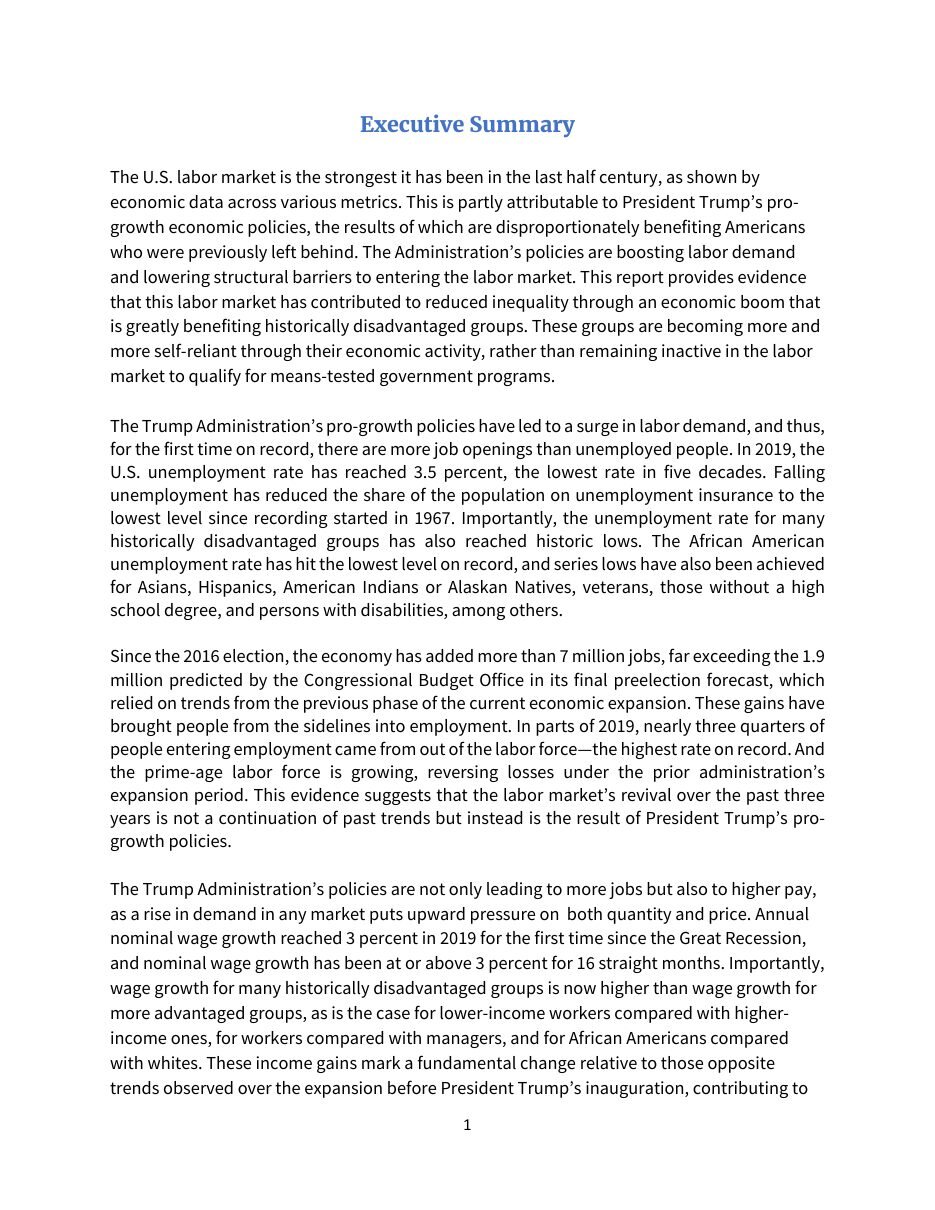
Executive-summary page of a 47-page Council of Economic Advisers report, December 2019. It opens with 'The U.S. labor market is the strongest it has been in the last half century' and then lists record-low unemployment rates for named groups, 7 million jobs against a 1.9 million CBO forecast, and wage growth. It attributes the results to 'President Trump's pro-growth policies' and presents the pre-election forecast as the only counterfactual.
- Date
- December 2019
- Period
- Contemporary
- Made by
- Council of Economic Advisers (Trump administration)
- Region
- North America
- Country
- United States
- Medium
- Document
- Issuer type
- State
- Regime
- Trump Administration
- Leader
- Donald Trump
- Audience
- Domestic public
- Purpose
- Persuade or win support
- Themes
- Labor, Economy and finance
- Techniques
- Card stacking
- Regime
- Trump administration
- Leader
- Donald Trump
- Source
- Identified Openly sourced: the speaker is who they say they are
- Source
- National Archives (Trump White House archived website), retrieved October 2, 2026
- Rights
- Public domain (U.S. government work; whitehouse.gov copyright policy)
White House Council of Economic Advisers, December 2019, via the National Archives archived Trump White House website
Text on the object
Executive Summary
The U.S. labor market is the strongest it has been in the last half century, as shown by economic data across various metrics. This is partly attributable to President Trump’s progrowth economic policies, the results of which are disproportionately benefiting Americans who were previously left behind. The Administration’s policies are boosting labor demand and lowering structural barriers to entering the labor market. This report provides evidence that this labor market has contributed to reduced inequality through an economic boom that is greatly benefiting historically disadvantaged groups. These groups are becoming more and more self-reliant through their economic activity, rather than remaining inactive in the labor market to qualify for means-tested government programs.

The Trump Administration’s pro-growth policies have led to a surge in labor demand, and thus, for the first time on record, there are more job openings than unemployed people. In 2019, the U.S. unemployment rate has reached 3.5 percent, the lowest rate in five decades. Falling unemployment has reduced the share of the population on unemployment insurance to the lowest level since recording started in 1967. Importantly, the unemployment rate for many historically disadvantaged groups has also reached historic lows. The African American unemployment rate has hit the lowest level on record, and series lows have also been achieved for Asians, Hispanics, American Indians or Alaskan Natives, veterans, those without a high school degree, and persons with disabilities, among others.

Since the 2016 election, the economy has added more than 7 million jobs, far exceeding the 1.9 million predicted by the Congressional Budget Office in its final preelection forecast, which relied on trends from the previous phase of the current economic expansion. These gains have brought people from the sidelines into employment. In parts of 2019, nearly three quarters of people entering employment came from out of the labor force—the highest rate on record. And the prime-age labor force is growing, reversing losses under the prior administration’s expansion period. This evidence suggests that the labor market’s revival over the past three years is not a continuation of past trends but instead is the result of President Trump’s progrowth policies.

The Trump Administration’s policies are not only leading to more jobs but also to higher pay, as a rise in demand in any market puts upward pressure on both quantity and price. Annual nominal wage growth reached 3 percent in 2019 for the first time since the Great Recession, and nominal wage growth has been at or above 3 percent for 16 straight months. Importantly, wage growth for many historically disadvantaged groups is now higher than wage growth for more advantaged groups, as is the case for lower-income workers compared with higherincome ones, for workers compared with managers, and for African Americans compared with whites. These income gains mark a fundamental change relative to those opposite trends observed over the expansion before President Trump’s inauguration, contributing to

1