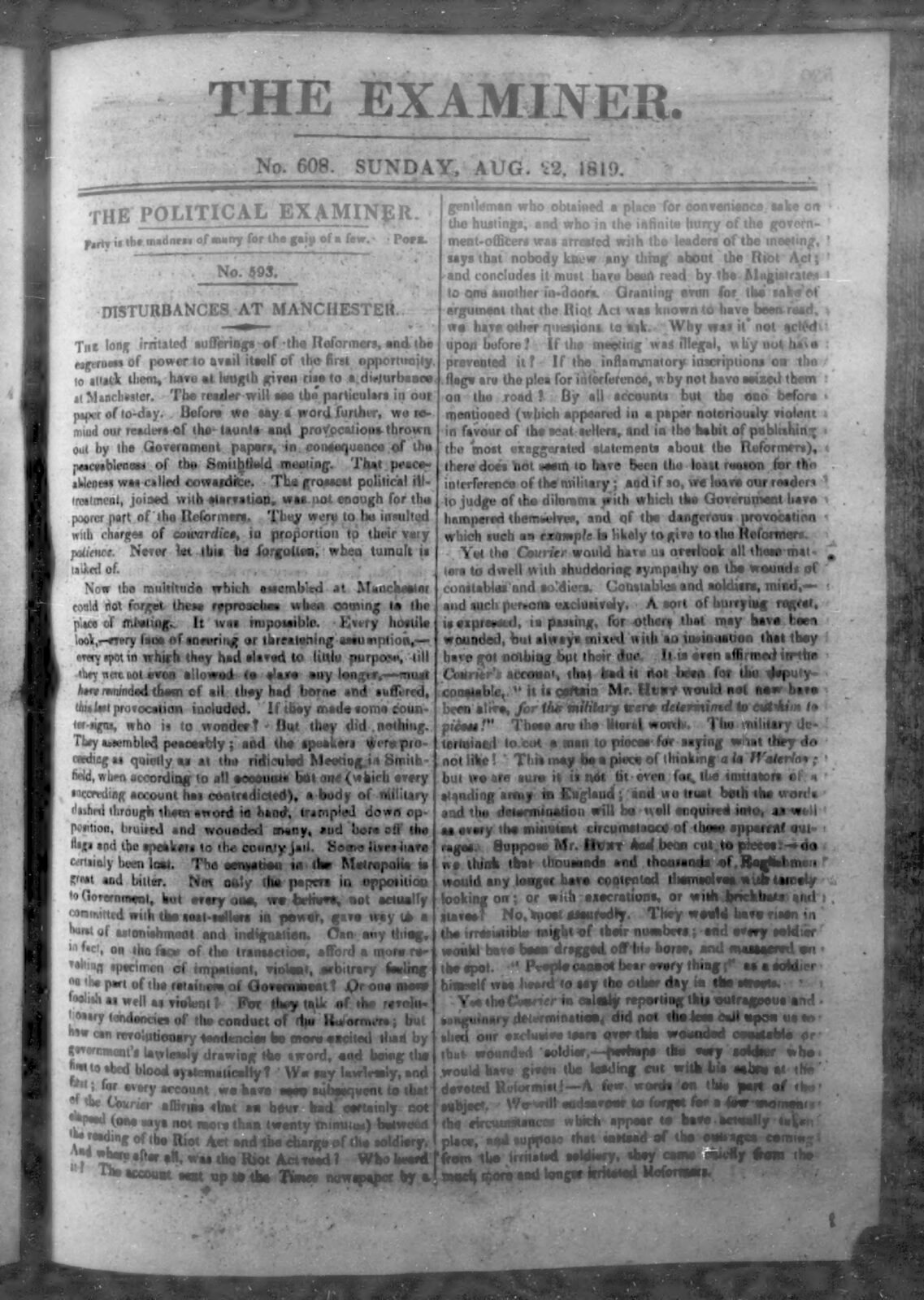
The Examiner, No. 608, 22 August 1819, 'Disturbances at Manchester' (Peterloo)
Front page of the London reformist weekly six days after the Manchester meeting of 16 August 1819, headed 'Disturbances at Manchester'. Tell: the leader answers the pro-government Courier and Times by name, quoting selected lines from their reports ('determined to cut him to pieces') and recounting the 'taunts and provocations' of the 'Government papers', so each side's account is built from the facts it chooses to stress.
- Date
- August 22, 1819
- Period
- Pre-1914
- Made by
- The Examiner, London (weekly edited by Leigh Hunt and John Hunt)
- Country
- United Kingdom
- Medium
- Newspaper pages
- Issuer type
- Media
- Regime
- Liverpool Government
- Leader
- Lord Liverpool
- Audience
- Domestic public
- Purpose
- Persuade or win support
- Event
- Peterloo Massacre
- Techniques
- Card stacking
- Source
- Identified Openly sourced: the speaker is who they say they are
- Source
- Internet Archive (Serials in Microfilm, item sim_examiner-a-weekly-paper-on-politics-literature-music_1819-08-22_608); rights basis on the Wikimedia Commons file page for the same issue, retrieved October 2, 2026
- Rights
- Public domain (periodical published in London on 22 August 1819; Commons file page for the scan tags PD-old-100-expired)
The Examiner, No. 608, London, 22 August 1819; scan via Internet Archive and Wikimedia Commons
Text on the object
THE EXAMINER.
No. 608.  SUNDAY, AUG. 22, 1819.

THE POLITICAL EXAMINER.
Party is the madness of many for the gain of a few.  POPE.
No. 593.

DISTURBANCES AT MANCHESTER.

The long irritated sufferings of the Reformers, and the eagerness of power to avail itself of the first opportunity to attack them, have at length given rise to a disturbance at Manchester. The reader will see the particulars in our paper of to-day. Before we say a word further, we remind our readers of the taunts and provocations thrown out by the Government papers, in consequence of the peaceableness of the Smithfield meeting. That peaceableness was called cowardice. [...] Never let this be forgotten, when tumult is talked of.

[...] Yet the Courier would have us overlook all these matters to dwell with shuddering sympathy on the wounds of constables and soldiers. Constables and soldiers, mind,--and such persons exclusively. [...] It is even affirmed in the Courier's account, that had it not been for the deputy-constable, "it is certain Mr. HUNT would not now have been alive, for the military were determined to cut him to pieces!" These are the literal words. The military determined to cut a man to pieces for saying what they do not like! [...]

[remainder of the two columns not transcribed; partly illegible in the dark scan]
Dark microfilm scan; the lines above were read from an enlarged, contrast-adjusted copy. [...] marks passages omitted from this transcription, not text missing on the page. Small differences from the printed wording are possible where the scan is blurred.