Content note: Period satirical prose describing the killing of Chinese soldiers at Ningpo in graphic terms, using period terms such as 'pig-tail' for Chinese people. This object is shown as it was published. Why
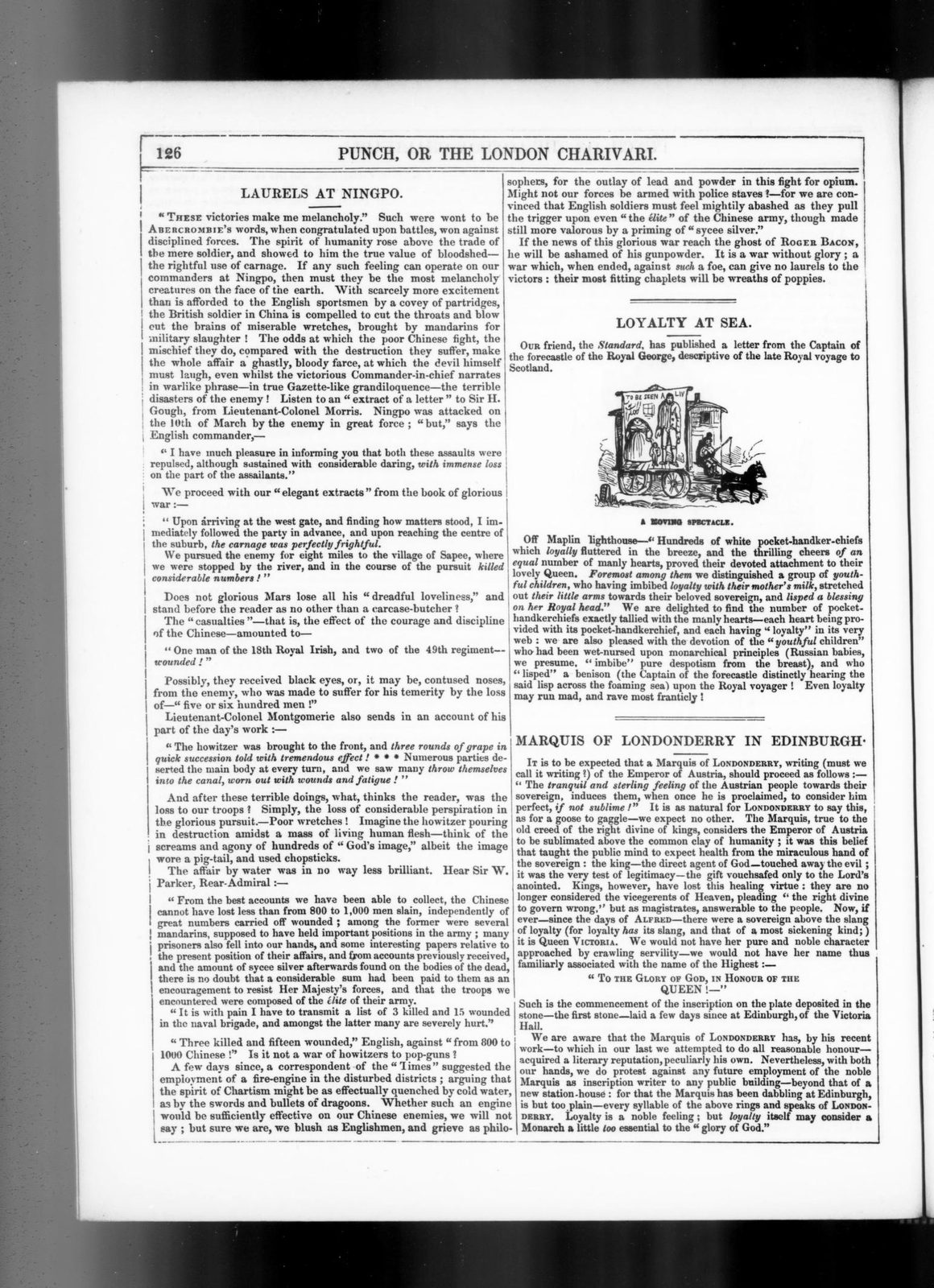
Punch, 'Laurels at Ningpo' column on the First Opium War, 1842
A page of the London satirical weekly Punch headed 'Laurels at Ningpo'. The column sets quoted British despatch lines about the fighting at Ningpo beside the casualty figures (three killed and fifteen wounded against 800 to 1,000 Chinese slain) and argues the war brings no glory. The tell is the selection and ordering of those figures, placed so the reader reaches one conclusion.
- Date
- 1842
- Period
- Pre-1914
- Made by
- Punch, or the London Charivari (London weekly)
- Country
- United Kingdom
- Medium
- Newspaper pages
- Issuer type
- Media
- Regime
- Peel Government
- Leader
- Robert Peel
- Audience
- Domestic public
- Purpose
- Persuade or win support
- Event
- First Opium War
- Techniques
- Card stacking
- Source
- Identified Openly sourced: the speaker is who they say they are
- Source
- Internet Archive (Punch 1842: Vol 3, Serials in Microfilm), retrieved October 2, 2026
- Rights
- Public domain by publication date (London 1842); IA item states no rights
Punch, or the London Charivari, vol. 3, 1842, p. 126. Internet Archive, item sim_punch_1842_3. Scan: Internet Archive (Serials in Microfilm), whose item page states no rights.
Text on the object
LAURELS AT NINGPO.

"THESE victories make me melancholy." Such were wont to be ABERCROMBIE'S words, when congratulated upon battles, won against disciplined forces. The spirit of humanity rose above the trade of the mere soldier, and showed to him the true value of bloodshed - the rightful use of carnage. If any such feeling can operate on our commanders at Ningpo, then must they be the most melancholy creatures on the face of the earth. With scarcely more excitement than is afforded to the English sportsmen by a covey of partridges, the British soldier in China is compelled to cut the throats and blow out the brains of miserable wretches, brought by mandarins for military slaughter! The odds at which the poor Chinese fight, the mischief they do, compared with the destruction they suffer, make the whole affair a ghastly, bloody farce, at which the devil himself must laugh, even whilst the victorious Commander-in-chief narrates in warlike phrase - in true Gazette-like grandiloquence - the terrible disasters of the enemy! [...]

"Three killed and fifteen wounded," English, against "from 800 to 1000 Chinese!" Is it not a war of howitzers to pop-guns?

[...] If the news of this glorious war reach the ghost of ROGER BACON, he will be ashamed of his gunpowder. It is a war without glory; a war which, when ended, against such a foe, can give no laurels to the victors: their most fitting chaplets will be wreaths of poppies.

[Remainder of the column and the two other items on the page (LOYALTY AT SEA, with a small woodcut 'A MOVING SPECTACLE'; MARQUIS OF LONDONDERRY IN EDINBURGH) not transcribed.]
Opening paragraph and closing lines transcribed from the committed image; ellipses [...] mark omitted passages. Not a full transcription of the page.