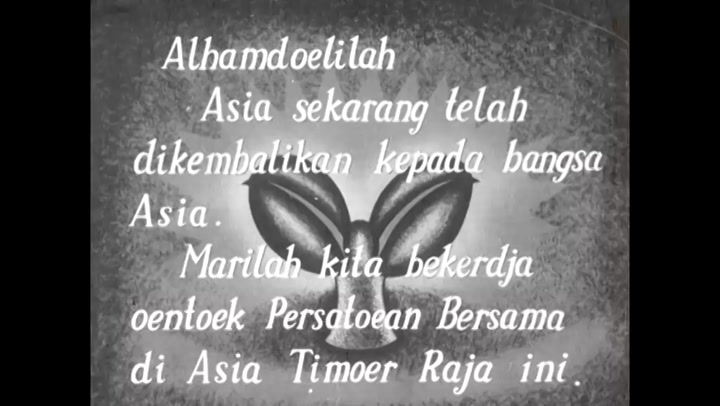
Still from "Chabar Dai Toa" no. 31, Japanese newsreel with Indonesian-language title cards for occupied Java (1942)
Black-and-white title card from a Japanese newsreel, lettered in Indonesian over a stylised double-leaf sprout: it opens with the Muslim formula of thanks, 'Alhamdoelilah', then says Asia has now been given back to the Asian peoples and calls on viewers to work for 'Persatoean Bersama' in 'Asia Timoer Raja'. Abstract unity-and-liberation wording with no stated terms (glittering generalities), prefaced by a religious phrase addressed to a mainly Muslim audience (transfer).
- Date
- February 19, 1942
- Period
- Second World War
- Made by
- Nippon Eigasha (Japan News Film Company), newsreel offered by the Japanese Information Office for audiences in the Dutch East Indies
- Region
- East Asia
- Country
- Empire of Japan
- Medium
- Film stills
- Issuer type
- Media
- Regime
- Showa Japan
- Leader
- Hideki Tojo
- Audience
- Foreign public
- Purpose
- Persuade or win support
- Event
- World War II
- Techniques
- Glittering generalitiesTransfer
- Leader
- Hideki Tōjō
- Source
- Identified Openly sourced: the speaker is who they say they are
- Source
- Internet Archive (Netherlands Institute for Sound and Vision collection of Japanese propaganda films), retrieved October 2, 2026
- Rights
- Public Domain Mark 1.0 (Internet Archive item, Sound and Vision release); Japan 1942 film, PD in US
Nippon Eigasha, 'Chabar Dai Toa' (31), 1942; released by the Netherlands Institute for Sound and Vision, via Internet Archive (Public Domain Mark 1.0)
Text on the object
Alhamdoelilah
Asia sekarang telah
dikembalikan kepada bangsa
Asia.
Marilah kita bekerdja
oentoek Persatoean Bersama
di Asia Timoer Raja ini.
Praise be to God. Asia has now been given back to the Asian people. Let us work for a united togetherness in this Great East Asia.
Spelling is the 1940s Dutch-influenced Indonesian orthography as lettered on the card (oe for u, dj for j). Read from the committed frame; the archive's English catalogue paraphrase of the same card reads 'Asia is again for the Asians'. Translation is a literal English rendering by Claude, not verified by a fluent reader.