Content note: Street scene of men in Korean dress stabbing and clubbing fallen people under Japanese flags; the caption uses a pejorative Chinese term for Japan (倭). This object is shown as it was published. Why
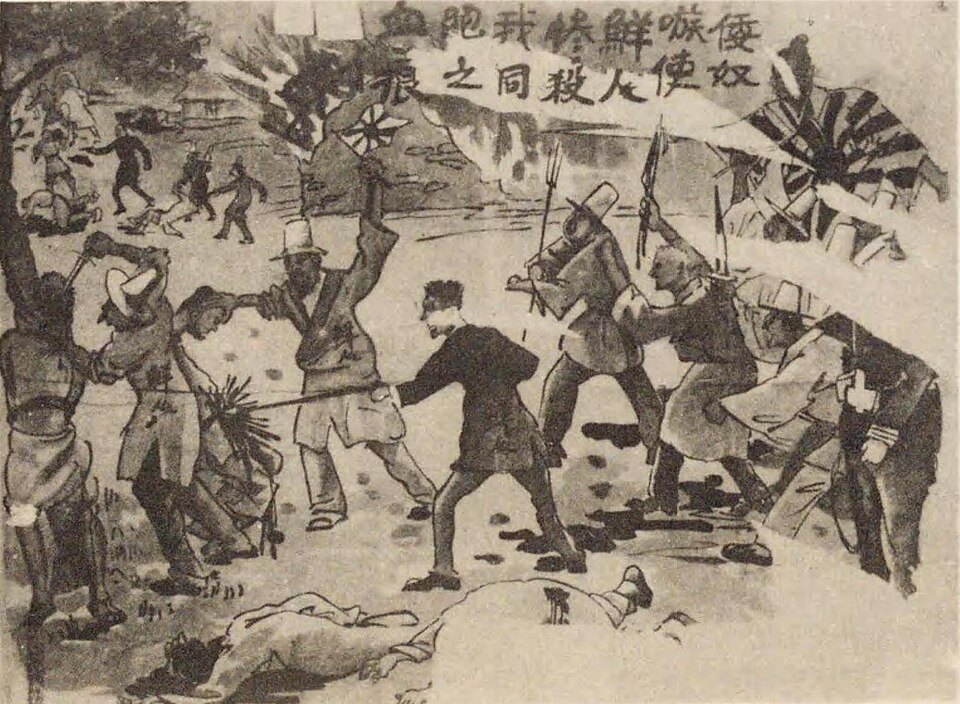
Chinese poster on the Korean-Chinese riots of July 1931 (倭嗾鮮人殺我同胞)
A street scene: men in Korean white hats and coats stab and club fallen people while Japanese rising-sun flags hang above, under a torn banner of Chinese characters that says the Japanese ('倭') set Koreans on 'our compatriots'. The tell: the violence in the picture is attributed to a third party by the banner alone, so blame is assigned to Japan through the caption rather than shown.
- Date
- July 1931
- Period
- Interwar
- Made by
- Chinese poster, issuer not named; reproduced in a Japanese book, 日出新聞社編纂『満洲建國と満洲・上海大事變史』(Hinode Shimbun, May 1932)
- Region
- East Asia
- Country
- China
- Medium
- Poster
- Issuer type
- Mixed
- Leader
- Chiang Kai Shek
- Audience
- Domestic public
- Purpose
- Demonize
- Event
- Mukden Incident
- Techniques
- ScapegoatingName-calling
- Source
- Unidentified Source blurred: contractors, cutouts, buried disclosure
- Source
- Wikimedia Commons file 'Chinese anti-Japanese poster published after the revenge by Koreans.jpg' (scan from Hinode Sh..., retrieved October 2, 2026
- Rights
- Public domain (anonymous 1931 Chinese poster, reproduced in a 1932 Japanese book)
Unknown Chinese issuer; reproduced in 日出新聞社編纂『満洲建國と満洲・上海大事變史』(1932); via Wikimedia Commons
Text on the object
倭嗾鮮 [illegible] 殺我 [illegible] 胞 [illegible]
[illegible] 奴便 [illegible] 殺人 [illegible] 同之 [illegible]
Japanese ('倭') incite Koreans [...] to kill our [...] compatriots [...] / [...] slaves then [...] kill people [...] same [...] [partial: the banner accuses Japan of setting Koreans against Chinese]The two banner lines run diagonally across a halftone and are torn by a white band; only fragments are legible at 960 px, so uncertain characters are marked [illegible] rather than guessed. 倭 is the old Chinese term for Japan, used pejoratively. Translation is FRAME's own literal rendering, machine-assisted and not verified by a fluent reader.