Content note: Colonial-era proclamation on slavery and emancipation in Saint-Domingue; speaks of slaves, whips and 'Nègues' in period terms. This object is shown as it was published. Why
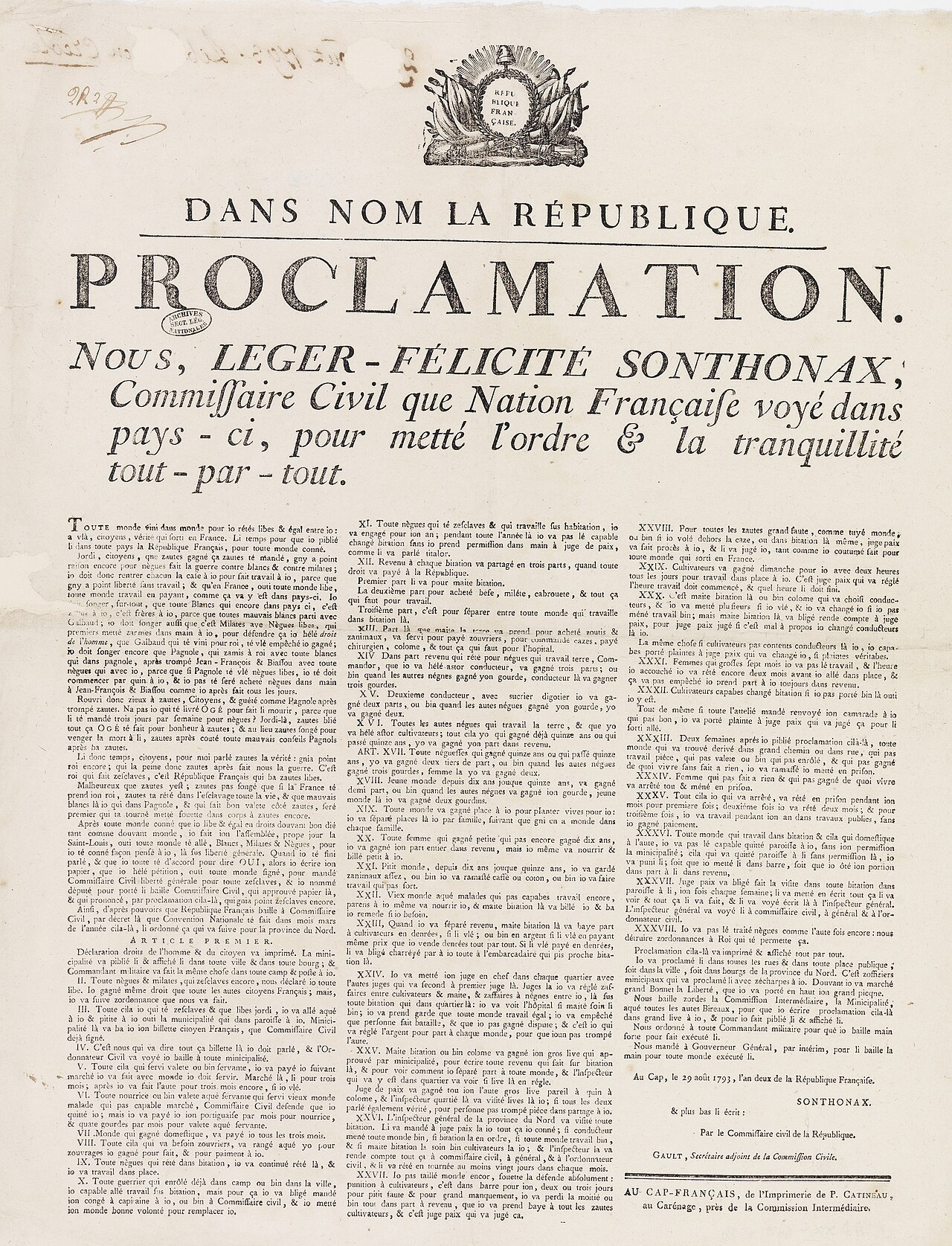
Proclamation de Sonthonax en créole, Cap-Français (Proclamation of Commissioner Sonthonax in Creole)
A folio broadside under a Republican emblem, printed in Saint-Domingue's French-based creole, proclaims emancipation in the colony's Northern Province and tells the insurgent and formerly enslaved population to lay down arms and return to work. The persuasion tells are a warning that a restored king means lifelong slavery and the whip, and blame placed on Spain and on 'bad Whites' for deceiving the insurgent leaders and for the death of Ogé.
- Date
- August 29, 1793
- Period
- Pre-1914
- Made by
- Léger-Félicité Sonthonax, civil commissioner of the French Republic, Cap-Français (Saint-Domingue); printed by P. Catineau
- Country
- France
- Medium
- Issuer type
- State
- Regime
- First French Republic
- Leader
- National Convention
- Audience
- Domestic public
- Event
- Haitian Revolution
- Techniques
- Fear appealScapegoating
- Source
- Identified Openly sourced: the speaker is who they say they are
- Source
- Archives nationales (France), via Wikimedia Commons, retrieved October 2, 2026
- Rights
- Public domain (published 1793; Commons PD-old and PDM scan tags, U.S. PD as pre-1931)
Archives nationales (France), AD/XX/C/69/A, via Wikimedia Commons
Text on the object
[Emblem: wreath and flags, lettered RÉPUBLIQUE FRANÇAISE]
DANS NOM LA RÉPUBLIQUE.
PROCLAMATION.
Nous, LEGER-FÉLICITÉ SONTHONAX, Commissaire Civil que Nation Française voyé dans pays-ci, pour metté l'ordre & la tranquillité tout-par-tout.

TOUTE monde vini dans monde pour io rété libes & égal entre io: a vlà, citoyens, vérité qui forti en France. Li temps pour que io pibli li dans toute pays la République Français, pour toute monde conné.

Jordi, citoyens, que zautes gagné ça zautes té mandé, gny a point raison encore pour nègues fait la guerre contre blancs & contre milates; io doit donc rentrer chacun la cafe à io pour fait travail à io, parce que gny a point liberté sans travail; & qu'en France, outi toute monde libe, toute monde travail en payant, comme ça va y est dans pays-ci. Io [illegible] songer, sur-tout, que toute Blancs qui encore dans pays ci, c'est [illegible] à io, c'est frères à io, parce que toutes mauvais blancs parti avec Galbaud; io doit songer aussi que c'est Milates ave Nègues libes, qui premiers metté zarmes dans main à io, pour défendre ça io hélé droit de l'homme, que Galbaud qui té vini pour roi, té vlé empêché io gagné; io doit songer encore que Pagnole, qui zamis à roi avec toute blancs qui dans pagnole, après trompé Jean-François & Biassou avec toute nègues qui avec io, parce que si Pagnole té vlé nègues libes, io té doit commencer par quin à io, & io pas té seré acheté nègues dans main à Jean-François & Biassou comme io après fait tous les jours.

Rouvri donc zieux à zautes, Citoyens, & guété comme Pagnole après trompé zautes. Na pas io qui té livré OGÉ pour fait li mourir, parce que li té mandé trois jours par semaine pour nègues? Jordi-là, zautes blié tout ça OGÉ té fait pour bonheur à zautes; & au lieu zautes fongé pour venger la mort à li, zautes après couté toute mauvais conseils Pagnols après ba zautes.

Li donc temps, citoyens, pour moi parlé zautes la vérité: gnia point roi encore; qui la peine donc zautes après fait nous la guerre. C'est roi qui fait zesclaves, c'est République Français qui ba zautes libes.

Malheureux que zautes yest; zautes pas songé que si la France té prend ion roi, zautes ta rété dans l'esclavage toute la vie, & que mauvais blancs là io qui dans Pagnole, & qui fait bon valete côté zautes, feré premier qui ta tourné metté fouette dans corps à zautes encore.

[Two paragraphs, on the Saint-Louis day assembly and petition and on the Convention's decree of March, are not transcribed here.]

ARTICLE PREMIER.
Déclaration droits de l'homme & du citoyen va imprimé. La minicipalité va pibli li & affiché li dans toute ville & dans toute bourg; & Commandant militaire va fait la même chose dans toute camp & posté à io.
II. Toute nègues & milates, qui zesclaves encore, nous déclaré io toute libe. Io gagné même droit que toute les autes citoyens Français; mais, io va suive zordonnance que nous va fait.
III. Toute cila io qui té zesclaves & que libes jordi, io va allé aqué à io & pitite à io outi la municipalité qui dans paroisse à io. Minicipalité là va ba io ion billette citoyen Français, que Commissaire Civil déjà signé.

[Articles IV to XXXVIII, in two further columns, are not transcribed here.]

Au Cap, le 29 août 1793, l'an deux de la République Française.
SONTHONAX.
& plus bas li écrit:
Par le Commissaire civil de la République.
GAULT, Secrétaire adjoint de la Commission Civile.

AU CAP-FRANÇAIS, de l'Imprimerie de P. CATINEAU, au Carénage, près de la Commission Intermédiaire.
[Emblem: wreath and flags, lettered FRENCH REPUBLIC]
IN THE NAME OF THE REPUBLIC.
PROCLAMATION.
We, LEGER-FÉLICITÉ SONTHONAX, Civil Commissioner whom the French Nation sent to this country, to put order and tranquillity everywhere.

Everyone comes into the world to remain free and equal among themselves: that, citizens, is the truth that comes out of France. It is time that they publish it in every country of the French Republic, so that everyone knows it.

Today, citizens, since you have got what you asked for, there is no longer any reason for Black people to make war against Whites and against Mulattoes; each of you must therefore return to his own hut to do his own work, because there is no liberty without work; and in France, where everyone is free, everyone works for pay, as it is going to be in this country. You [illegible] think, above all, that all the Whites who are still in this country, they are [illegible] to you, they are your brothers, because all the bad Whites left with Galbaud; you must also think that it is the Mulattoes with free Black people who first put arms in your hands, to defend what you call the rights of man, which Galbaud, who came for the king, wanted to prevent you from getting; you must think again that Spain, which is a friend of the king with all the Whites who are in Spain, has deceived Jean-François and Biassou with all the Black people who are with you, because if Spain had wanted free Black people, it would have had to begin with its own, and you would not have been bought as Black people into the hands of Jean-François and Biassou as you are every day.

Open your eyes then, citizens, and look how Spain has deceived you. Was it not you who handed over Ogé to have him killed, because he asked for three days a week for Black people? Today you forget all that Ogé did for your happiness; and instead of thinking to avenge his death, you go on listening to all the bad counsels of the Spaniards that they give you.

It is time, citizens, for me to tell you the truth: there is no king any more; so why do you go on making war on us. It is the king who makes slaves, it is the French Republic that gives you freedom.

Unhappy that you are; you have not thought that if France took a king again, you would remain in slavery all your lives, and that those bad Whites who are in Spain, and who play the good servant at your side, would be the first to turn and put the whip on your bodies again.

[Two paragraphs, on the Saint-Louis day assembly and petition and on the Convention's decree of March, are not transcribed here.]

ARTICLE ONE.
The Declaration of the Rights of Man and of the Citizen shall be printed. The municipality shall publish it and post it in every town and every village; and the military commander shall do the same in every camp and post of theirs.
II. All Black people and Mulattoes who are still slaves, we declare them all free. They shall have the same rights as all the other French citizens; but they shall follow the ordinance that we shall make.
III. All those who were slaves and who are free today shall go with their children to the municipality of their parish. The municipality shall give them a French-citizen ticket, which the Civil Commissioner has already signed.

[Articles IV to XXXVIII, in two further columns, are not transcribed here.]

At the Cap, 29 August 1793, year two of the French Republic.
SONTHONAX.
And lower down it is written:
By the Civil Commissioner of the Republic.
GAULT, Assistant Secretary of the Civil Commission.

AT CAP-FRANÇAIS, from the printing house of P. CATINEAU, at the Carénage, near the Intermediate Commission.
Read from a 1920-px rendering of the Commons scan. The preamble, Articles I to III and the colophon are transcribed; two paragraphs and Articles IV to XXXVIII are not. Long s is rendered as s. Two words are obscured by ink and marked [illegible]. The translation is a literal gloss of creole forms into English, machine-made by Claude and not checked by a fluent Haitian Creole or French reader.