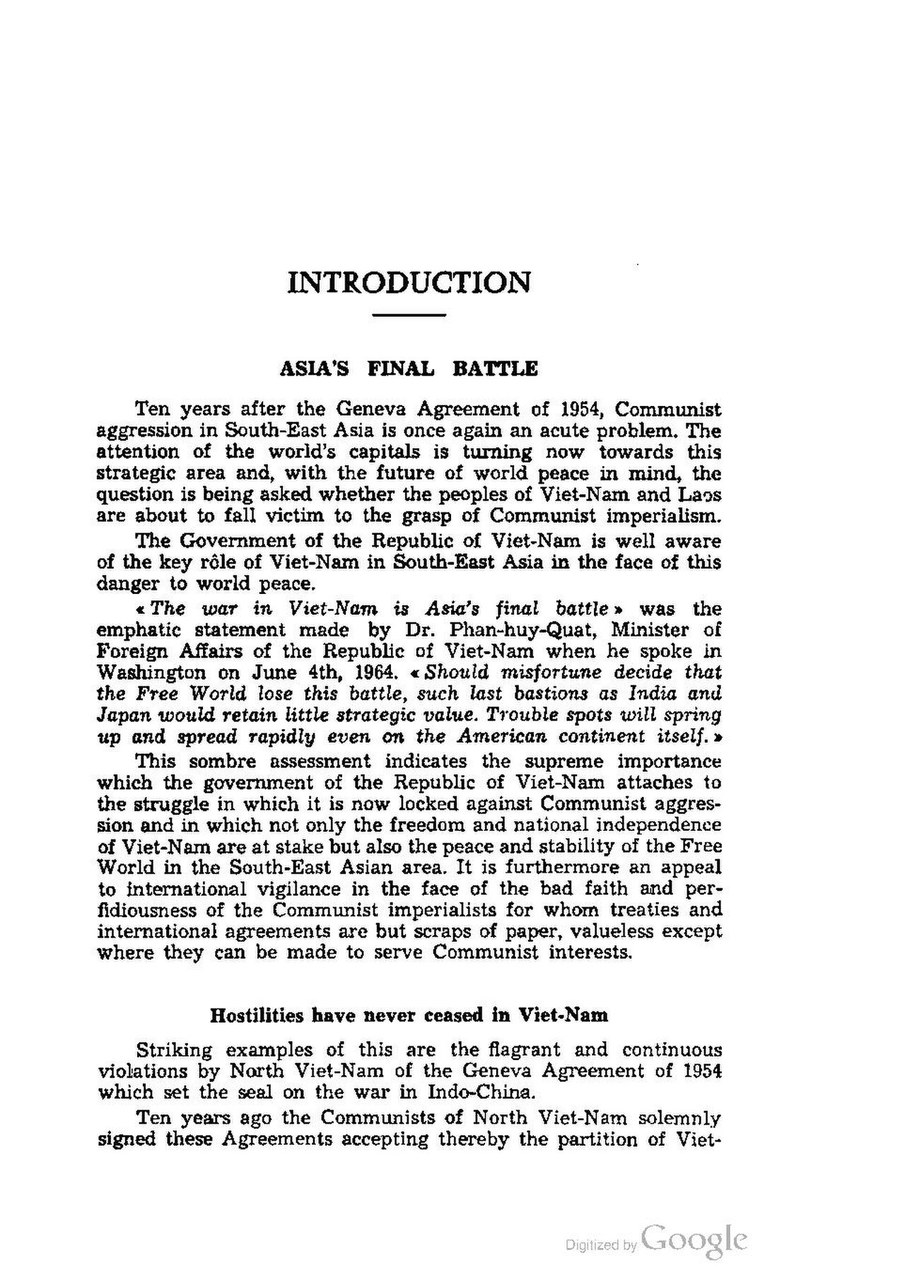
Communist Aggression Against the Republic of Viet-Nam (Ministry of Foreign Affairs, Saigon, July 1964), introduction 'Asia's Final Battle', page 9
A typeset introduction under the heading 'Asia's Final Battle' quotes the foreign minister's statement that if 'the Free World' lost the battle, India and Japan 'would retain little strategic value' and 'trouble spots will spring up and spread rapidly even on the American continent itself'. The tell: a staged chain of consequences reaching far beyond Vietnam is offered as the reason to support the government's cause, alongside the labels 'Communist imperialists' and 'perfidiousness'.
- Date
- July 1964
- Period
- Cold War
- Made by
- Ministry of Foreign Affairs, Republic of Vietnam
- Region
- Southeast Asia
- Country
- South Vietnam
- Medium
- Books and pamphlets
- Issuer type
- State
- Regime
- Nguyen Khanh Government
- Leader
- Nguyen Khanh
- Audience
- Foreign public
- Purpose
- Persuade or win support
- Event
- Vietnam War
- Techniques
- Fear appeal
- Source
- Identified Openly sourced: the speaker is who they say they are
- Source
- Wikimedia Commons (Google Books scan of a Ministry of Foreign Affairs volume), retrieved October 2, 2026
- Rights
- Public domain (Commons tag PD-South VietnamGov: Republic of Vietnam government work)
Ministry of Foreign Affairs, Republic of Vietnam; digitised by Google Books, via Wikimedia Commons.
Text on the object
INTRODUCTION

ASIA'S FINAL BATTLE

Ten years after the Geneva Agreement of 1954, Communist aggression in South-East Asia is once again an acute problem. The attention of the world's capitals is turning now towards this strategic area and, with the future of world peace in mind, the question is being asked whether the peoples of Viet-Nam and Laos are about to fall victim to the grasp of Communist imperialism.

The Government of the Republic of Viet-Nam is well aware of the key rôle of Viet-Nam in South-East Asia in the face of this danger to world peace.

« The war in Viet-Nam is Asia's final battle » was the emphatic statement made by Dr. Phan-huy-Quat, Minister of Foreign Affairs of the Republic of Viet-Nam when he spoke in Washington on June 4th, 1964. « Should misfortune decide that the Free World lose this battle, such last bastions as India and Japan would retain little strategic value. Trouble spots will spring up and spread rapidly even on the American continent itself. »

This sombre assessment indicates the supreme importance which the government of the Republic of Viet-Nam attaches to the struggle in which it is now locked against Communist aggression and in which not only the freedom and national independence of Viet-Nam are at stake but also the peace and stability of the Free World in the South-East Asian area. It is furthermore an appeal to international vigilance in the face of the bad faith and perfidiousness of the Communist imperialists for whom treaties and international agreements are but scraps of paper, valueless except where they can be made to serve Communist interests.

Hostilities have never ceased in Viet-Nam

Striking examples of this are the flagrant and continuous violations by North Viet-Nam of the Geneva Agreement of 1954 which set the seal on the war in Indo-China.

Ten years ago the Communists of North Viet-Nam solemnly signed these Agreements accepting thereby the partition of Viet-
Transcribed from the Commons page-9 image of the PDF; line-end hyphenation is rejoined except the final 'Viet-', which is cut by the page break. The 'Digitized by Google' watermark is omitted.