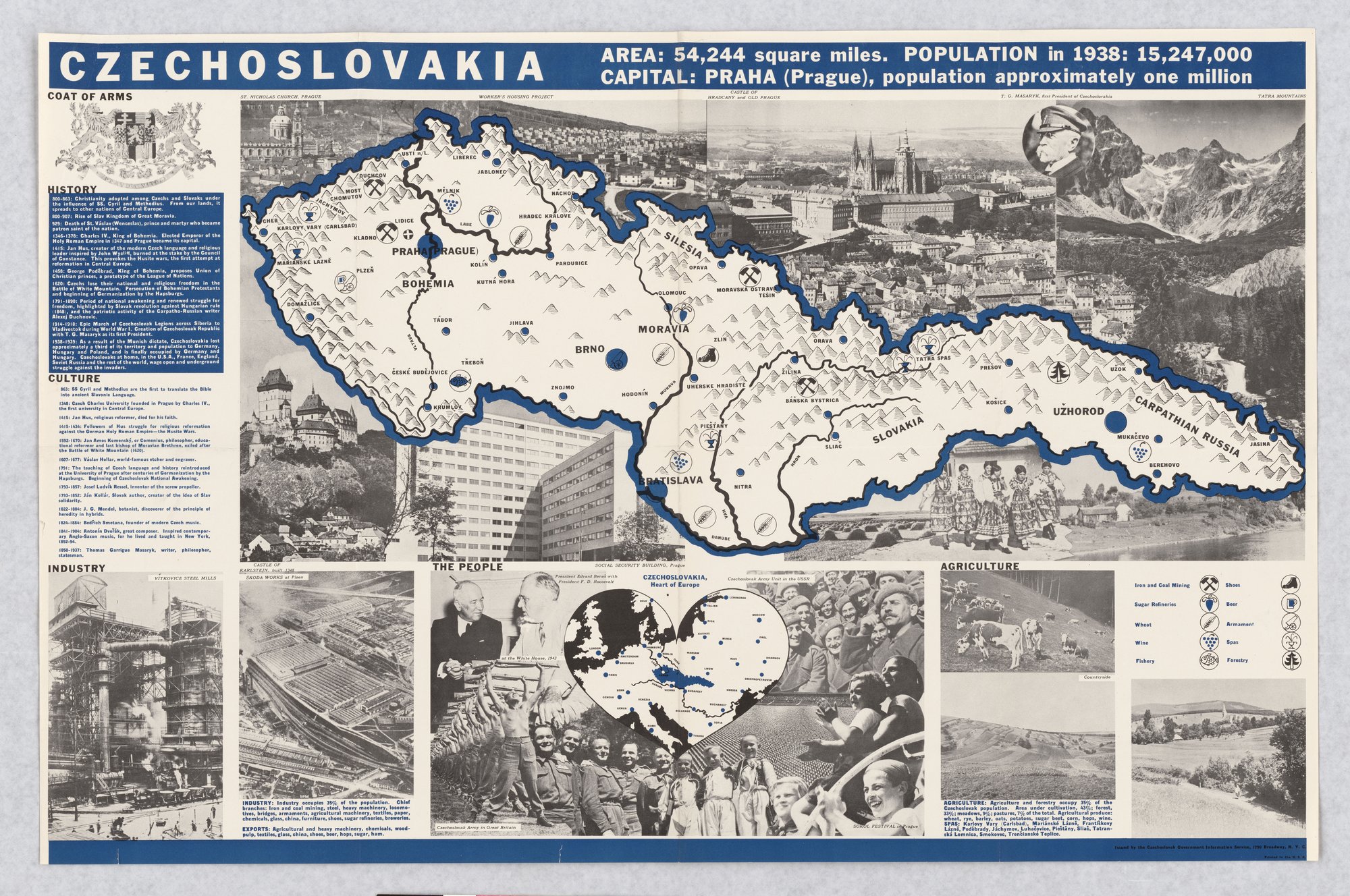
Czechoslovakia (illustrated information map sheet, blue printing)
Large map sheet headed CZECHOSLOVAKIA, with a map ringed in blue and panels on history, culture, industry and agriculture, plus photographs of Masaryk, President Benes with President Roosevelt at the White House, 1943, and Czechoslovak troops. The tell is transfer: the exile government borrows the prestige of allied leaders and armies, within an otherwise informational layout.
Propaganda techniques used in this poster
- Date
- 1943
- Period
- Second World War
- Made by
- Czechoslovak Government Information Service, 1790 Broadway, New York
- Region
- Western and Central Europe
- Country
- Czechoslovakia
- Medium
- Poster
- Issuer type
- State
- Regime
- Czechoslovak Government in Exile
- Leader
- Edvard Benes
- Audience
- Foreign public
- Purpose
- Persuade or win support
- Themes
- War and the military, Home front
- Event
- World War II
- Source
- Identified Openly sourced: the speaker is who they say they are
- Source
- U.S. National Archives and Records Administration, Record Group 44, World War II Posters, retrieved October 4, 2026
- Rights
- Held by NARA, Unrestricted; US exile-body issue, hosted by owner decision
Czechoslovak Government Information Service, 1790 Broadway, New York. National Archives and Records Administration, RG 44, 44-PA-623 (NAID 514101).
Text on the object
CZECHOSLOVAKIA
AREA: 54,244 square miles. POPULATION in 1938: 15,247,000
CAPITAL: PRAHA (Prague), population approximately one million
COAT OF ARMS
HISTORY
800-863: Christianity adopted among Czechs and Slovaks under the influence of SS. Cyril and Methodius. From our lands, it spreads to other nations of Central Europe.
800-907: Rise of Slav Kingdom of Great Moravia.
929: Death of St. Václav (Wenceslas), prince and martyr who became patron saint of the nation.
1346-1378: Charles IV., King of Bohemia. Elected Emperor of the Holy Roman Empire in 1347 and Prague became its capital.
1415: Jan Hus, creator of the modern Czech language and religious leader inspired by John Wycliff, burned at the stake by the Council of Constance. This provokes the Hussite wars, the first attempt at reformation in Central Europe.
1458: George Poděbrad, King of Bohemia, proposes Union of Christian princes, a prototype of the League of Nations.
1620: Czechs lose their national and religious freedom in the Battle of White Mountain. Persecution of Bohemian Protestants and beginning of Germanization by the Hapsburgs.
1791-1890: Period of national awakening and renewed struggle for freedom, highlighted by Slovak revolution against Hungarian rule (1848), and the patriotic activity of the Carpatho-Russian writer Alexej Duchnovic.
1914-1918: Epic March of Czechoslovak Legions across Siberia to Vladivostok during World War I. Creation of Czechoslovak Republic with T. G. Masaryk as its first President.
1938-1939: As a result of the Munich dictate, Czechoslovakia lost approximately a third of its territory and population to Germany, Hungary and Poland, and is finally occupied by Germany and Hungary. Czechoslovaks at home, in the U.S.A., France, England, Soviet Russia and the rest of the world, wage open and underground struggle against the invaders.
CULTURE
863: SS Cyril and Methodius are the first to translate the Bible into ancient Slavonic Language.
1348: Czech Charles University founded in Prague by Charles IV., the first university in Central Europe.
1415: Jan Hus, reformer, died for his ideas.
1415-1434: Followers of Hus struggle for religious reformation against the Roman Empire - the Hussite Wars.
1592-1670: Jan Amos Komenský, or Comenius, philosopher, educational reformer and last bishop of Moravian Brethren, exiled after the Battle of White Mountain (1620).
1791: The teaching of Czech language and history reintroduced at the University of Prague after centuries of Germanization by the Hapsburgs. Beginning of Czechoslovak National Awakening.
1793-1852: Ján Kollár, Slovak author, creator of the idea of Slav solidarity.
1824-1884: Bedřich Smetana, founder of modern Czech music.
1841-1904: Antonín Dvořák, great composer. Inspired contemporary Anglo-Saxon music, for he lived and taught in New York, 1892-94.
1850-1937: Thomas Garrigue Masaryk, writer, philosopher, statesman.
INDUSTRY
INDUSTRY: Industry occupies 35% of the population. Chief branches: Iron and coal mining, steel, heavy machinery, locomotives, bridges, armaments, agricultural machinery, textiles, paper, chemicals, glass, china, furniture, shoes, sugar refineries, breweries.
EXPORTS: Agricultural and heavy machinery, chemicals, woodpulp, textiles, glass, china, shoes, beer, hops, sugar, ham.
THE PEOPLE
CZECHOSLOVAKIA, Heart of Europe
President Edvard Beneš with President F. D. Roosevelt at the White House, 1943
Czechoslovak Army Unit in the USSR
Czechoslovak Army in Great Britain
SOKOL FESTIVAL in Prague
AGRICULTURE
AGRICULTURE: Agriculture and forestry occupy 35% of the Czechoslovak population. Area under cultivation, 43%; forest, 33%; meadows, 9%; pastures, 7% of the total. Agricultural produce: wheat, rye, barley, oats, potatoes, sugar beet, corn, hops, wine.
Issued by the Czechoslovak Government Information Service, 1790 Broadway, N. Y. C.
Printed in the U. S. A.
Omitted for the 4000-character limit: Culture entries 1607-1677, 1793-1857, 1822-1884; all photo captions except two; the SPAS list; map place names; the symbol legend. Everything else is transcribed; some diacritics may be imperfect.