Content note: Satirical broadside mocking Emiliano Zapata in period verse. This object is shown as it was published. Why
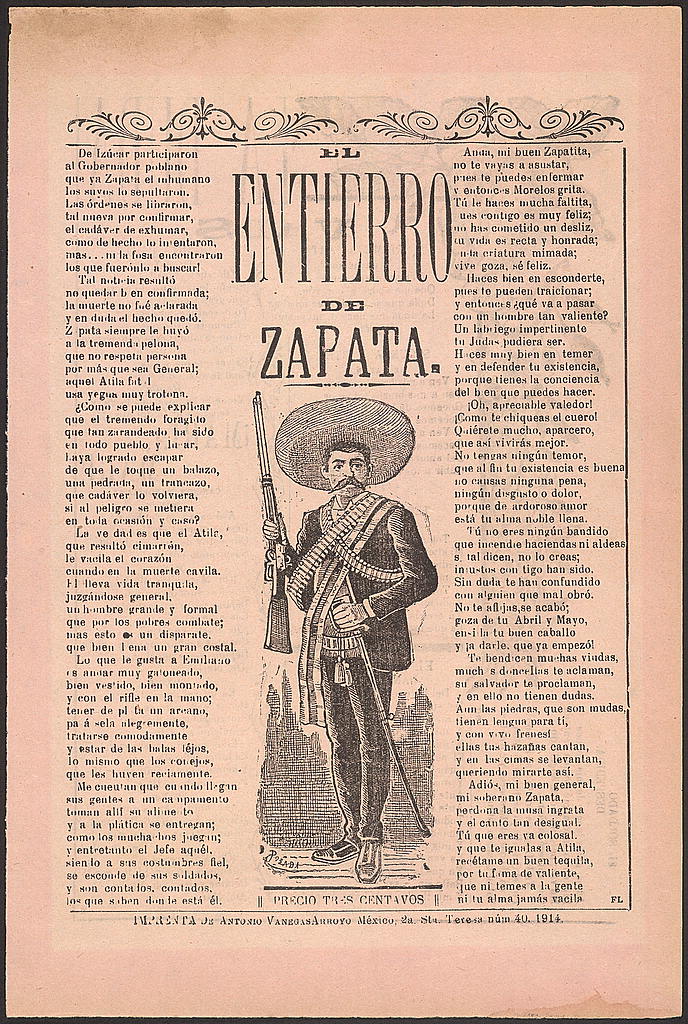
El entierro de Zapata (The Burial of Zapata)
A pink broadside with a full-length woodcut of Emiliano Zapata, rifle in hand and cartridge belts crossed, printed between two columns of verse. Under the headline of a reported burial, the left column calls him 'the inhuman', 'that fatal Attila', an 'outlaw' and a 'runaway' who hides from his own soldiers, and the right column addresses him in mock praise. The tell is the string of loaded labels and mockery doing the work in place of any report of what he did.
- Date
- 1914
- Period
- Pre-1914
- Made by
- Antonio Vanegas Arroyo (Firm), commercial broadside printer, Mexico City; verse signed FL; woodcut signed Posada
- Region
- Latin America
- Country
- Mexico
- Medium
- Issuer type
- Corporation
- Regime
- Huerta Government
- Leader
- Victoriano Huerta
- Audience
- Domestic public
- Purpose
- Demonize
- Event
- Mexican Revolution
- Techniques
- Name-calling
- Source
- Identified Openly sourced: the speaker is who they say they are
- Source
- Library of Congress, retrieved October 2, 2026
- Rights
- Public domain (published 1914, before 1931; LoC: No known restrictions on reproduction in the U.S.)
Library of Congress Prints and Photographs Division, Washington, D.C. 20540 USA, PGA - Vanegas, no. 112 (LC-DIG-ppmsc-04583)
Text on the object
EL
ENTIERRO
DE
ZAPATA.

De Izúcar participaron
al Gobernador poblano
que ya Zapata el inhumano
los suyos lo sepultaron.
Las órdenes se libraron,
tal nueva por confirmar,
el cadáver de exhumar,
como de hecho lo inventaron,
mas... ni la fosa encontraron
los que fuerónlo a buscar!
Tal noticia resultó
no quedar bien confirmada;
la muerte no fué aclarada
y en duda el hecho quedó.
Zapata siempre le huyó
a la tremenda pelona,
que no respeta persona
por más que sea General;
aquel Atila fatal
usa yegua muy trotona.
¿Cómo se puede explicar
que el tremendo foragido
que tan zarandeado ha sido
en todo pueblo y lugar,
haya logrado escapar
de que le toque un balazo,
una pedrada, un trancazo,
que cadáver lo volviera,
si al peligro se metiera
en toda ocasión y caso?
La verdad es que el Atila,
que resultó cimarrón,
le vacila el corazón
cuando en la muerte cavila.
El lleva vida tranquila,
juzgándose general,
un hombre grande y formal
que por los pobres combate;
mas esto es un disparate,
que bien llena un gran costal.
Lo que le gusta a Emiliano
es andar muy gatoneado,
bien vestido, bien montado,
y con el rifle en la mano;
tener de plata un arcano,
pasársela alegremente,
tratarse comodamente
y estar de las balas léjos,
lo mismo que los conejos,
que les huyen reciamente.
Me cuentan que cuando llegan
sus gentes a un campamento
toman allí su alimento
y a la plática se entregan;
como los muchachos juegan;
y entretanto el Jefe aquél,
siendo a sus costumbres fiel,
se esconde de sus soldados,
y son contados, contados,
los que saben donde está él.

Anda, mi buen Zapatita,
no te vayas a asustar,
pues te puedes enfermar
y entonces Morelos grita.
Tú le haces mucha faltita,
pues contigo es muy feliz;
no has cometido un desliz,
tu vida es recta y honrada;
[illegible] criatura mimada;
vive goza, sé feliz.
Haces bien en esconderte,
pues te pueden traicionar;
y entonces ¿qué va a pasar
con un hombre tan valiente?
Un labriego impertinente
tu Judas pudiera ser.
Haces muy bien en temer
y en defender tu existencia,
porque tienes la conciencia
del bien que puedes hacer.
¡Oh, apreciable valedor!
¡Como te chiqueas el cuero!
Quiérete mucho, aparcero,
que así vivirás mejor.
No tengas ningún temor,
que al fin tu existencia es buena
no causas ninguna pena,
ningún disgusto o dolor,
porque de ardoroso amor
está tu alma noble llena.
Tú no eres ningún bandido
que incendie haciendas ni aldeas
si tal dicen, no lo creas;
injustos contigo han sido.
Sin duda te han confundido
con alguien que mal obró.
No te aflijas, se acabó;
goza de tu Abril y Mayo,
ensilla tu buen caballo
y ¡a darle, que ya empezó!
Te bendicen muchas viudas,
muchas doncellas te aclaman,
su salvador te proclaman,
y en ello no tienen dudas.
Aun las piedras, que son mudas,
tienen lengua para ti,
y con vivo frenesí
ellas tus hazañas cantan,
y en las cimas se levantan,
queriendo mirarte así.
Adiós, mi buen general,
mi soberano Zapata,
perdona la musa ingrata
y el canto tan desigual.
Tú que eres ya colosal,
y que te igualas a Atila,
recétame un buen tequila,
por tu fama de valiente,
que ni temes a la gente
ni tu alma jamás vacila
FL

|| PRECIO TRES CENTAVOS ||
IMPRENTA DE ANTONIO VANEGAS ARROYO México, 2a. Sta. Teresa núm. 40. 1914.
THE
BURIAL
OF
ZAPATA.

From Izúcar they reported
to the Governor of Puebla
that Zapata the inhuman
had been buried by his own people.
Orders were issued,
the news being yet to confirm,
to exhume the corpse,
as in fact they invented it,
but... not even the grave did they find,
those who went to look for it!
Such news turned out
not to be well confirmed;
the death was not cleared up
and the fact remained in doubt.
Zapata always fled from
the dreadful Bald One [Death],
who respects no person
however much he be a General;
that fatal Attila
rides a very fast-trotting mare.
How can it be explained
that the tremendous outlaw [foragido]
who has been so shaken about
in every town and place,
has managed to escape
being hit by a bullet,
a stone, a blow,
that would have turned him into a corpse,
if he put himself in danger
on every occasion and case?
The truth is that the Attila,
who turned out a runaway [cimarrón],
his heart falters
when he broods on death.
He leads a quiet life,
judging himself a general,
a big and serious man
who fights for the poor;
but this is nonsense,
which fills a big sack.
What Emiliano likes
is to go about very smartly dressed [gatoneado],
well dressed, well mounted,
and with the rifle in his hand;
to have a secret store of silver,
to pass the time merrily,
to treat himself comfortably
and to stay far from the bullets,
just like the rabbits,
who flee from them hard.
They tell me that when
his people reach a camp
they take their food there
and give themselves to chatting;
as boys play;
and meanwhile that Chief,
faithful to his habits,
hides from his soldiers,
and they are counted, counted,
those who know where he is.

Come now, my good little Zapata,
do not go and take fright,
for you might fall ill
and then Morelos cries out.
You are much missed by it,
for it is very happy with you;
you have not committed a slip,
your life is straight and honourable;
[illegible] pampered creature;
live, enjoy, be happy.
You do well to hide,
for they could betray you;
and then what will happen
to such a brave man?
An impertinent peasant
could be your Judas.
You do very well to fear
and to defend your existence,
because you have the awareness
of the good you can do.
Oh, esteemed comrade!
How you coddle your hide!
Love yourself dearly, partner,
for thus you will live better.
Have no fear at all,
for after all your existence is good,
you cause no sorrow,
no displeasure or pain,
because with ardent love
your noble soul is filled.
You are no bandit
who burns haciendas or villages;
if they say so, do not believe it;
they have been unjust to you.
No doubt they have confused you
with someone who did wrong.
Do not grieve, it is over;
enjoy your April and May,
saddle your good horse
and go at it, for it has begun!
Many widows bless you,
many maidens acclaim you,
they proclaim you their saviour,
and in this they have no doubts.
Even the stones, which are mute,
have a tongue for you,
and with lively frenzy
they sing your exploits,
and rise up on the peaks,
wishing to look upon you thus.
Farewell, my good general,
my sovereign Zapata,
forgive the ungrateful muse
and the very uneven song.
You who are already colossal,
and who match yourself to Attila,
prescribe me a good tequila,
for your fame as a brave man,
who fear no people
and whose soul never wavers
FL

|| PRICE THREE CENTAVOS ||
PRINTING HOUSE OF ANTONIO VANEGAS ARROYO Mexico, 2a. Sta. Teresa no. 40. 1914.
Recto only, from enlarged crops. Where a worn letter was unambiguous from the verse the word is given in full; one word is [illegible]. Spelling as printed ('foragido', 'léjos'). Translation is a literal gloss by Claude, not reader-checked; brackets are glosses.