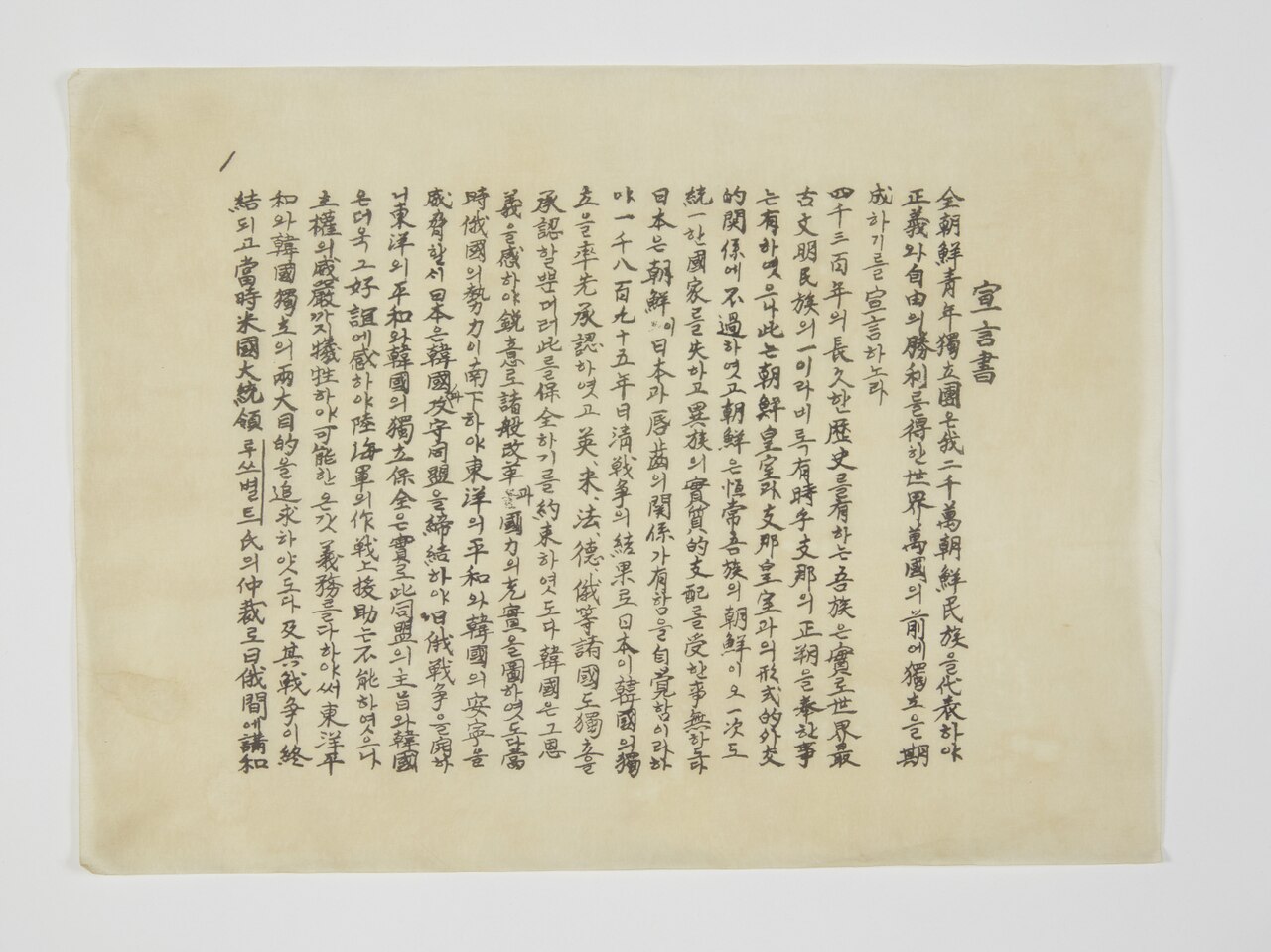
宣言書 (Declaration of Independence), 8 February 1919, first sheet of a handwritten copy
The first sheet of a handwritten copy of the 8 February 1919 declaration issued in Tokyo by Korean students addresses 'all the nations of the world that have won the victory of justice and freedom', then recounts Korea's 4,300-year history and earlier great-power recognition of its independence. Borrowing the Allied victory's own slogans for Korea's claim is the transfer; 'justice and freedom' are the glittering generalities.
- Date
- February 8, 1919
- Period
- Interwar
- Made by
- Korean Young People's Independence Corps (朝鮮靑年獨立團), Korean students in Tokyo
- Region
- East Asia
- Country
- Korea Under Japanese Rule
- Medium
- Document
- Issuer type
- Movement
- Regime
- Government General of Korea
- Leader
- Hasegawa Yoshimichi
- Audience
- Foreign public
- Purpose
- Persuade or win support
- Themes
- Empire and colonialism, Race and ethnicity
- Event
- Korean Independence Movement 1919
- Techniques
- Glittering generalitiesTransfer
- Source
- Identified Openly sourced: the speaker is who they say they are
- Source
- Wikimedia Commons (handwritten copy, credited to Kyongbuk Ilbo), retrieved September 29, 2026
- Rights
- Public domain (issued 1919; Commons tag PD-Korea-1910-1945; published before 1931)
Korean Young People's Independence Corps (朝鮮靑年獨立團), 1919; via Wikimedia Commons
Text on the object
宣言書

全朝鮮靑年獨立團은 我二千萬朝鮮民族을 代表하야 正義와 自由의 勝利를 得한 世界萬國의 前에 獨立을 期成하기를 宣言하노라

四千三百年의 長久한 歷史를 有하는 吾族은 實로 世界最古文明民族의 一이라 비록 有時乎 支那의 正朔을 奉한 事는 有하얏스나 此는 朝鮮皇室과 支那皇室과의 形式的外交的關係에 不過하얏고 朝鮮은 恒常 吾族의 朝鮮이오 一次도 統一한 國家를 失하고 異族의 實質的支配를 受한 事 無하야
日本은 朝鮮이 日本과 脣齒의 關係가 有함을 自覺함이라 하야 一千八百九十五年 日淸戰爭의 結果로 日本이 韓國의 獨立을 率先承認하얏고 英、米、法、德、俄 等 諸國도 獨立을 承認할 뿐머러 此를 保全하기를 約束하얏도다 韓國은 그 恩義을 感하야 銳意로 諸般改革[과] 國力의 充實을 圖하얏도다 當時 俄國의 勢力이 南下하야 東洋의 平和와 韓國의 安寧을 威脅할시 日本은 韓國[과?] 攻守同盟을 締結하야 [日?]俄戰爭을 開하니 東洋의 平和와 韓國의 獨立保全은 實로 此同盟의 主旨와 韓國은 더욱 그 好誼에 感하야 陸海軍의 作戰上 援助는 不能하얏으나 主權의 威嚴까지 犧牲하야 可能한 온갓 義務를 다하야써 東洋平和와 韓國獨立의 兩大目的을 追求하얏도다 及 其戰爭이 終結되고 當時 米國大統領 루쓰벨트氏의 仲裁로 日俄間에 講和

[sheet ends mid-sentence; upper left corner marked 1]
Declaration

The All-Korea Young People's Independence Corps, representing our twenty million Korean people, declares that it will bring about independence before all the nations of the world that have won the victory of justice and freedom.

Our people, having a long history of four thousand three hundred years, is truly one of the world's most ancient civilized peoples. Although at times we did receive the Chinese calendar, that was no more than a formal diplomatic relationship between the Korean imperial house and the Chinese imperial house; Korea has always been our people's Korea and has never once lost its unified state and come under the real rule of another people.
Japan, having realized that Korea and Japan stand in a lips-and-teeth relationship, took the lead in 1895, as a result of the Sino-Japanese War, in recognizing Korea's independence, and Britain, America, France, Germany, Russia and other countries not only recognized its independence but promised to preserve it. Korea, grateful for that kindness, earnestly set about various reforms [and] strengthening of national power. At that time, when Russian power was moving south and threatening the peace of the East and Korea's security, Japan concluded an offensive-defensive alliance with Korea and began the Russo-Japanese War; the peace of the East and the preservation of Korea's independence were truly the purpose of this alliance, and Korea, grateful for its good will, though unable to help in the army's and navy's operations, discharged every possible duty, even sacrificing the dignity of sovereignty, in pursuit of the two great aims of peace in the East and Korean independence. When the war ended and, by the mediation of the then American President Roosevelt, peace between Japan and Russia ...

[sheet ends mid-sentence; upper left corner marked 1]
Handwritten; columns run right to left. Two small interlinear insertions (a 과 after 改革, another between 韓國 and 攻守同盟) and a small character before 俄戰爭 are read tentatively, marked with brackets.