Gros-plans lunaires du Ranger poster (French, Beirut)
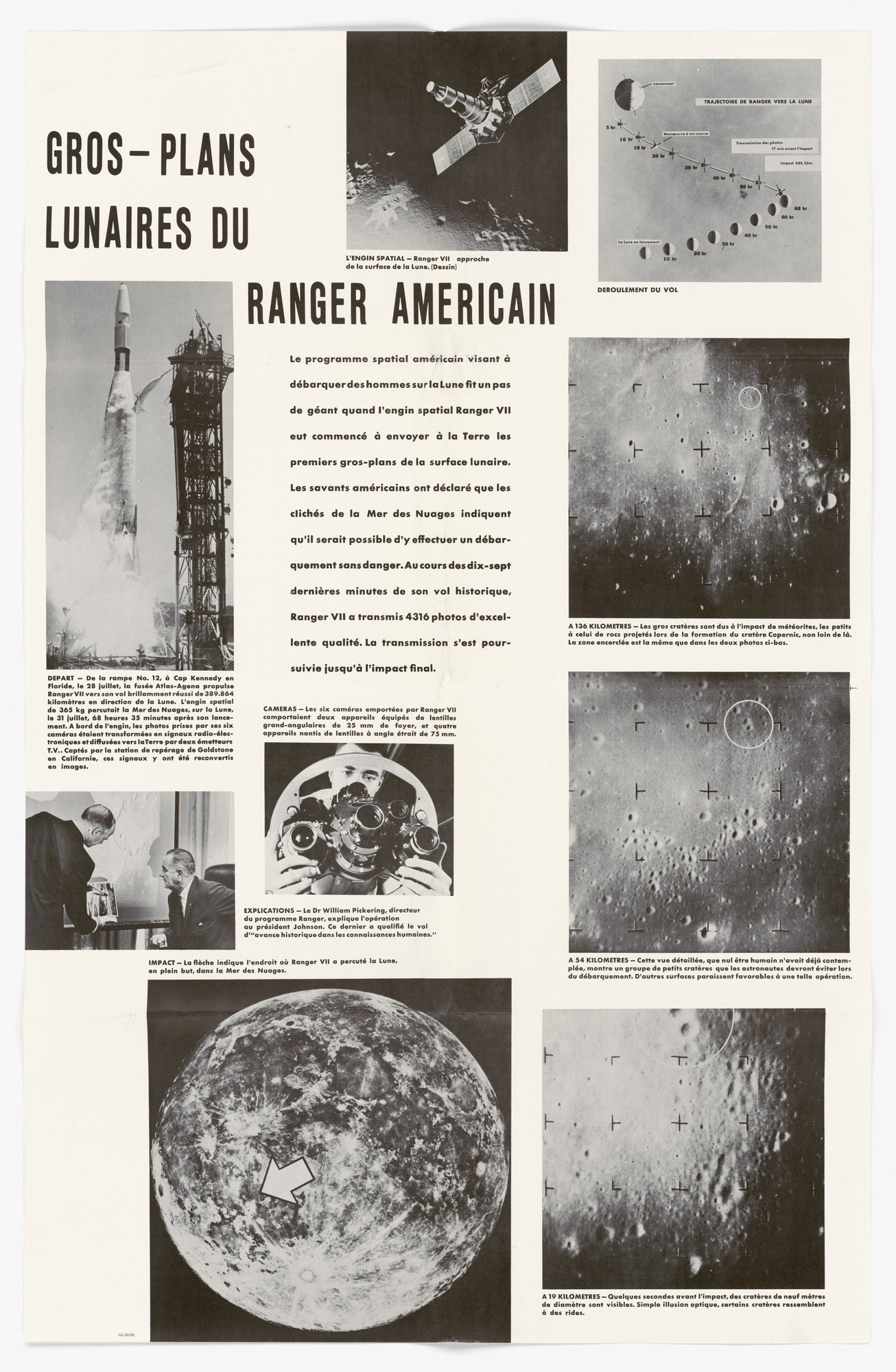
A French-language A poster of lunar photographs from the U.S. Ranger VII probe: launch of the Atlas-Agena rocket, an artist's drawing of the spacecraft, a flight-path diagram, a six-camera array, President Johnson with Dr William Pickering, an arrowed full-Moon view of the impact point, and three close-ups from 136, 54 and 19 kilometres. The text says U.S. scientists judged the Sea of Clouds suitable for safe astronaut landings. The tell is glittering generalities and transfer: 'giant step' and 'historic flight' wording, and the presidential briefing scene, attach prestige to the program.
Propaganda techniques used in this poster
- Date
- September 24, 1964
- Period
- Cold War
- Made by
- U.S. Information Agency (Department of State program), Propaganda Posters Distributed in Asia, Latin America and the Middle East series (RSC Beirut)
- Region
- North America
- Country
- United States
- Medium
- Poster
- Issuer type
- State
- Regime
- Johnson Administration
- Leader
- Lyndon B. Johnson
- Audience
- Foreign public
- Purpose
- Persuade or win support
- Theme
- Science and technology
- Event
- Cold War
- Source
- Unidentified Source blurred: contractors, cutouts, buried disclosure
- Source
- U.S. National Archives (NARA), Record Group 306, Posters in Asia, Latin America, Middle East, retrieved October 4, 2026
- Rights
- Public domain (U.S. government work; NARA RG 306)
U.S. Information Agency / Department of State, September 24, 1964. National Archives, Record Group 306 (NAID 6949209, 306-PPB-285).
Text on the object
GROS-PLANS
LUNAIRES DU
RANGER AMERICAIN

Le programme spatial américain visant à débarquer des hommes sur la Lune fit un pas de géant quand l'engin spatial Ranger VII eut commencé à envoyer à la Terre les premiers gros-plans de la surface lunaire. Les savants américains ont déclaré que les clichés de la Mer des Nuages indiquent qu'il serait possible d'y effectuer un débarquement sans danger. Au cours des dix-sept dernières minutes de son vol historique, Ranger VII a transmis 4316 photos d'excellente qualité. La transmission s'est poursuivie jusqu'à l'impact final.

L'ENGIN SPATIAL — Ranger VII approche de la surface de la Lune. (Dessin)

[schéma:] Lancement / TRAJECTOIRE DE RANGER VERS LA LUNE / 5 hr / 10 hr / 16 hr / Manoeuvre à mi-course / 20 hr / 30 hr / 40 hr / 50 hr / Transmission des photos 17 min avant l'impact / Impact 68h 35m / 68 hr / 60 hr / 50 hr / 40 hr / 30 hr / 20 hr / 10 hr / La Lune au lancement
DEROULEMENT DU VOL

DEPART — De la rampe No. 12, à Cap Kennedy en Floride, le 28 juillet, la fusée Atlas-Agena propulse Ranger VII vers son vol brillamment réussi de 389.864 kilomètres en direction de la Lune. L'engin spatial de 365 kg percutait la Mer des Nuages, sur la Lune, le 31 juillet, 68 heures 35 minutes après son lancement. A bord de l'engin, les photos prises par ses six caméras étaient transformées en signaux radio-électroniques et diffusées vers la Terre par deux émetteurs T.V.. Captés par la station de repérage de Goldstone en Californie, ces signaux y ont été reconvertis en images.

CAMERAS — Les six caméras emportées par Ranger VII comportaient deux appareils équipés de lentilles grand-angulaires de 25 mm de foyer, et quatre appareils nantis de lentilles à angle étroit de 75 mm.

EXPLICATIONS — Le Dr William Pickering, directeur du programme Ranger, explique l'opération au président Johnson. Ce dernier a qualifié le vol d'"avance historique dans les connaissances humaines."

IMPACT — La flèche indique l'endroit où Ranger VII a percuté la Lune, en plein but, dans la Mer des Nuages.

A 136 KILOMETRES — Les gros cratères sont dus à l'impact de météorites, les petits à celui de rocs projetés lors de la formation du cratère Copernic, non loin de là. La zone encerclée est la même que dans les deux photos ci-bas.

A 54 KILOMETRES — Cette vue détaillée, que nul être humain n'avait déjà contemplée, montre un groupe de petits cratères que les astronautes devront éviter lors du débarquement. D'autres surfaces paraissent favorables à une telle opération.

A 19 KILOMETRES — Quelques secondes avant l'impact, des cratères de neuf mètres de diamètre sont visibles. Simple illusion optique, certains cratères ressemblent à des rides.

65-56(8)
CLOSE-UPS OF THE MOON FROM THE AMERICAN RANGER

The American space program aimed at landing men on the Moon took a giant step when the spacecraft Ranger VII began to send the first close-ups of the lunar surface back to Earth. American scientists have declared that the pictures of the Sea of Clouds indicate that a landing there could be made without danger. During the last seventeen minutes of its historic flight, Ranger VII transmitted 4,316 photos of excellent quality. Transmission continued until the final impact.

THE SPACECRAFT — Ranger VII approaches the surface of the Moon. (Drawing)

[diagram:] Launch / TRAJECTORY OF RANGER TO THE MOON / 5 hr / 10 hr / 16 hr / Mid-course maneuver / 20 hr / 30 hr / 40 hr / 50 hr / Transmission of photos 17 min before impact / Impact 68h 35m / 68 hr / 60 hr / 50 hr / 40 hr / 30 hr / 20 hr / 10 hr / The Moon at launch
COURSE OF THE FLIGHT

DEPARTURE — From pad No. 12 at Cape Kennedy in Florida on 28 July, the Atlas-Agena rocket propels Ranger VII on its brilliantly successful flight of 389,864 kilometers toward the Moon. The 365 kg spacecraft struck the Sea of Clouds on the Moon on 31 July, 68 hours 35 minutes after its launch. On board, the photos taken by its six cameras were transformed into radio-electronic signals and broadcast toward Earth by two TV transmitters. Picked up by the Goldstone tracking station in California, these signals were converted back into images there.

CAMERAS — The six cameras carried by Ranger VII included two devices fitted with wide-angle lenses of 25 mm focal length, and four devices fitted with narrow-angle lenses of 75 mm.

EXPLANATIONS — Dr William Pickering, director of the Ranger program, explains the operation to President Johnson. The latter described the flight as a 'historic advance in human knowledge.'

IMPACT — The arrow indicates the place where Ranger VII struck the Moon, dead on target, in the Sea of Clouds.

AT 136 KILOMETERS — The large craters are due to the impact of meteorites, the small ones to that of rocks thrown up when the crater Copernicus was formed, not far from there. The circled zone is the same as in the two photos below.

AT 54 KILOMETERS — This detailed view, which no human being had ever contemplated before, shows a group of small craters that astronauts will have to avoid during landing. Other surfaces appear favorable for such an operation.

AT 19 KILOMETERS — A few seconds before impact, craters nine meters in diameter are visible. A simple optical illusion makes some craters look like wrinkles.

65-56(8)
Printed code at lower left read as 65-56(8).