Content note: Republican press bulletin accusing British forces of deliberately burning Irish towns and killing civilians in 1920. This object is shown as it was published. Why
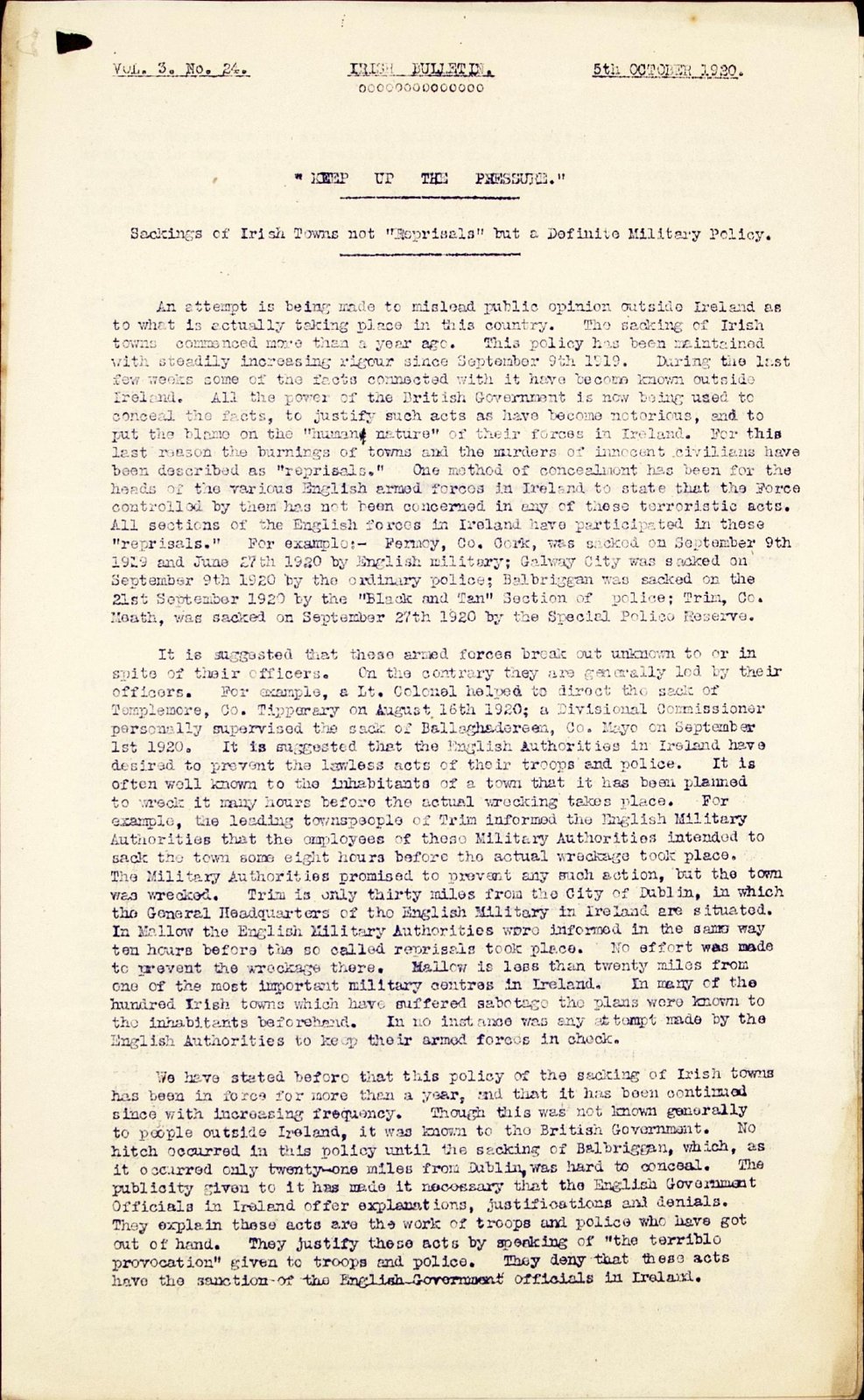
Irish Bulletin, Vol. 3 No. 24, 5 October 1920: 'Keep Up the Pressure'
First page of a typed press bulletin of the republican Dail Eireann, headed 'Keep up the pressure', arguing that the burning of Irish towns was 'not reprisals but a definite military policy'. Tells: loaded labels for British forces ('terroristic acts', 'Black and Tan') and a list of burned towns with dates and units, while the incidents said to have provoked them are mentioned only as the British government's excuse.
- Date
- October 5, 1920
- Period
- Interwar
- Made by
- Dail Eireann Publicity Department (Irish Bulletin), Dublin
- Country
- United Kingdom
- Medium
- Newspaper pages
- Issuer type
- Movement
- Regime
- Lloyd George Government
- Leader
- David Lloyd George
- Audience
- Foreign public
- Purpose
- Persuade or win support
- Techniques
- Name-callingCard stacking
- Source
- Identified Openly sourced: the speaker is who they say they are
- Source
- Internet Archive (Irish Republican Digital Archive), retrieved October 2, 2026
- Rights
- Public domain (published in Dublin 5 October 1920, before 1931; US PD by date)
Irish Bulletin, Dail Eireann Publicity Department, Dublin, 5 October 1920; scan via the Irish Republican Digital Archive on the Internet Archive. The Internet Archive item page carries no rights statement; the basis is the publication date.
Text on the object
Vol. 3. No. 24.     IRISH BULLETIN.     5th OCTOBER 1920.

"KEEP UP THE PRESSURE."

Sackings of Irish Towns not "Reprisals" but a Definite Military Policy.

An attempt is being made to mislead public opinion outside Ireland as to what is actually taking place in this country. The sacking of Irish towns commenced more than a year ago. This policy has been maintained with steadily increasing rigour since September 9th 1919. During the last few weeks some of the facts connected with it have become known outside Ireland. All the power of the British Government is now being used to conceal the facts, to justify such acts as have become notorious, and to put the blame on the "human nature" of their forces in Ireland. For this last reason the burnings of towns and the murders of innocent civilians have been described as "reprisals." [...] All sections of the English forces in Ireland have participated in these "reprisals." For example:- Fermoy, Co. Cork, was sacked on September 9th 1919 and June 27th 1920 by English military; Galway City was sacked on September 9th 1920 by the ordinary police; Balbriggan was sacked on the 21st September 1920 by the "Black and Tan" Section of police; Trim, Co. Meath, was sacked on September 27th 1920 by the Special Police Reserve.

[remaining paragraphs not transcribed]
Typescript with some faded and overstruck letters in the headings; the first two paragraphs are transcribed with an omission marked [...]. The text of 'English' for British forces is the Bulletin's own usage.