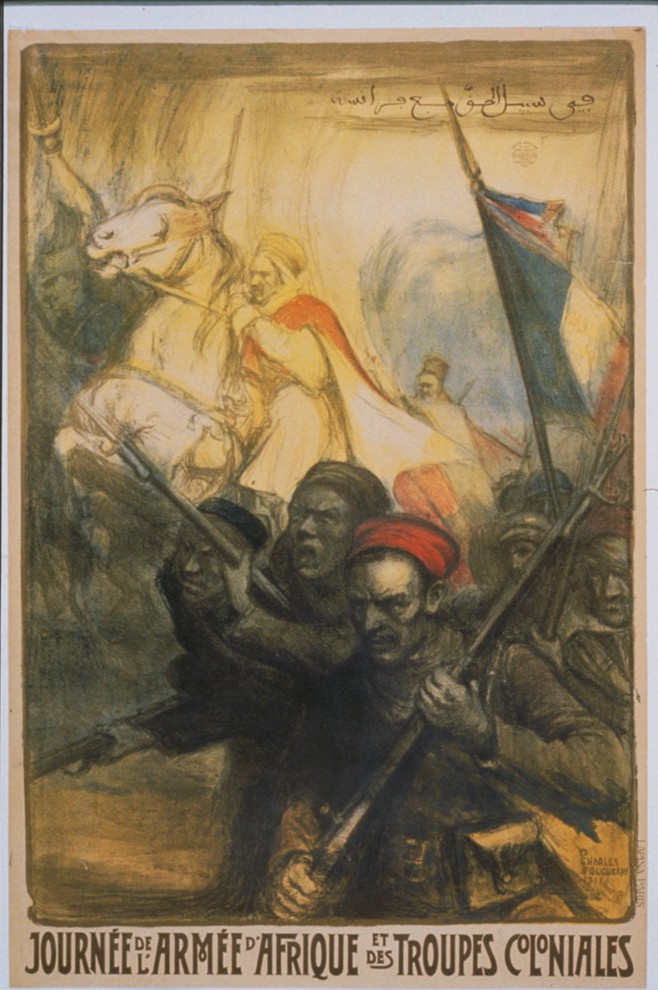
Journée de l'armée d'Afrique et des troupes coloniales (Day of the Army of Africa and the Colonial Troops), Fouqueray
Colour lithograph of colonial infantry in a red chechia and other uniforms, bayonets forward, advancing under the tricolour behind a mounted North African horseman in a red-lined burnous, with a line of Arabic script above and the title 'Day of the Army of Africa and the Colonial Troops' below. Transfer tell: the flag, the cavalry and the Arabic phrase 'in the cause of right, with France' attach the soldiers' courage to the French national cause.
- Date
- 1917
- Period
- First World War
- Made by
- Journée de l'Armée d'Afrique et des Troupes coloniales (French fundraising day); artist Charles Fouqueray, printer Lapina, Paris
- Region
- Western and Central Europe
- Country
- France
- Medium
- Poster
- Issuer type
- Mixed
- Regime
- Ribot Government
- Leader
- Alexandre Ribot
- Audience
- Domestic public
- Purpose
- Fundraise
- Themes
- War and the military, Empire and colonialism, Economy and finance
- Event
- World War I
- Techniques
- Transfer
- Source
- Identified Openly sourced: the speaker is who they say they are
- Source
- Library of Congress, Prints and Photographs Division, retrieved September 29, 2026
- Rights
- Public domain (published Paris 1917, before 1931; LOC states it owns no rights and gives no restriction)
Charles Fouqueray, Journée de l'armée d'Afrique et des troupes coloniales, Paris: Lapina, 1917. Library of Congress, POS - Fr .F68, no. 4 (C size) [P&P].
Text on the object
[Arabic, top:] في سبيل الحق مع فرنسا
[signature, lower right:] CHARLES FOUQUERAY 1917
JOURNÉE DE L'ARMÉE D'AFRIQUE ET DES TROUPES COLONIALES
[a small vertical imprint at the lower right margin is illegible]
[Arabic:] In the cause of right, with France. [Signature:] Charles Fouqueray 1917. Day of the Army of Africa and the Colonial Troops.
The Arabic line is handwritten-style script and is read as 'fi sabil al-haqq ma' faransa'; the reading is a machine transcription, not checked by a fluent reader of Arabic. The tiny vertical imprint at the lower right margin cannot be read.