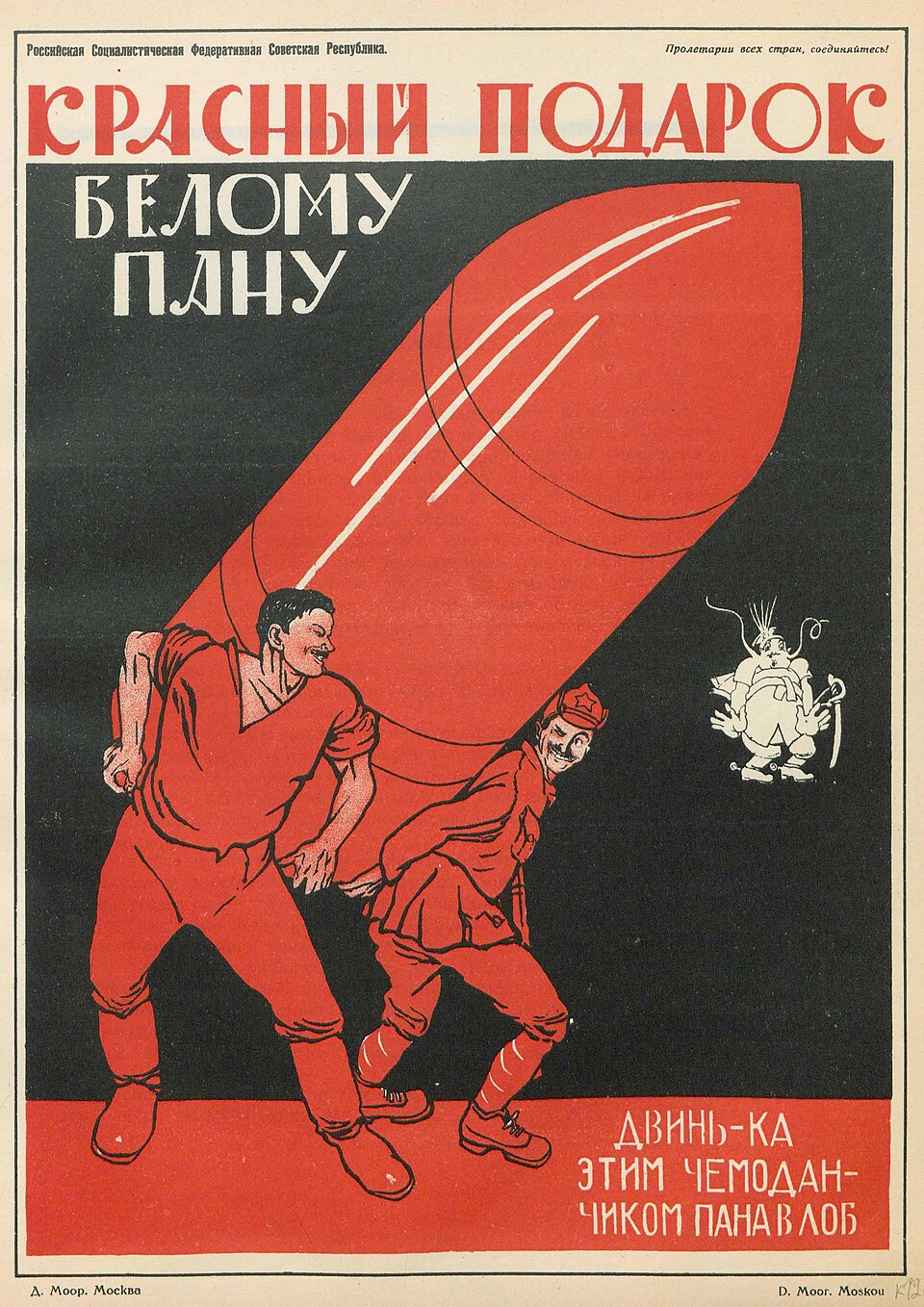
Красный подарок белому пану (A Red Gift for the White Lord): Soviet Polish-Soviet War poster
A grinning worker and a Red Army soldier heft an outsized red artillery shell on their backs, aimed at a tiny, plump cartoon nobleman with a sabre at the right edge, under the headline 'A Red Gift for the White Lord' and the line 'give the lord one in the forehead with this little suitcase'. The label 'white lord' (biely pan) and the shrunken comic figure turn the opposing side into a stock class-enemy type.
- Date
- 1920
- Period
- Interwar
- Made by
- Russian Soviet Federative Socialist Republic (Polish-Soviet War agitation); artist Dmitry Moor
- Region
- Eastern Europe and Eurasia
- Country
- Soviet Russia
- Medium
- Poster
- Issuer type
- State
- Regime
- Soviet Russia
- Leader
- Vladimir Lenin
- Audience
- Domestic public
- Purpose
- Mobilize or secure compliance
- Themes
- War and the military, Labor
- Event
- Polish Soviet War
- Techniques
- Name-calling
- Source
- Identified Openly sourced: the speaker is who they say they are
- Source
- Wikimedia Commons, retrieved September 29, 2026
- Rights
- Public domain (published 1920; Commons: PD-Russia-expired, PD-Art)
Dmitry Moor, Red Gift for the White Lord, RSFSR, 1920; via Wikimedia Commons.
Text on the object
Российская Социалистическая Федеративная Советская Республика.          Пролетарии всех стран, соединяйтесь!

КРАСНЫЙ ПОДАРОК
БЕЛОМУ ПАНУ

ДВИНЬ-КА
ЭТИМ ЧЕМОДАН-
ЧИКОМ ПАНА В ЛОБ

Д. Моор. Москва          D. Moor. Moskou
[handwritten mark at bottom right, illegible]
Russian Socialist Federative Soviet Republic.          Workers of all countries, unite!

RED GIFT
FOR THE WHITE LORD

GIVE THE LORD ONE
IN THE FOREHEAD
WITH THIS LITTLE SUITCASE

D. Moor. Moscow          D. Moor. Moskou [as printed]
[handwritten mark, illegible]
The top line spells 'Российская Социалистическая' as printed on the poster. 'Moskou' in the bottom-right imprint is transcribed as printed. A small handwritten mark at the bottom right edge is not legible.