Military Courtesy
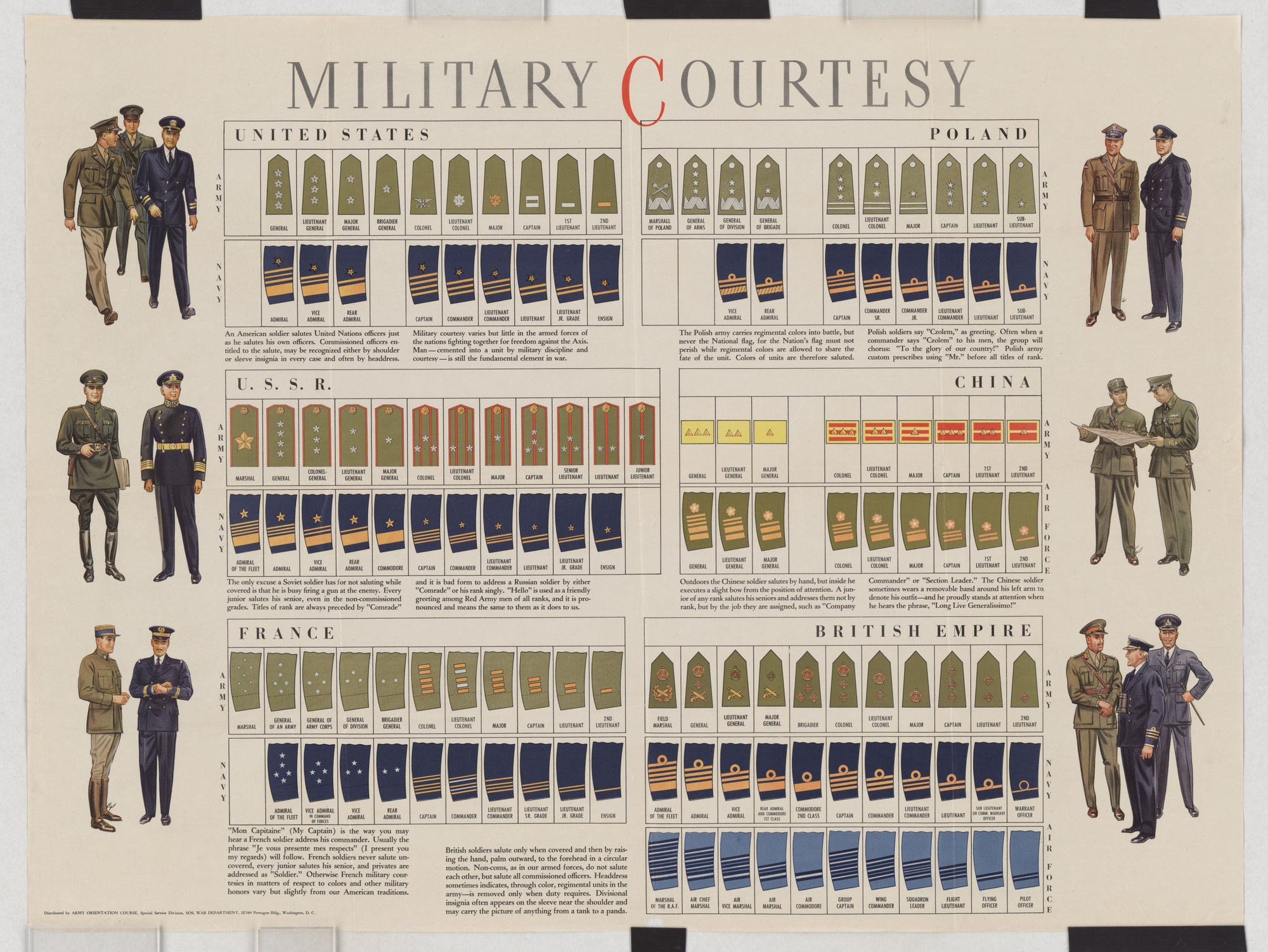
Wall chart of the saluting customs and rank insignia of the United States, Poland, the U.S.S.R., China, France and the British Empire, with rows of shoulder and sleeve badges and painted figures in each uniform. The sheet is reference material for servicemen and the technique is faint here: the closest is a glittering-generalities tone in its line about nations 'fighting together for freedom against the Axis'.
Propaganda techniques used in this poster
- Date
- 1942
- Period
- Second World War
- Made by
- Army Orientation Course, Special Service Division, SOS, War Department
- Region
- North America
- Country
- United States
- Medium
- Poster
- Issuer type
- Military
- Regime
- Roosevelt Administration
- Leader
- Franklin D. Roosevelt
- Audience
- Own forces
- Purpose
- Warn or inform
- Theme
- War and the military
- Event
- World War II
- Regime
- Roosevelt administration
- Leader
- Franklin D. Roosevelt
- Source
- Identified Openly sourced: the speaker is who they say they are
- Source
- U.S. National Archives and Records Administration, Record Group 44, World War II Posters, retrieved October 4, 2026
- Rights
- Public domain (U.S. government work)
Army Orientation Course, Special Service Division, SOS, War Department. National Archives and Records Administration, RG 44, 44-PA-1356 (NAID 515010).
Text on the object
MILITARY COURTESY
UNITED STATES
ARMY: GENERAL; LIEUTENANT GENERAL; MAJOR GENERAL; BRIGADIER GENERAL; COLONEL; LIEUTENANT COLONEL; MAJOR; CAPTAIN; 1ST LIEUTENANT; 2ND LIEUTENANT
NAVY: ADMIRAL; VICE ADMIRAL; REAR ADMIRAL; CAPTAIN; COMMANDER; LIEUTENANT COMMANDER; LIEUTENANT; LIEUTENANT JR. GRADE; ENSIGN
An American soldier salutes United Nations officers just as he salutes his own officers. Commissioned officers entitled to the salute, may be recognized either by shoulder or sleeve insignia in every case and often by headdress.
Military courtesy varies but little in the armed forces of the nations fighting together for freedom against the Axis. Man—cemented into a unit by military discipline and courtesy—is still the fundamental element in war.
POLAND
ARMY: MARSHALL OF POLAND; GENERAL OF ARMS; GENERAL OF DIVISION; GENERAL OF BRIGADE; COLONEL; LIEUTENANT COLONEL; MAJOR; CAPTAIN; LIEUTENANT; SUB-LIEUTENANT
NAVY: VICE ADMIRAL; REAR ADMIRAL; CAPTAIN; COMMANDER SR.; COMMANDER JR.; LIEUTENANT COMMANDER; LIEUTENANT; SUB-LIEUTENANT
The Polish army carries regimental colors into battle, but never the National flag, for the Nation's flag must not perish while regimental colors are allowed to share the fate of the unit. Colors of units are therefore saluted.
Polish soldiers say "Czolem" as greeting. Often when a commander says "Czolem" to his men, the group will chorus: "To the glory of our country!" Polish army custom prescribes using "Mr." before all titles of rank.
U.S.S.R.
ARMY: MARSHAL; GENERAL; COLONEL-GENERAL; LIEUTENANT GENERAL; MAJOR GENERAL; COLONEL; LIEUTENANT COLONEL; MAJOR; CAPTAIN; SENIOR LIEUTENANT; LIEUTENANT; JUNIOR LIEUTENANT
NAVY: ADMIRAL OF THE FLEET; ADMIRAL; VICE ADMIRAL; REAR ADMIRAL; COMMODORE; CAPTAIN; COMMANDER; LIEUTENANT COMMANDER; LIEUTENANT; LIEUTENANT JR. GRADE; ENSIGN
The only excuse a Soviet soldier has for not saluting while covered is that he is busy firing a gun at the enemy. Every junior salutes his senior, even in the non-commissioned grades. Titles of rank are always preceded by "Comrade"
and it is bad form to address a Russian soldier by either "Comrade" or his rank singly. "Hello" is used as a friendly greeting among Red Army men of all ranks, and it is pronounced and means the same to them as it does to us.
CHINA
ARMY: GENERAL; LIEUTENANT GENERAL; MAJOR GENERAL; COLONEL; LIEUTENANT COLONEL; MAJOR; CAPTAIN; 1ST LIEUTENANT; 2ND LIEUTENANT
AIR FORCE: GENERAL; LIEUTENANT GENERAL; MAJOR GENERAL; COLONEL; LIEUTENANT COLONEL; MAJOR; CAPTAIN; 1ST LIEUTENANT; 2ND LIEUTENANT
Outdoors the Chinese soldier salutes by hand, but inside he executes a slight bow from the position of attention. A junior of any rank salutes his seniors and addresses them not by rank, but by the job they are assigned, such as "Company Commander" or "Section Leader." The Chinese soldier sometimes wears a removable band around his left arm to denote his outfit—and he proudly stands at attention when he hears the phrase, "Long Live Generalissimo!"
FRANCE
ARMY: MARSHAL; GENERAL OF AN ARMY; GENERAL OF ARMY CORPS; GENERAL OF DIVISION; BRIGADIER GENERAL; COLONEL; LIEUTENANT COLONEL; MAJOR; CAPTAIN; LIEUTENANT; 2ND LIEUTENANT
NAVY: ADMIRAL OF THE FLEET; VICE ADMIRAL IN COMMAND OF FORCES; VICE ADMIRAL; REAR ADMIRAL; CAPTAIN; COMMANDER; LIEUTENANT COMMANDER; LIEUTENANT SR. GRADE; LIEUTENANT JR. GRADE; ENSIGN
"Mon Capitaine" (My Captain) is the way you may hear a French soldier address his commander. Usually the phrase "Je vous presente mes respects" (I present you my respects) will follow. French soldiers never salute uncovered, every junior salutes his senior, and privates are addressed as "Soldier." Otherwise French military courtesies in matters of respect to colors and other military honors vary but slightly from our American traditions.
[text cut at the 4000-character cap; omitted: the British Empire panel's army, navy and air force rank labels and its paragraph on British salutes, and the distribution imprint line at the foot]