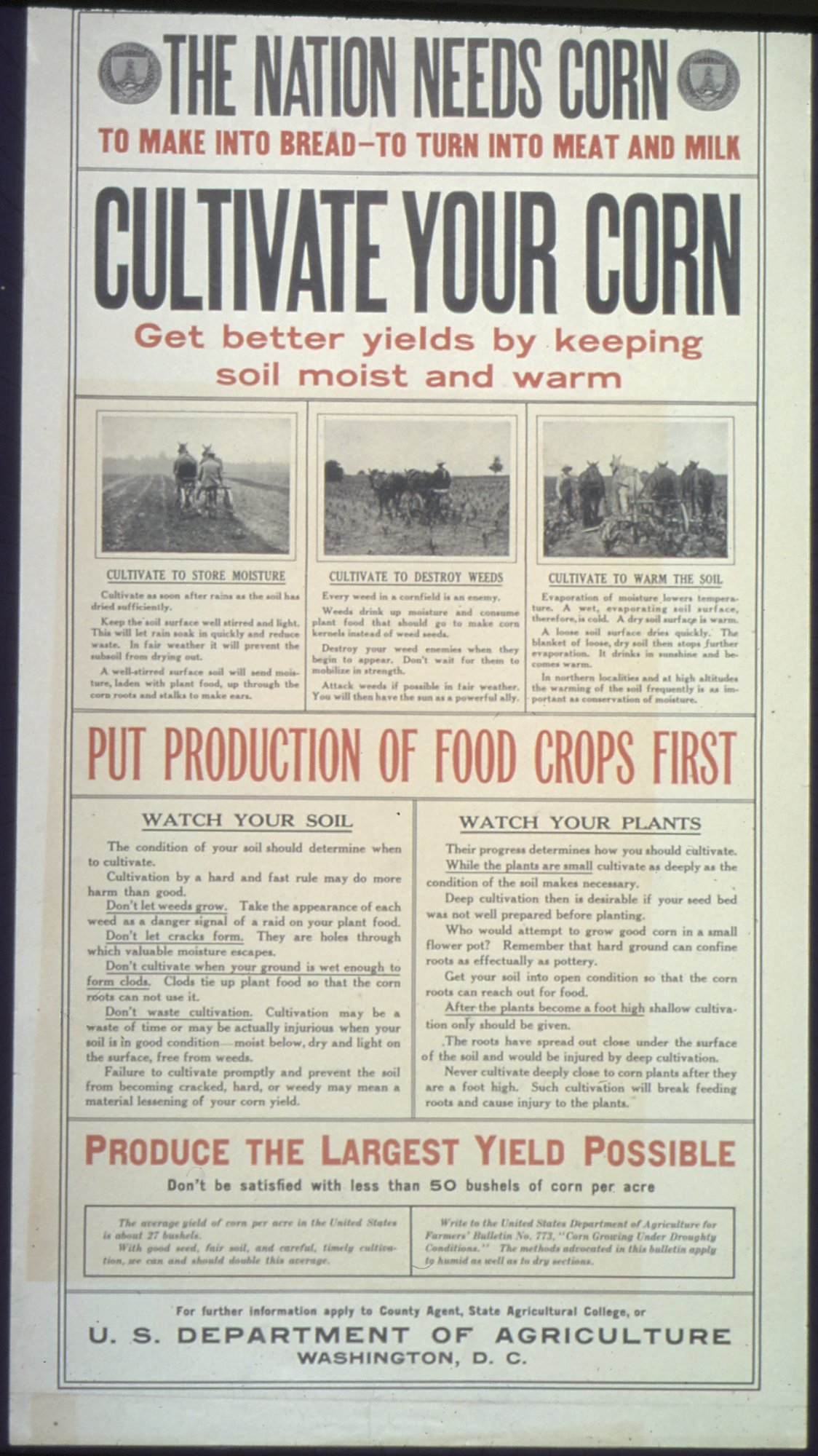
The Nation Needs Corn: Cultivate Your Corn
A text-led sheet with three small photographs of horse-drawn cultivation sits under the headline 'Cultivate Your Corn' and the instruction 'Put production of food crops first.' Two columns of practical advice on soil and plants follow, ending with a target yield of 50 bushels per acre. The persuasion is mostly instruction; the only appeal beyond practice is the opening framing of corn as the nation's need and a patriotic duty.
Propaganda techniques used in this poster
- Date
- 1918
- Period
- First World War
- Made by
- U.S. Department of Agriculture
- Region
- North America
- Country
- United States
- Medium
- Poster
- Issuer type
- State
- Regime
- Wilson Administration
- Leader
- Woodrow Wilson
- Audience
- Domestic public
- Purpose
- Mobilize or secure compliance
- Themes
- Home front, Science and technology
- Event
- World War I
- Regime
- Wilson administration
- Leader
- Woodrow Wilson
- Source
- Identified Openly sourced: the speaker is who they say they are
- Source
- U.S. National Archives (NARA), RG 4 (U.S. Food Administration), World War I Posters (NAID 512439), retrieved October 3, 2026
- Rights
- NARA Unrestricted; hosted by owner decision
U.S. Department of Agriculture. National Archives and Records Administration, 4-P-105.
Text on the object
THE NATION NEEDS CORN
TO MAKE INTO BREAD—TO TURN INTO MEAT AND MILK
CULTIVATE YOUR CORN
Get better yields by keeping soil moist and warm

CULTIVATE TO STORE MOISTURE
Cultivate as soon after rains as the soil has dried sufficiently.
Keep the soil surface well stirred and light. This will let rain soak in quickly and reduce waste. In fair weather it will prevent the subsoil from drying out.
A well-stirred surface soil will send moisture, laden with plant food, up through the corn roots and stalks to make ears.

CULTIVATE TO DESTROY WEEDS
Every weed in a cornfield is an enemy.
Weeds drink up moisture and consume plant food that should go to make corn kernels instead of weed seeds.
Destroy your weed enemies when they begin to appear. Don't wait for them to mobilize in strength.
Attack weeds if possible in fair weather. You will then have the sun as a powerful ally.

CULTIVATE TO WARM THE SOIL
Evaporation of moisture lowers temperature. A wet, evaporating soil surface, therefore, is cold. A dry soil surface is warm.
A loose soil surface dries quickly. The blanket of loose, dry soil then stops further evaporation. It drinks in sunshine and becomes warm.
In northern localities and at high altitudes the warming of the soil frequently is as important as conservation of moisture.

PUT PRODUCTION OF FOOD CROPS FIRST

WATCH YOUR SOIL
The condition of your soil should determine when to cultivate.
Cultivation by a hard and fast rule may do more harm than good.
Don't let weeds grow. Take the appearance of each weed as a danger signal of a raid on your plant food.
Don't let cracks form. They are holes through which valuable moisture escapes.
Don't cultivate when your ground is wet enough to form clods. Clods tie up plant food so that the corn roots can not use it.
Don't waste cultivation. Cultivation may be a waste of time or may be actually injurious when your soil is in good condition—moist below, dry and light on the surface, free from weeds.
Failure to cultivate promptly and prevent the soil from becoming cracked, hard, or weedy may mean a material lessening of your corn yield.

WATCH YOUR PLANTS
Their progress determines how you should cultivate.
While the plants are small cultivate as deeply as the condition of the soil makes necessary.
Deep cultivation then is desirable if your seed bed was not well prepared before planting.
Who would attempt to grow good corn in a small flower pot? Remember that hard ground can confine roots as effectually as pottery.
Get your soil into open condition so that the corn roots can reach out for food.
After the plants become a foot high shallow cultivation only should be given.
The roots have spread out close under the surface of the soil and would be injured by deep cultivation.
Never cultivate deeply close to corn plants after they are a foot high. Such cultivation will break feeding roots and cause injury to the plants.

PRODUCE THE LARGEST YIELD POSSIBLE
Don't be satisfied with less than 50 bushels of corn per acre

The average yield of corn per acre in the United States is about 27 bushels.
With good seed, fair soil, and careful, timely cultivation, we can and should double this average.

Write to the United States Department of Agriculture for Farmers' Bulletin No. 773, "Corn Growing Under Droughty Conditions." The methods advocated in this bulletin apply to humid as well as to dry sections.

For further information apply to County Agent, State Agricultural College, or
U. S. DEPARTMENT OF AGRICULTURE
WASHINGTON, D. C.
Three photographs (plowing and cultivating corn with horse teams) sit above the three 'Cultivate to...' columns; they carry no captions.