Content note: A sabre ending in whip lashes (the emblem of slavery's punishment) offered to an army marshal by caricatured ministers. This object is shown as it was published. Why
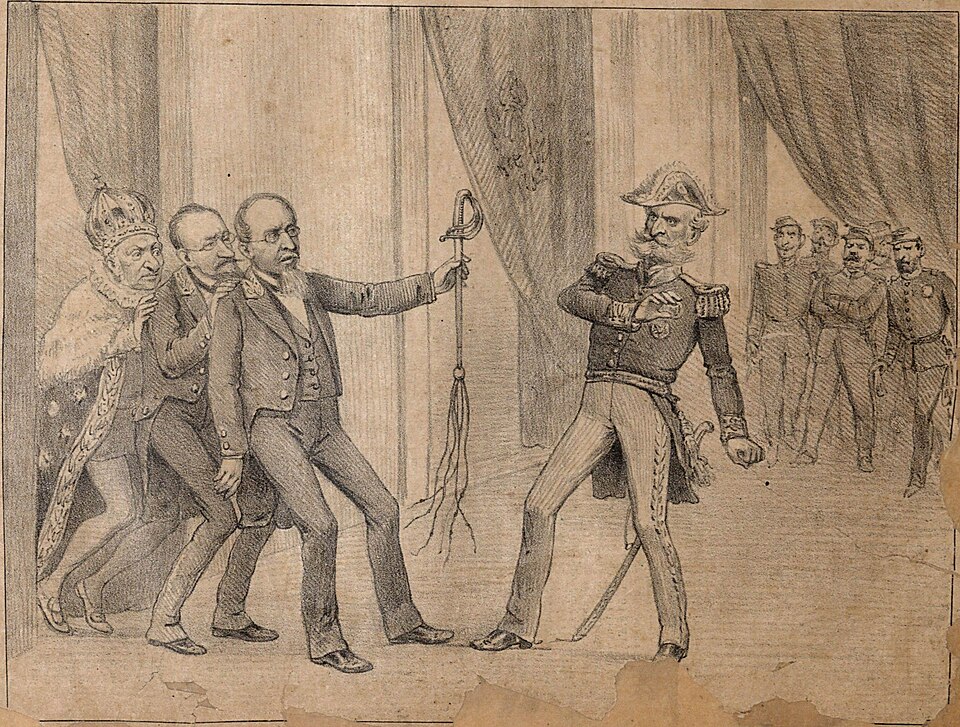
A nova espada que o governo pretende apresentar ao exército (The New Sword the Government Means to Present to the Army)
A lithograph cartoon shows a crowned figure in imperial robes (identified as the Baron of Cotegipe) and two ministers pressing on an army marshal (Deodoro) a sabre whose blade ends in leather lashes, while the marshal folds his arms and refuses and officers watch from the right. The tell is the object: the whip of slavery's punishment is grafted onto the government's sword, and the printed legend calls the enslaved 'wretched' people who 'fight for their freedom'.
- Date
- October 22, 1887
- Period
- Pre-1914
- Made by
- Revista Illustrada (Rio de Janeiro), no. 468; artist not identified in the Commons record
- Region
- Latin America
- Country
- Empire of Brazil
- Medium
- Cartoon
- Issuer type
- Media
- Regime
- Empire of Brazil
- Leader
- Joao Mauricio Wanderley
- Audience
- Domestic public
- Purpose
- Persuade or win support
- Themes
- Race and ethnicity, War and the military
- Event
- Abolition of Slavery in Brazil
- Techniques
- Transfer
- Source
- Identified Openly sourced: the speaker is who they say they are
- Source
- Wikimedia Commons, retrieved September 29, 2026
- Rights
- Public domain (published 1887, before 1931; PD-Art / PD-old-100 per Wikimedia Commons)
Revista Illustrada (Rio de Janeiro), no. 468, 22 October 1887, via Wikimedia Commons / Biblioteca Nacional (Brazil)
Text on the object
A nova espada que o governo pretende apresentar ao exército para vencer aos míseros escravisados, que combatem pela sua liberdade!
The new sword that the government intends to present to the army in order to defeat the wretched enslaved, who fight for their freedom!
The legend is taken from the caption recorded on the Wikimedia Commons file page (file name and description, citing Revista Illustrada no. 468). The hosted crop of the cartoon carries no visible printed text, so it could not be read from the image itself.