Content note: Bodies of pogrom victims labelled 'Kishineff' beneath a figure with a whip (1904 cartoon). This object is shown as it was published. Why
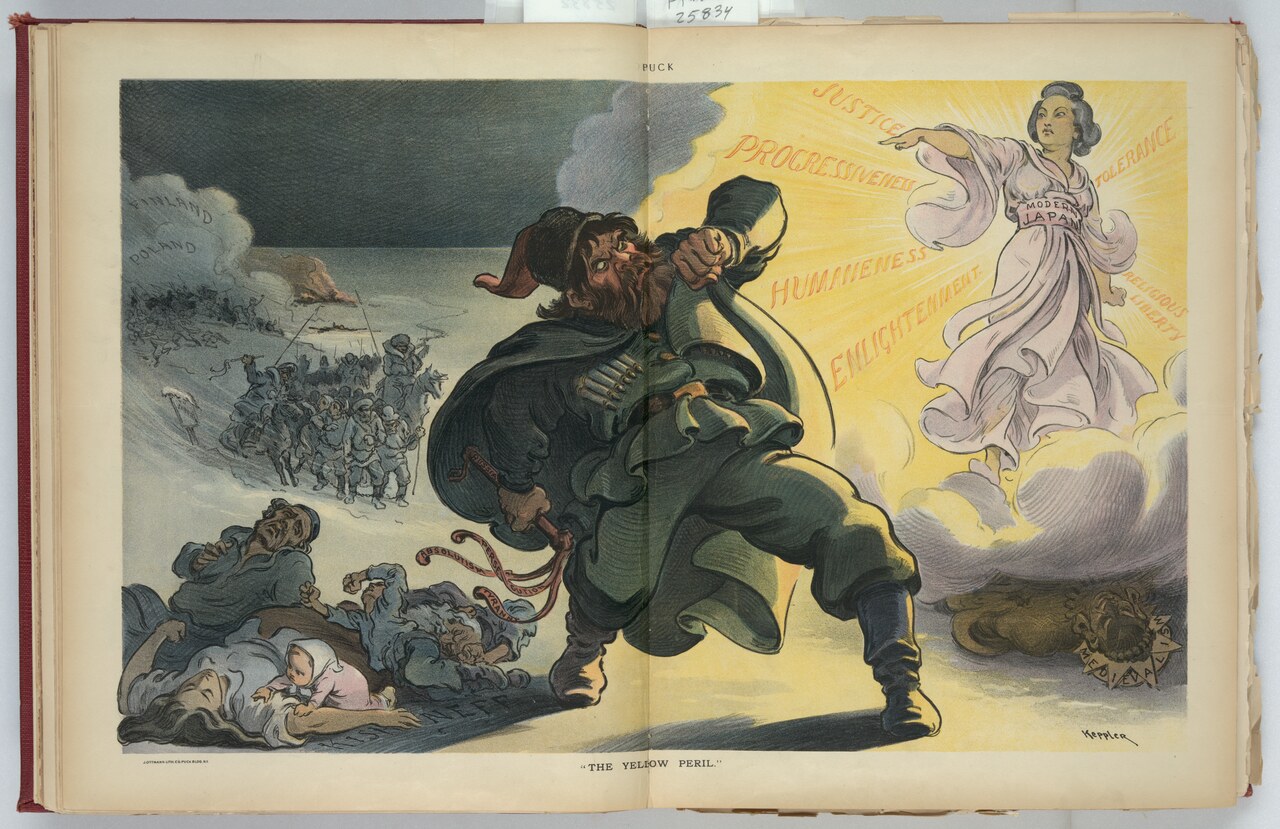
"The Yellow Peril" (Puck, 1904)
Centerfold that turns the phrase "yellow peril" on Russia: a bearded Russian with a whip labelled "Russia" (lashes "Absolutism, Persecution, Tyranny") stands over bodies marked "Kishineff" and shields his eyes from a radiant woman labelled "Modern Japan", ringed by the words Justice, Progressiveness, Humaneness, Enlightenment, Tolerance and Religious Liberty. Virtue words are attached to one belligerent and abuse words to the other.
- Date
- March 23, 1904
- Period
- Pre-1914
- Made by
- Puck magazine (Keppler & Schwarzmann); drawn by Keppler
- Region
- North America
- Country
- United States
- Medium
- Cartoon
- Issuer type
- Media
- Leader
- Theodore Roosevelt
- Audience
- Domestic public
- Purpose
- Persuade or win support
- Event
- Russo Japanese War
- Techniques
- Name-callingGlittering generalities
- Source
- Identified Openly sourced: the speaker is who they say they are
- Source
- Library of Congress, Prints and Photographs Division, retrieved October 2, 2026
- Rights
- Public domain (published in the U.S. in 1904; LOC: no known restrictions on publication)
Keppler, "The Yellow Peril", Puck v. 55 no. 1412, 23 March 1904, centerfold (Keppler & Schwarzmann); LC-DIG-ppmsca-25833
Text on the object
PUCK.

[cloud, upper left] FINLAND · POLAND
[ground beside the bodies] KISHINEFF
[sash on the Russian figure] RUSSIA
[ribbons on the whip lashes] ABSOLUTISM · PERSECUTION · TYRANNY
[sash on the radiant woman] MODERN JAPAN
[words in the light, left to right and around her] JUSTICE · PROGRESSIVENESS · HUMANENESS · ENLIGHTENMENT · TOLERANCE · RELIGIOUS LIBERTY
[star-shaped badge on the crushed figure, lower right] MEDIAEVALISM
[signature, lower right] KEPPLER
"THE YELLOW PERIL."

[lower left imprint, lithographer, too small to read] [illegible]
Read from a 1280 px downscale of the Library of Congress master scan, with enlarged crops of the lower corners. The "Kishineff" lettering is partly hidden by the figures' bodies; the lithographer's imprint at lower left is too small to read.