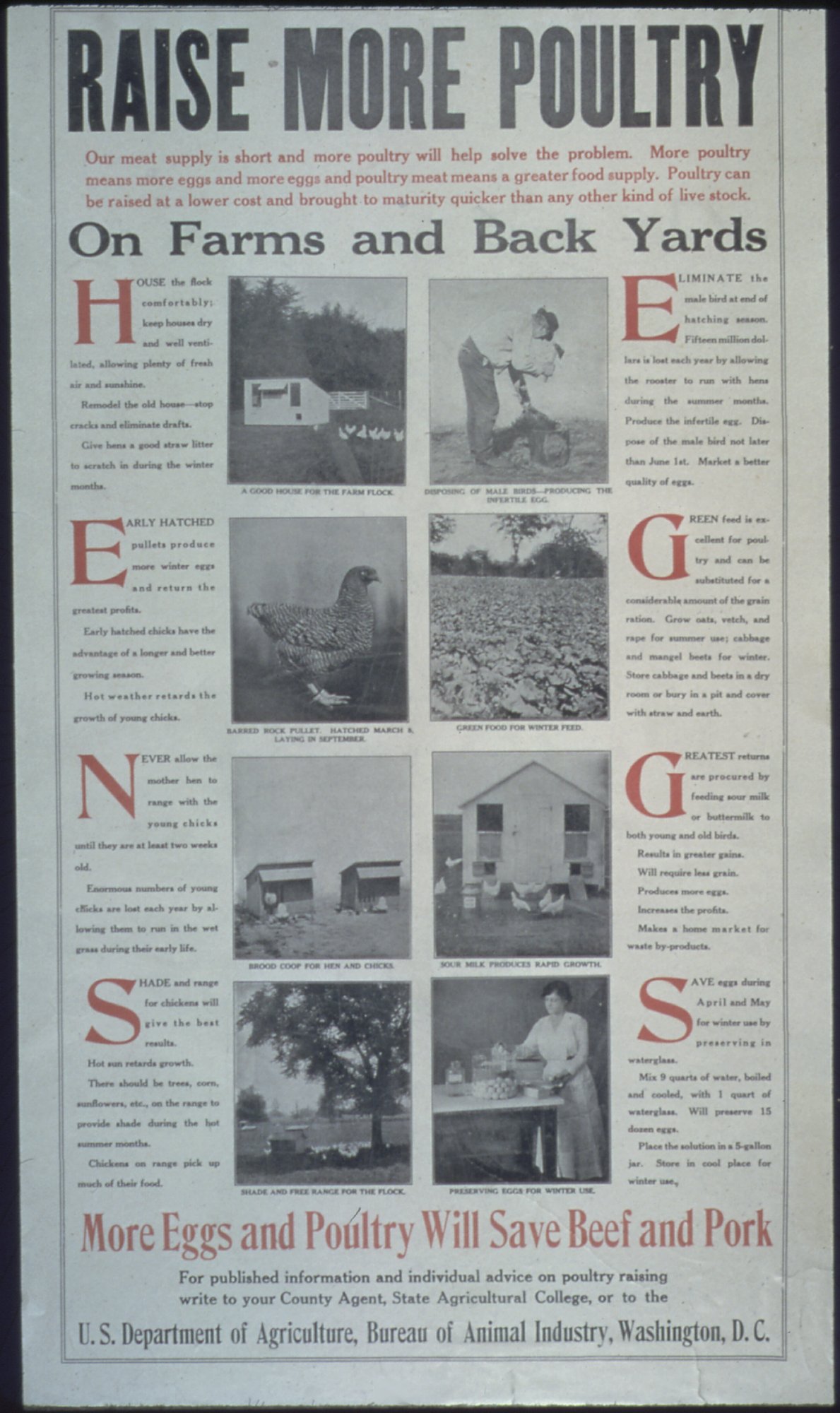
Raise More Poultry on Farms and Back Yards: More Eggs and Poultry Will Save Beef and Pork
A dense instructional sheet carries eight captioned photographs of poultry houses, pullets, hen coops and egg preservation, with the acrostic H-E-N-S-E-G-G-S down the margins of its advice paragraphs. It is a practical how-to with a stated reason, that eggs and poultry will save beef and pork. The persuasion sits in its everyday, household framing of a national supply goal.
Propaganda techniques used in this poster
- Date
- 1917
- Period
- First World War
- Made by
- U.S. Department of Agriculture, Bureau of Animal Industry
- Region
- North America
- Country
- United States
- Medium
- Poster
- Issuer type
- State
- Regime
- Wilson Administration
- Leader
- Woodrow Wilson
- Audience
- Domestic public
- Purpose
- Mobilize or secure compliance
- Themes
- Home front, Economy and finance
- Event
- World War I
- Regime
- Wilson administration
- Leader
- Woodrow Wilson
- Source
- Identified Openly sourced: the speaker is who they say they are
- Source
- U.S. National Archives (NARA), RG 4 (U.S. Food Administration), World War I Posters (NAID 512439), retrieved October 3, 2026
- Rights
- NARA Unrestricted; hosted by owner decision
U.S. Department of Agriculture, Bureau of Animal Industry. National Archives and Records Administration, 4-P-132.
Text on the object
RAISE MORE POULTRY
Our meat supply is short and more poultry will help solve the problem. More poultry means more eggs and more eggs and poultry meat means a greater food supply. Poultry can be raised at a lower cost and brought to maturity quicker than any other kind of live stock.
On Farms and Back Yards

HOUSE the flock comfortably; keep houses dry and well ventilated, allowing plenty of fresh air and sunshine.
Remodel the old house—stop cracks and eliminate drafts.
Give hens a good straw litter to scratch in during the winter months.
[photo] A GOOD HOUSE FOR THE FARM FLOCK.

[photo] DISPOSING OF MALE BIRDS—PRODUCING THE INFERTILE EGG.
ELIMINATE the male bird at end of hatching season. Fifteen million dollars is lost each year by allowing the rooster to run with hens during the summer months. Produce the infertile egg. Dispose of the male bird not later than June 1st. Market a better quality of eggs.

EARLY HATCHED pullets produce more winter eggs and return the greatest profits.
Early hatched chicks have the advantage of a longer and better growing season.
Hot weather retards the growth of young chicks.
[photo] BARRED ROCK PULLET. HATCHED MARCH 8, LAYING IN SEPTEMBER.

[photo] GREEN FOOD FOR WINTER FEED.
GREEN feed is excellent for poultry and can be substituted for a considerable amount of the grain ration. Grow oats, vetch, and rape for summer use; cabbage and mangel beets for winter. Store cabbage and beets in a dry room or bury in a pit and cover with straw and earth.

NEVER allow the mother hen to range with the young chicks until they are at least two weeks old.
Enormous numbers of young chicks are lost each year by allowing them to run in the wet grass during their early life.
[photo] BROOD COOP FOR HEN AND CHICKS.

[photo] SOUR MILK PRODUCES RAPID GROWTH.
GREATEST returns are procured by feeding sour milk or buttermilk to both young and old birds.
Results in greater gains.
Will require less grain.
Produces more eggs.
Increases the profits.
Makes a home market for waste by-products.

SHADE and range for chickens will give the best results.
Hot sun retards growth.
There should be trees, corn, sunflowers, etc., on the range to provide shade during the hot summer months.
Chickens on range pick up much of their food.
[photo] SHADE AND FREE RANGE FOR THE FLOCK.

[photo] PRESERVING EGGS FOR WINTER USE.
SAVE eggs during April and May for winter use by preserving in waterglass.
Mix 9 quarts of water, boiled and cooled, with 1 quart of waterglass. Will preserve 15 dozen eggs.
Place the solution in a 5-gallon jar. Store in cool place for winter use.

More Eggs and Poultry Will Save Beef and Pork
For published information and individual advice on poultry raising
write to your County Agent, State Agricultural College, or to the
U. S. Department of Agriculture, Bureau of Animal Industry, Washington, D. C.
The large initial letters of the paragraphs spell HENS down the left column and EGGS down the right column. Photograph captions are printed under each photograph and are transcribed in place.