Content note: Wartime editorial calling Germany's conduct 'bloodthirsty', 'criminal' and 'treacherous'. This object is shown as it was published. Why
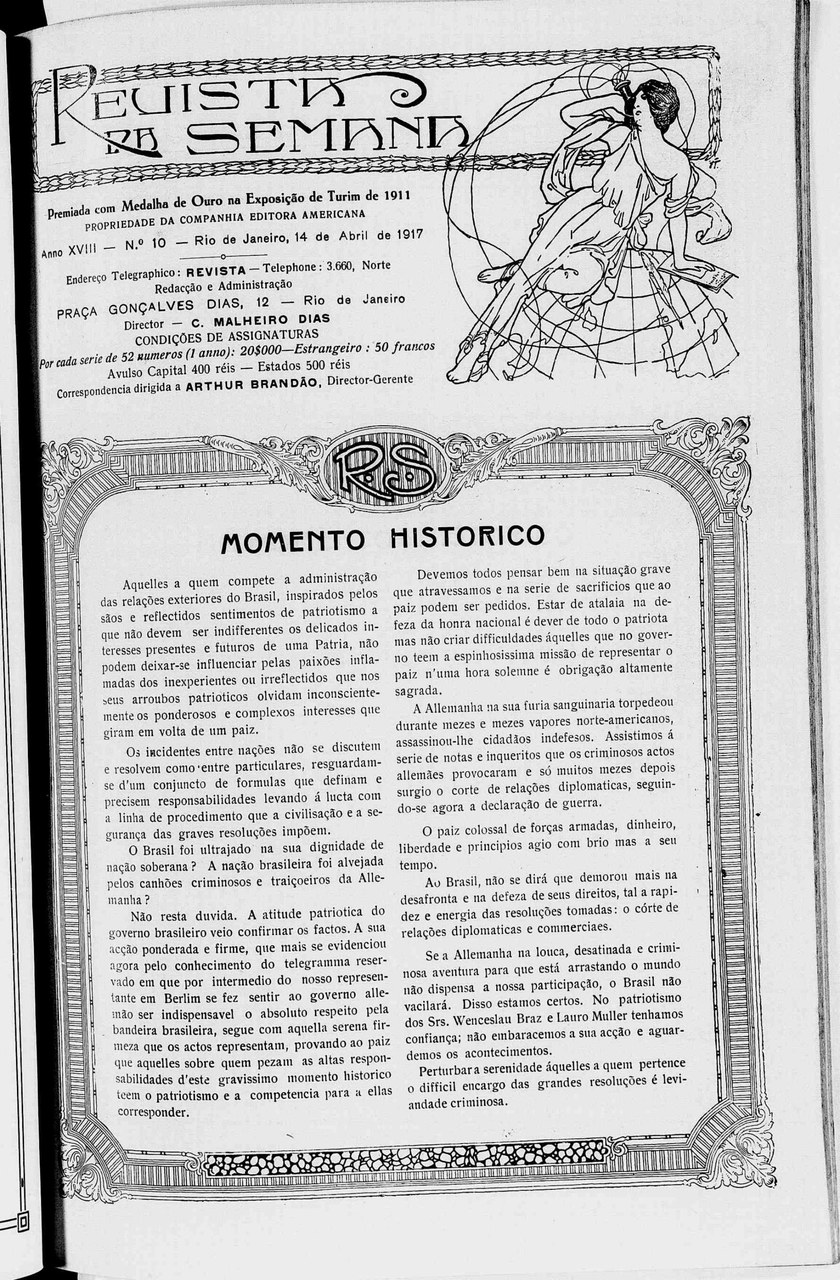
Momento historico, Revista da Semana, 14 April 1917 (Historic Moment)
Full-page unsigned editorial in a Rio illustrated weekly, ten days after Brazil broke relations with Germany over the sinking of the steamer Parana. It calls Germany's ships 'criminal and treacherous cannon', its conduct 'bloodthirsty fury' and a 'mad, senseless and criminal adventure', and asks readers to trust the government and not 'disturb the serenity' of its decisions. The tell: the loaded labels do the work of the argument against one named belligerent, while the second half asks for patience.
- Date
- April 14, 1917
- Period
- First World War
- Made by
- Revista da Semana (Companhia Editora Americana, Rio de Janeiro), director C. Malheiro Dias
- Region
- Latin America
- Country
- Brazil
- Medium
- Newspaper pages
- Issuer type
- Media
- Leader
- Venceslau Bras
- Audience
- Domestic public
- Purpose
- Persuade or win support
- Themes
- War and the military, Home front
- Event
- World War I
- Techniques
- Name-calling
- Source
- Identified Openly sourced: the speaker is who they say they are
- Source
- Internet Archive (Revista da Semana, Rio de Janeiro, 1917, no. 10; community scan), retrieved October 2, 2026
- Rights
- Public domain (published 1917, before 1931); the Internet Archive page states no rights or licence
Revista da Semana, Companhia Editora Americana, Rio de Janeiro, no. 10, 14 April 1917, via the Internet Archive.
Text on the object
MOMENTO HISTORICO

Aquelles a quem compete a administração das relações exteriores do Brasil, inspirados pelos sãos e reflectidos sentimentos de patriotismo a que não devem ser indifferentes os delicados interesses presentes e futuros de uma Patria, não podem deixar-se influenciar pelas paixões inflamadas dos inexperientes ou irreflectidos que nos seus arroubos patrioticos olvidam inconscientemente os ponderosos e complexos interesses que giram em volta de um paiz.
Os incidentes entre nações não se discutem e resolvem como entre particulares, resguardam-se d'um conjuncto de formulas que definam e precisem responsabilidades levando á lucta com a linha de procedimento que a civilisação e a segurança das graves resoluções impõem.
O Brasil foi ultrajado na sua dignidade de nação soberana? A nação brasileira foi alvejada pelos canhões criminosos e traiçoeiros da Allemanha?
Não resta duvida. A atitude patriotica do governo brasileiro veio confirmar os factos. [...]

Devemos todos pensar bem na situação grave que atravessamos e na serie de sacrificios que ao paiz podem ser pedidos. Estar de atalaia na defeza da honra nacional é dever de todo o patriota mas não criar difficuldades áquelles que no governo teem a espinhosissima missão de representar o paiz n'uma hora solemne é obrigação altamente sagrada.
A Allemanha na sua furia sanguinaria torpedeou durante mezes e mezes vapores norte-americanos, assassinou-lhe cidadãos indefesos. Assistimos á serie de notas e inqueritos que os criminosos actos allemães provocaram e só muitos mezes depois surgio o corte de relações diplomaticas, seguindo-se agora a declaração de guerra.
O paiz colossal de forças armadas, dinheiro, liberdade e principios agio com brio mas a seu tempo.
Ao Brasil, não se dirá que demorou mais na desafronta e na defeza de seus direitos, tal a rapidez e energia das resoluções tomadas: o côrte de relações diplomaticas e commerciaes.
Se a Allemanha na louca, desatinada e criminosa aventura para que está arrastando o mundo não dispensa a nossa participação, o Brasil não vacilará. Disso estamos certos. No patriotismo dos Srs. Wenceslau Braz e Lauro Muller tenhamos confiança; não embaracemos a sua acção e aguardemos os acontecimentos.
Perturbar a serenidade áquelles a quem pertence o difficil encargo das grandes resoluções é leviandade criminosa.

[masthead:] REVISTA DA SEMANA. Premiada com Medalha de Ouro na Exposição de Turim de 1911. PROPRIEDADE DA COMPANHIA EDITORA AMERICANA. Anno XVIII — N.º 10 — Rio de Janeiro, 14 de Abril de 1917. Director — C. MALHEIRO DIAS
HISTORIC MOMENT

Those whose task is the administration of Brazil's foreign relations, inspired by the sound and reflective sentiments of patriotism to which the delicate present and future interests of a Fatherland must not be indifferent, cannot let themselves be swayed by the inflamed passions of the inexperienced or unreflective, who in their patriotic outbursts unconsciously forget the weighty and complex interests that revolve around a country.
Incidents between nations are not discussed and resolved as between private parties; they are shielded by a set of formulas that define and specify responsibilities, leading to the struggle by the line of conduct that civilisation and the security of grave resolutions require.
Was Brazil outraged in its dignity as a sovereign nation? Was the Brazilian nation shot at by the criminal and treacherous cannon of Germany?
There is no doubt. The patriotic attitude of the Brazilian government has come to confirm the facts. [...]

We must all think carefully about the grave situation we are going through and about the series of sacrifices that may be asked of the country. To be on watch in the defence of the national honour is the duty of every patriot, but not to create difficulties for those who in government have the most thorny mission of representing the country in a solemn hour is a highly sacred obligation.
Germany in its bloodthirsty fury torpedoed North American steamers for months and months, murdered defenceless citizens of theirs. We watched the series of notes and inquiries that the criminal German acts provoked, and only many months later came the severing of diplomatic relations, now followed by the declaration of war.
The country colossal in armed forces, money, liberty and principles acted with spirit but in its own time.
Of Brazil it will not be said that it was slower in avenging the affront and defending its rights, such were the speed and energy of the resolutions taken: the severing of diplomatic and commercial relations.
If Germany, in the mad, senseless and criminal adventure towards which it is dragging the world, does not dispense with our participation, Brazil will not waver. Of that we are certain. In the patriotism of Messrs. Wenceslau Braz and Lauro Muller let us have confidence; let us not hinder their action, and let us await events.
To disturb the serenity of those to whom the difficult charge of the great resolutions belongs is criminal levity.

[masthead:] REVISTA DA SEMANA. Awarded the Gold Medal at the Turin Exposition of 1911. PROPERTY OF THE COMPANHIA EDITORA AMERICANA. Year XVIII, No. 10, Rio de Janeiro, 14 April 1917. Director: C. MALHEIRO DIAS
The marked omission [...] is the last part of the left column (the paragraph on the reserved telegram sent through Brazil's representative in Berlin and the government's 'serene firmness'); the rest of the editorial is given, left column then right column. Machine translation by Claude, not verified by a fluent reader.