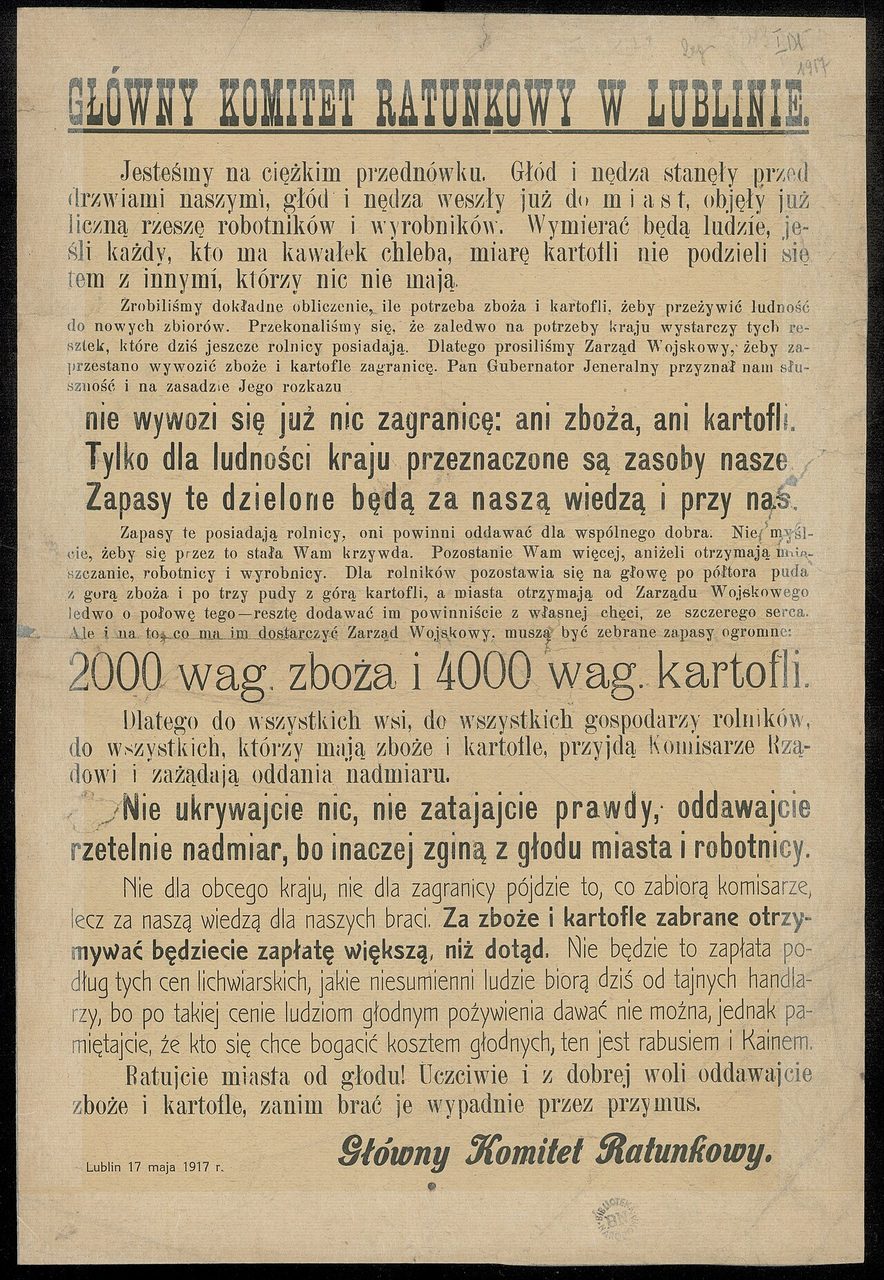
Główny Komitet Ratunkowy w Lublinie, appeal to hand over surplus grain and potatoes, 17 May 1917
A dense Polish-language text poster, with the demand in bold: 'nothing is exported abroad', grain and potatoes are to be handed over. The tells are the stated stakes ('people will die', the cities 'will perish of hunger') and the closing label for anyone who enriches himself at the cost of the hungry: 'robber and Cain'.
- Date
- May 17, 1917
- Period
- First World War
- Made by
- Główny Komitet Ratunkowy w Lublinie (Main Relief Committee, Lublin), under the Austro-Hungarian military administration
- Country
- Austria Hungary
- Medium
- Poster
- Issuer type
- NGO
- Regime
- Austria Hungary
- Leader
- Karl I
- Audience
- Domestic public
- Themes
- Home front, Economy and finance
- Techniques
- Fear appealName-calling
- Source
- Identified Openly sourced: the speaker is who they say they are
- Source
- Wikimedia Commons (from the National Library of Poland, Polona), retrieved October 2, 2026
- Rights
- Public domain (published 1917; anonymous work, Commons PD-anon-70-EU)
Główny Komitet Ratunkowy w Lublinie, 1917, National Library of Poland (Polona), via Wikimedia Commons (public domain).
Text on the object
GŁÓWNY KOMITET RATUNKOWY W LUBLINIE.

Jesteśmy na ciężkim przednówku. Głód i nędza stanęły przed drzwiami naszymi, głód i nędza weszły już do miast, objęły już liczną rzeszę robotników i wyrobników. Wymierać będą ludzie, jeśli każdy, kto ma kawałek chleba, miarę kartofli nie podzieli się tem z innymi, którzy nic nie mają.
Zrobiliśmy dokładne obliczenie, ile potrzeba zboża i kartofli, żeby przeżywić ludność do nowych zbiorów. Przekonaliśmy się, że zaledwo na potrzeby kraju wystarczy tych resztek, które dziś jeszcze rolnicy posiadają. Dlatego prosiliśmy Zarząd Wojskowy, żeby zaprzestano wywozić zboże i kartofle zagranicę. Pan Gubernator Jeneralny przyznał nam słuszność i na zasadzie Jego rozkazu
nie wywozi się już nic zagranicę: ani zboża, ani kartofli.
Tylko dla ludności kraju przeznaczone są zasoby nasze.
Zapasy te dzielone będą za naszą wiedzą i przy nas.
Zapasy te posiadają rolnicy, oni powinni oddawać dla wspólnego dobra. Nie myślcie, żeby się przez to stała Wam krzywda. Pozostanie Wam więcej, aniżeli otrzymają mieszczanie, robotnicy i wyrobnicy. Dla rolników pozostawia się na głowę po półtora puda z górą zboża i po trzy pudy z górą kartofli, a miasta otrzymają od Zarządu Wojskowego ledwo o połowę tego—resztę dodawać im powinniście z własnej chęci, ze szczerego serca. Ale i na to, co ma im dostarczyć Zarząd Wojskowy, muszą być zebrane zapasy ogromne:
2000 wag. zboża i 4000 wag. kartofli.
Dlatego do wszystkich wsi, do wszystkich gospodarzy rolników, do wszystkich, którzy mają zboże i kartofle, przyjdą Komisarze Rządowi i zażądają oddania nadmiaru.
Nie ukrywajcie nic, nie zatajajcie prawdy, oddawajcie rzetelnie nadmiar, bo inaczej zginą z głodu miasta i robotnicy.
Nie dla obcego kraju, nie dla zagranicy pójdzie to, co zabiorą komisarze, lecz za naszą wiedzą dla naszych braci. Za zboże i kartofle zabrane otrzymywać będziecie zapłatę większą, niż dotąd. Nie będzie to zapłata podług tych cen lichwiarskich, jakie niesumiennie ludzie biorą dziś od tajnych handlarzy, bo po takiej cenie ludziom głodnym pożywienia dawać nie można, jednak pamiętajcie, że kto się chce bogacić kosztem głodnych, ten jest rabusiem i Kainem.
Ratujcie miasta od głodu! Uczciwie i z dobrej woli oddawajcie zboże i kartofle, zanim brać je wypadnie przez przymus.

Lublin 17 maja 1917 r.
Główny Komitet Ratunkowy.
MAIN RELIEF COMMITTEE IN LUBLIN.

We are in a hard pre-harvest hunger season. Hunger and misery have stood before our doors, hunger and misery have already entered the towns and seized a great mass of workers and day-labourers. People will die out if everyone who has a piece of bread or a measure of potatoes does not share it with others who have nothing.
We have made an exact calculation of how much grain and potatoes are needed to feed the population until the new harvest. We have convinced ourselves that the remnants the farmers still hold today barely suffice for the needs of the country. Therefore we asked the Military Administration to stop the export of grain and potatoes abroad. The Governor-General acknowledged that we were right and, on the basis of His order,
nothing is any longer exported abroad: neither grain nor potatoes.
Our stocks are intended only for the population of the country.
These stocks will be divided with our knowledge and in our presence.
These stocks are held by the farmers, they should give them up for the common good. Do not think that wrong will thereby be done to you. More will remain to you than townspeople, workers and day-labourers will receive. For farmers there is left, per head, one and a half poods and more of grain and three poods and more of potatoes, while the towns will receive from the Military Administration barely half of that—the rest you should add for them of your own wish, from a sincere heart. But even for what the Military Administration is to supply to them, enormous stocks must be collected:
2000 wagon-loads of grain and 4000 wagon-loads of potatoes.
Therefore to all villages, to all farmers, to all who have grain and potatoes, Government Commissioners will come and demand the surrender of the surplus.
Hide nothing, conceal not the truth, hand over the surplus honestly, for otherwise the towns and the workers will perish of hunger.
Not for a foreign country, not for abroad will go what the commissioners take, but with our knowledge for our brothers. For the grain and potatoes taken you will receive payment greater than until now. It will not be payment at those usurious prices that people unscrupulously take today from secret traders, because at such a price food cannot be given to hungry people, but remember that whoever wants to enrich himself at the cost of the hungry is a robber and a Cain.
Save the towns from hunger! Honestly and of good will hand over grain and potatoes, before it falls to be taken by compulsion.

Lublin, 17 May 1917.
Main Relief Committee.
A handwritten library notation at the top margin and a library stamp at the lower right are not transcribed. 'wag.' is rendered 'wagon-loads' as the abbreviation of 'wagon' (an assumption); 'pud' is the Russian unit of about 16 kg. Translation is a machine translation by Claude, not verified by a fluent reader.