Safe handling of gasoline supplies
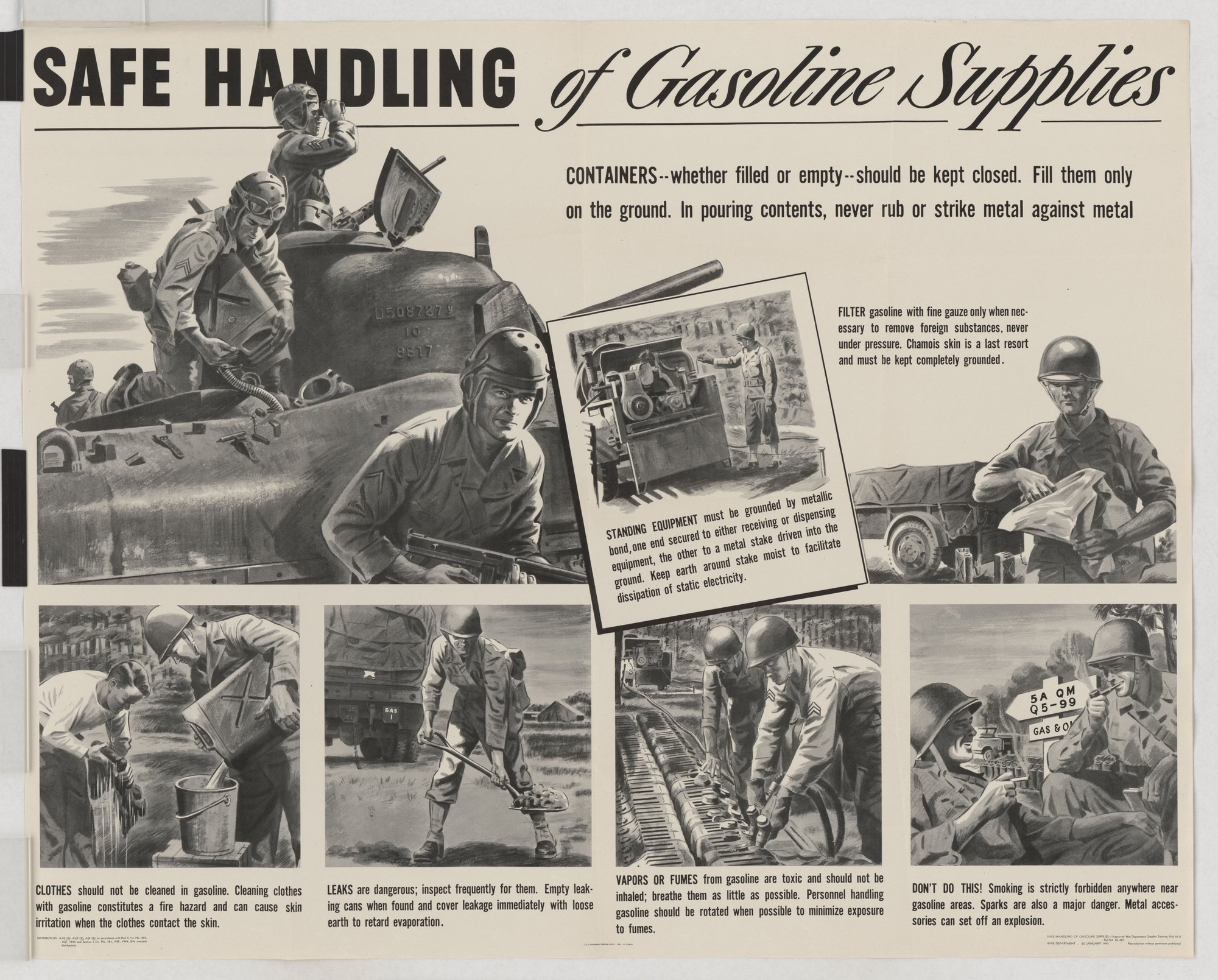
Army training sheet: a large tank-crew scene and six smaller panels show soldiers pouring from fuel cans, grounding equipment, filtering fuel, cleaning clothes in gasoline, shovelling earth on a leak and smoking near fuel, each with a rule beside it. It is instructional; the technique is faint, a mild fear-appeal in the 'Don't do this!' panel.
Propaganda techniques used in this poster
- Date
- 1945
- Period
- Second World War
- Made by
- War Department (Graphic Training Aid 10-8)
- Region
- North America
- Country
- United States
- Medium
- Poster
- Issuer type
- Military
- Regime
- Roosevelt Administration
- Leader
- Franklin D. Roosevelt
- Audience
- Own forces
- Purpose
- Warn or inform
- Themes
- War and the military, Science and technology
- Event
- World War II
- Regime
- Roosevelt administration
- Leader
- Franklin D. Roosevelt
- Source
- Identified Openly sourced: the speaker is who they say they are
- Source
- U.S. National Archives and Records Administration, Record Group 44, World War II Posters, retrieved October 4, 2026
- Rights
- Public domain (U.S. government work)
War Department. National Archives and Records Administration, RG 44, 44-PA-1658 (NAID 515325).
Text on the object
SAFE HANDLING of Gasoline Supplies
CONTAINERS--whether filled or empty--should be kept closed. Fill them only on the ground. In pouring contents, never rub or strike metal against metal
FILTER gasoline with fine gauze only when necessary to remove foreign substances, never under pressure. Chamois skin is a last resort and must be kept completely grounded.
STANDING EQUIPMENT must be grounded by metallic bond, one end secured to either receiving or dispensing equipment, the other to a metal stake driven into the ground. Keep earth around stake moist to facilitate dissipation of static electricity.
CLOTHES should not be cleaned in gasoline. Cleaning clothes with gasoline constitutes a fire hazard and can cause skin irritation when the clothes contact the skin.
LEAKS are dangerous; inspect frequently for them. Empty leaking cans when found and cover leakage immediately with loose earth to retard evaporation.
VAPORS OR FUMES from gasoline are toxic and should not be inhaled; breathe them as little as possible. Personnel handling gasoline should be rotated when possible to minimize exposure to fumes.
DON'T DO THIS! Smoking is strictly forbidden anywhere near gasoline areas. Sparks are also a major danger. Metal accessories can set off an explosion.
[on signpost in picture: 5A QM Q5-99 / GAS & OIL]
[on tank: D5087879 / 10 / 8817]
DISTRIBUTION: AAF (1), AGF (1), ASF (1), in accordance with Part II, Cir. No. 422, ASF, 1944 and Section I, Cir. No. 181, ASF, 1944. (No oversea distribution).
[imprint: U.S. Government Printing Office 1945, remainder illegible]
SAFE HANDLING OF GASOLINE SUPPLIES—Approved War Department Graphic Training Aid 10-8
Ref FM 10-465
WAR DEPARTMENT . 22 JANUARY 1945
Reproduction without permission prohibited