Content note: News broadside describing a gun battle with deaths and a woodcut of the fight. This object is shown as it was published. Why
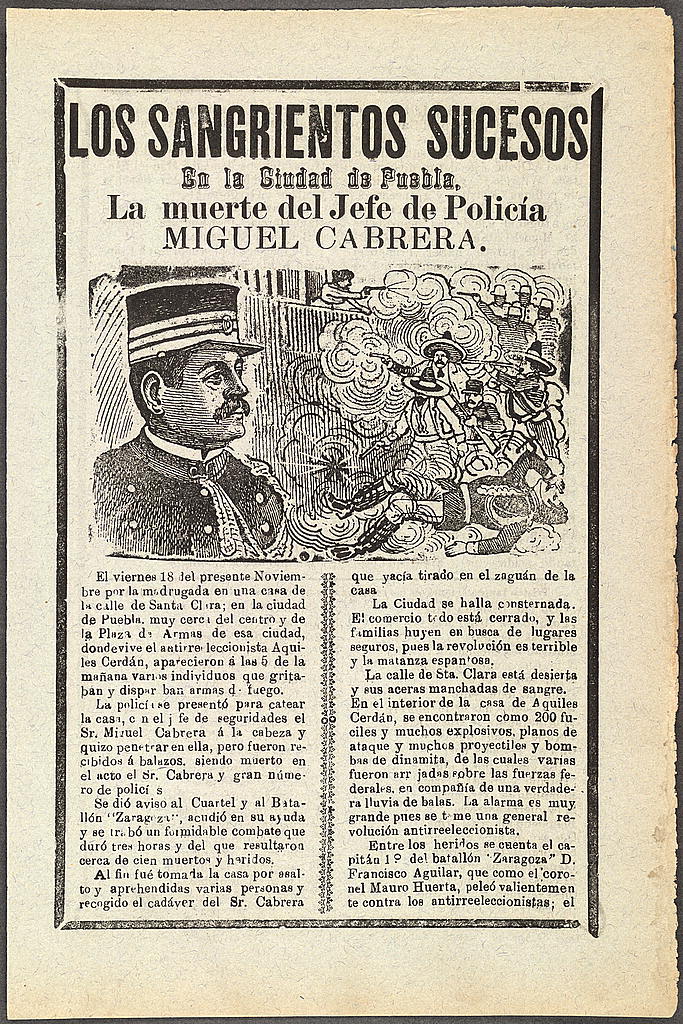
Los sangrientos sucesos en la ciudad de Puebla: la muerte del Jefe de Policía Miguel Cabrera (The Bloody Events in the City of Puebla: The Death of Police Chief Miguel Cabrera)
A news broadside headed by a bust of the slain police chief beside a woodcut of a gun battle in smoke. Its account of the 18 November 1910 fight at the Serdán house is told from the police and army side: officers 'received with gunfire', a city 'dismayed', families fleeing, streets 'stained with blood', dynamite and 200 rifles found, and the closing alarm that a 'general anti-re-electionist revolution' is feared. The tells are the catastrophe wording and the single frame of a terrible revolution.
- Date
- November 1910
- Period
- Pre-1914
- Made by
- Antonio Vanegas Arroyo (Firm), commercial broadside printer, Mexico City
- Region
- Latin America
- Country
- Mexico
- Medium
- Issuer type
- Corporation
- Regime
- Diaz Government
- Leader
- Porfirio Diaz
- Audience
- Domestic public
- Purpose
- Warn or inform
- Event
- Mexican Revolution
- Techniques
- Fear appeal
- Source
- Identified Openly sourced: the speaker is who they say they are
- Source
- Library of Congress, retrieved October 2, 2026
- Rights
- Public domain (published 1910, before 1931; LoC: No known restrictions on reproduction in the U.S.)
Library of Congress Prints and Photographs Division, Washington, D.C. 20540 USA, PGA - Vanegas, no. 49 (LC-DIG-ppmsc-04479)
Text on the object
LOS SANGRIENTOS SUCESOS
En la Ciudad de Puebla,
La muerte del Jefe de Policía
MIGUEL CABRERA.

El viernes 18 del presente Noviembre por la madrugada en una casa de la calle de Santa Clara; en la ciudad de Puebla, muy cerca del centro y de la Plaza de Armas de esa ciudad, dondevive el antirreleccionista Aquiles Cerdán, aparecieron á las 5 de la mañana varios individuos que gritaban y disparaban armas de fuego.
La policía se presentó para catear la casa, con el jefe de seguridades el Sr. Miguel Cabrera á la cabeza y quizo penetrar en ella, pero fueron recibidos á balazos, siendo muerto en el acto el Sr. Cabrera y gran número de policías
Se dió aviso al Cuartel y al Batallón "Zaragoza", acudió en su ayuda y se trabó un formidable combate que duró tres horas y del que resultaron cerca de cien muertos y heridos.
Al fin fué tomada la casa por asalto y aprehendidas varias personas y recogido el cadáver del Sr. Cabrera que yacía tirado en el zaguán de la casa
La Ciudad se halla consternada. El comercio todo está cerrado, y las familias huyen en busca de lugares seguros, pues la revolución es terrible y la matanza espantosa.
La calle de Sta. Clara está desierta y sus aceras manchadas de sangre.
En el interior de la casa de Aquiles Cerdán, se encontraron como 200 fusiles y muchos explosivos, planos de ataque y muchos proyectiles y bombas de dinamita, de las cuales varias fueron arrojadas sobre las fuerzas federales, en compañía de una verdadera lluvia de balas. La alarma es muy grande pues se teme una general revolución antirreeleccionista.
Entre los heridos se cuenta el capitán 1º del batallón "Zaragoza" D. Francisco Aguilar, que como el coronel Mauro Huerta, peleó valientemente contra los antirreeleccionistas; el
[text continues on the verso, not hosted]
THE BLOODY EVENTS
In the City of Puebla,
The death of the Chief of Police
MIGUEL CABRERA.

On Friday the 18th of the present November, at dawn, in a house on Santa Clara street, in the city of Puebla, very near the centre and the Plaza de Armas of that city, where the anti-re-electionist Aquiles Cerdán lives, there appeared at 5 in the morning several individuals who shouted and fired firearms.
The police came to search the house, with the chief of security, Mr. Miguel Cabrera, at the head, and wanted to enter it, but were received with gunfire, Mr. Cabrera and a large number of policemen being killed on the spot
Notice was given to the Barracks and the "Zaragoza" Battalion came to its aid and a formidable combat was joined that lasted three hours and from which there resulted nearly a hundred dead and wounded.
At last the house was taken by assault and several persons seized and the body of Mr. Cabrera picked up, which lay thrown in the entrance hall of the house
The City is dismayed. All commerce is closed, and families flee in search of safe places, since the revolution is terrible and the slaughter dreadful.
Santa Clara street is deserted and its pavements stained with blood.
In the interior of the house of Aquiles Cerdán there were found about 200 rifles and many explosives, plans of attack and many projectiles and dynamite bombs, of which several were thrown upon the federal forces, together with a veritable rain of bullets. The alarm is very great, since a general anti-re-electionist revolution is feared.
Among the wounded is counted the first captain of the "Zaragoza" battalion Mr. Francisco Aguilar, who like Colonel Mauro Huerta fought valiantly against the anti-re-electionists; the
[text continues on the verso, not hosted]
Recto only, read from enlarged crops of the LoC scan, left column then right. The text breaks off at the foot of the right column ('el') and continues on the verso, which is not hosted. A few letters are worn in the scan; the readings follow the evident words. Spelling and accents are as printed, including 'Cerdán', 'quizo' and 'dondevive'. The translation is a literal gloss by Claude, not checked by a fluent reader.