Content note: Official Japanese imperial text on the 1910 annexation of Korea, printed in Korean translation; shown as issued. This object is shown as it was published. Why
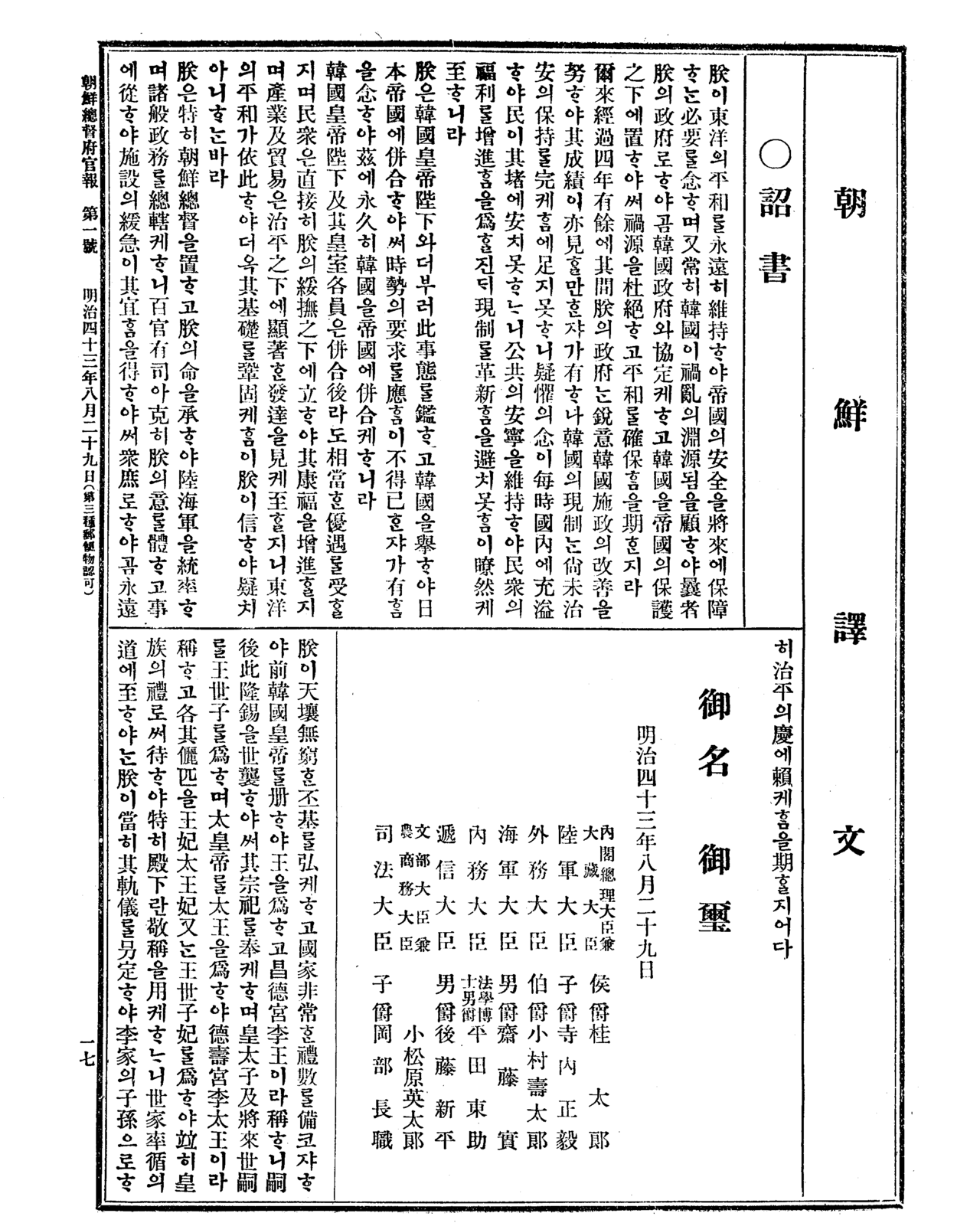
詔書 (Imperial Rescript on the Annexation of Korea), Korean translation, Official Gazette of the Government-General of Korea no. 1, p. 17
Page 17 of the first Official Gazette of the Government-General of Korea prints, in Korean translation, the Emperor Meiji's rescript of 29 August 1910 on Korea's incorporation into the Japanese Empire. The text grounds the act in 'the peace of the East' and 'the welfare of the people' and names it 倂合 ('joining, merging') throughout; those phrases are the tell.
- Date
- August 29, 1910
- Period
- Pre-1914
- Made by
- Government of Japan (Emperor Meiji's rescript, countersigned by the cabinet), printed in the Official Gazette of the Government-General of Korea
- Region
- East Asia
- Country
- Empire of Japan
- Medium
- Document
- Issuer type
- State
- Regime
- Meiji Japan
- Leader
- Katsura Taro
- Audience
- Domestic public
- Purpose
- Persuade or win support
- Theme
- Empire and colonialism
- Event
- Japan Korea Annexation
- Techniques
- Glittering generalitiesEuphemism / doublespeak
- Source
- Identified Openly sourced: the speaker is who they say they are
- Source
- Wikimedia Commons (Official Gazette of the Government-General of Korea, August 29, 1910, p. 17), retrieved September 29, 2026
- Rights
- Public domain (1910 official gazette; Commons tag PD-Japan; published before 1931)
Government-General of Korea, Official Gazette no. 1, 29 August 1910; via Wikimedia Commons
Text on the object
[header, left margin] 朝鮮總督府官報 第一號 明治四十三年八月二十九日(第三種郵便物認可)
[header, right margin] 朝鮮譯文
[page number, foot] 一七

○詔書

朕이東洋의平和를永遠히維持ᄒᆞ야帝國의安全을將來에保障ᄒᆞ는必要를念ᄒᆞ며又常히韓國이禍亂의淵源됨을顧ᄒᆞ야曩者朕의政府로ᄒᆞ야곰韓國政府와協定케ᄒᆞ고韓國을帝國의保護之下에置ᄒᆞ야써禍源을杜絶ᄒᆞ고平和를確保ᄒᆞᆷ을期ᄒᆞᆫ지라爾來經過四年有餘에其間朕의政府는銳意韓國施政의改善을努ᄒᆞ야其成績이亦見ᄒᆞᆯ만ᄒᆞ자가有ᄒᆞ나韓國의現制는尙未治安의保持를完케ᄒᆞᆷ에足지못ᄒᆞ니疑懼의念이每時國內에充溢ᄒᆞ야民이其堵에安치못ᄒᆞ는니公共의安寧을維持ᄒᆞ야民衆의福利를增進ᄒᆞᆷ을爲ᄒᆞᆯ진디現制를革新ᄒᆞᆷ을避치못ᄒᆞᆷ이瞭然케至ᄒᆞ니라

朕은韓國皇帝陛下와더부러此事態를鑑ᄒᆞ고韓國을擧ᄒᆞ야日本帝國에倂合ᄒᆞ야써時勢의要求를應ᄒᆞᆷ이不得已ᄒᆞᆫ자가有ᄒᆞᆷ을念ᄒᆞ야玆에永久히韓國을帝國에倂合케ᄒᆞ니라韓國皇帝陛下及其皇室各員은倂合後라도相當ᄒᆞᆫ優遇를受ᄒᆞᆯ지며民衆은直接히朕의綏撫之下에立ᄒᆞ야其康福을增進ᄒᆞᆯ지며産業及貿易은治平之下에顯著ᄒᆞᆫ發達을見케至ᄒᆞᆯ지니東洋의平和가依此ᄒᆞ야더옥其基礎를鞏固케ᄒᆞᆷ이朕이信ᄒᆞ야疑치아니ᄒᆞ는바라

朕은特히朝鮮總督을置ᄒᆞ고朕의命을承ᄒᆞ야陸海軍을統率ᄒᆞ며諸般政務를總轄케ᄒᆞ니百官有司아克히朕의意를體ᄒᆞ고事에從ᄒᆞ야施設의緩急이其宜ᄒᆞᆷ을得ᄒᆞ야써衆庶로ᄒᆞ야곰永遠히治平의慶에賴케ᄒᆞᆷ을期ᄒᆞᆯ지어다

御名御璽

明治四十三年八月二十九日

內閣總理大臣兼大藏大臣 侯爵 桂太郞
陸軍大臣 子爵 寺內正毅
外務大臣 伯爵 小村壽太郞
海軍大臣 男爵 齊藤實
內務大臣 法學博士男爵 平田東助
遞信大臣 男爵 後藤新平
文部大臣兼農商務大臣 小松原英太郞
司法大臣 子爵 岡部長職

[second block, lower left; continues on the next page] 朕이天壤無窮ᄒᆞᆫ丕基를弘케ᄒᆞ고國家非常ᄒᆞᆫ禮數를備코자ᄒᆞ야前韓國皇帝를冊ᄒᆞ야王을爲ᄒᆞ고昌德宮李王이라稱ᄒᆞ니嗣後此隆錫을世襲ᄒᆞ야써其宗祀를奉케ᄒᆞ며皇太子及將來世嗣를王世子를爲ᄒᆞ며太皇帝를太王을爲ᄒᆞ야德壽宮李太王이라稱ᄒᆞ고各其儷匹을王妃太王妃又는王世子妃를爲ᄒᆞ야並히皇族의禮로써待ᄒᆞ야特히殿下란敬稱을用케ᄒᆞ니世家率循의道에至ᄒᆞ야는朕이當히其軌儀를另定ᄒᆞ야李家의子孫으로ᄒᆞ
[header] Official Gazette of the Government-General of Korea, no. 1, Meiji 43 (1910), 29 August (approved as third-class mail)
[header] Korean translation
[page number] 17

Imperial Rescript

We, bearing in mind the necessity of maintaining the peace of the East permanently and securing the safety of the Empire for the future, and considering always that Korea has been the source of trouble and disorder, formerly had Our government conclude an agreement with the Korean government and placed Korea under the protection of the Empire, intending thereby to eliminate the source of trouble and to secure peace. In the more than four years since, Our government has earnestly striven to improve Korea's administration, and results can be seen; yet Korea's present system is still insufficient to ensure the maintenance of public order, feelings of doubt and fear fill the country at all times, and the people cannot settle peacefully in their homes. It is clear that, in order to maintain public tranquillity and promote the people's welfare, reform of the present system cannot be avoided.

We, together with His Majesty the Emperor of Korea, having considered this state of affairs, and reflecting that there is no course but to take the whole of Korea into the Empire of Japan in response to the demands of the times, hereby permanently join Korea to the Empire. His Majesty the Emperor of Korea and the members of his imperial house shall receive appropriate favourable treatment even after the joining; the people, placed directly under Our care, shall increase their well-being; industry and trade shall show remarkable development under peace and order; and We believe without doubt that the peace of the East will thereby be made still firmer.

We especially establish a Governor-General of Korea, who, receiving Our command, shall command the army and navy and supervise all governmental affairs; may all officials fully embody Our will and, following the business at hand, adjust the pace of measures as is fitting, so that the multitude may forever rely on the blessings of peace and order.

Imperial name and seal

Meiji 43rd year, 8th month, 29th day

Prime Minister and Minister of Finance, Marquis Katsura Tarō; Minister of the Army, Viscount Terauchi Masatake; Minister for Foreign Affairs, Count Komura Jutarō; Minister of the Navy, Baron Saitō Makoto; Minister of Home Affairs, Doctor of Law Baron Hirata Tōsuke; Minister of Communications, Baron Gotō Shinpei; Minister of Education and of Agriculture and Commerce, Komatsubara Eitarō; Minister of Justice, Viscount Okabe Nagakage.

[second block, lower left; continues on the next page] We, wishing to enlarge the great foundation that endures as long as heaven and earth and to provide a ceremonial suited to an extraordinary occasion for the state, confer on the former Emperor of Korea the title of King, styled the Yi King of Changdeok Palace, and this honour shall be inherited by his heirs so that they may maintain the ancestral rites; the Crown Prince and future heirs shall be styled 王世子 (Crown Prince of the King's house); the Emperor Emeritus (太皇帝) shall be styled Great King, the Yi Great King of Deoksu Palace; their consorts shall be styled Queen, Queen Dowager or Crown Princess, and shall all be treated with the ceremonial of the imperial family, with the honorific 殿下 (Highness) used especially; as to the rules of these princely houses, We shall Ourselves establish their procedure, so that the descendants of the Yi house ...
Printed in the 1910 mixed script with the archaic letter arae-a (ᆞ), written here as ᄒᆞ for the verb stem; a few particles may differ from the print. Columns run right to left; the right-hand block ends at 期ᄒᆞᆯ지어다 and is followed by the seal formula and signatures. The rescript's own Japanese wording is not reproduced.