Content note: The ethnic slur "kolbasnik" for Germans. This object is shown as it was published. Why
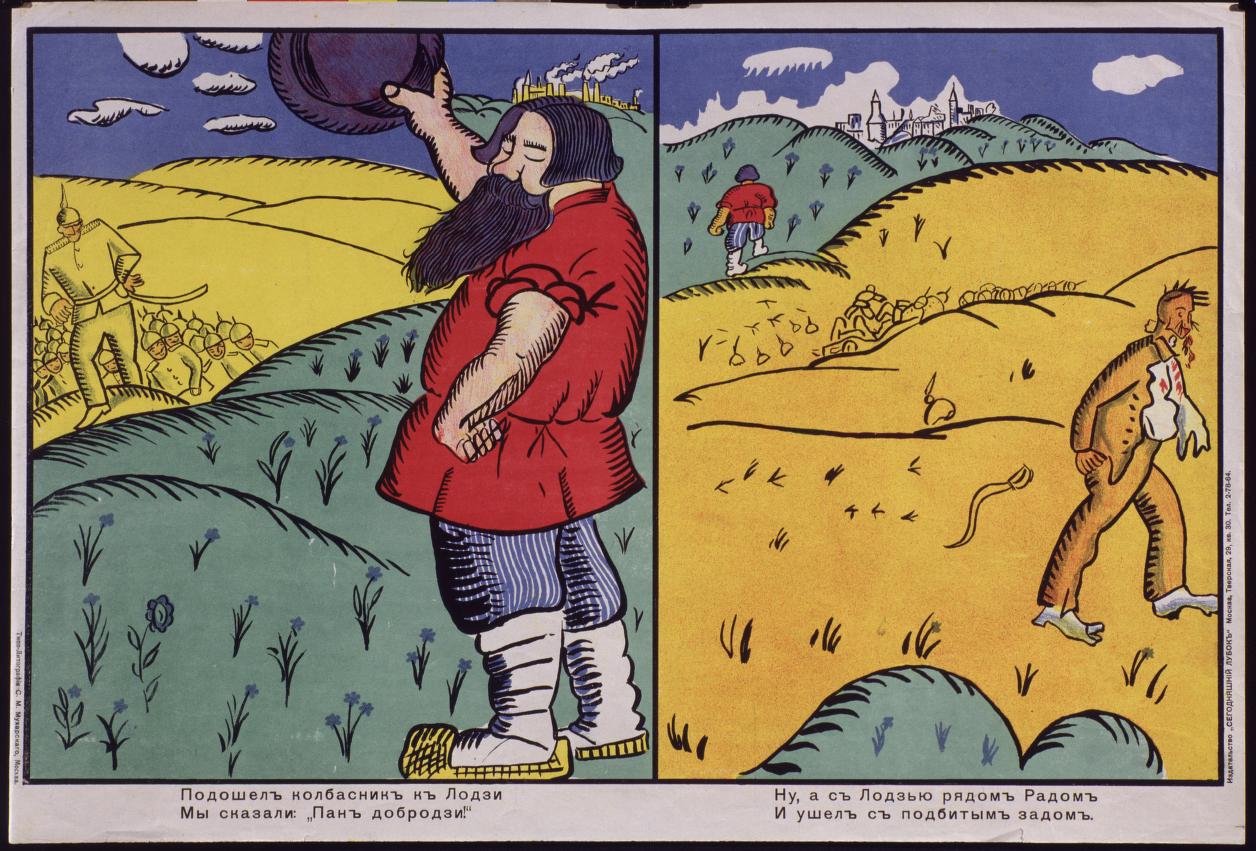
Подошёл колбасник к Лодзи (A Sausage-Maker Came to Łódź)
In two panels a giant Russian peasant in bast shoes doffs his cap to Kaiser Wilhelm II and his army, then strolls off while the Kaiser limps away in rags. Mayakovsky's verse calls the Kaiser a 'kolbasnik' (sausage-maker), a Russian slur for Germans, and says he left Radom 'with a bruised backside'. The ethnic label and the joke replace any account of the fighting.
- Date
- 1914
- Period
- First World War
- Made by
- Segodniashnii Lubok publishers, Moscow; Kazimir Malevich (image), Vladimir Mayakovsky (verse)
- Region
- Eastern Europe and Eurasia
- Country
- Russian Empire
- Medium
- Issuer type
- Media
- Regime
- Russian Empire
- Leader
- Nicholas II
- Audience
- Domestic public
- Purpose
- Reassure
- Themes
- War and the military, Home front
- Event
- World War I
- Techniques
- Name-calling
- Source
- Identified Openly sourced: the speaker is who they say they are
- Source
- Library of Congress, retrieved September 27, 2026
- Rights
- Public domain in the U.S. (published before 1931)
Malevich, Kazimir Severinovich, 1878-1935 Artist.; Mayakovsky, Vladimir, 1893-1930 Author in Quotations or Text Extracts.. 1914. Library of Congress.
Text on the object
Подошелъ колбасникъ къ Лодзи
Мы сказали: „Панъ добродзи!"

Ну, а съ Лодзью рядомъ Радомъ
И ушелъ съ подбитымъ задомъ.

Типо-Литография С. М. Мухарского, Москва.

Издательство „СЕГОДНЯШНIЙ ЛУБОКЪ" Москва, Тверская, 29, кв. 30. Тел. 2-78-64.
The sausage-maker came up to Łódź,
We said: "Good day, sir!"

Well, and next to Łódź is Radom,
And he left with a battered backside.

S. M. Mukharsky Type-Lithography, Moscow.

Publishing house "Today's Lubok", Moscow, Tverskaya, 29, apt. 30. Tel. 2-78-64.
The two-line verse under each panel is printed in pre-1918 Russian orthography (with the hard-sign ъ). The publisher's and printer's imprints run vertically in tiny type along the left and right margins; read at high zoom, both are legible. The phone number's last two digits are the least certain character in that fine print.