Content note: Derisive caricature of Mao Zedong as a footstool for a Stalin figure. This object is shown as it was published. Why
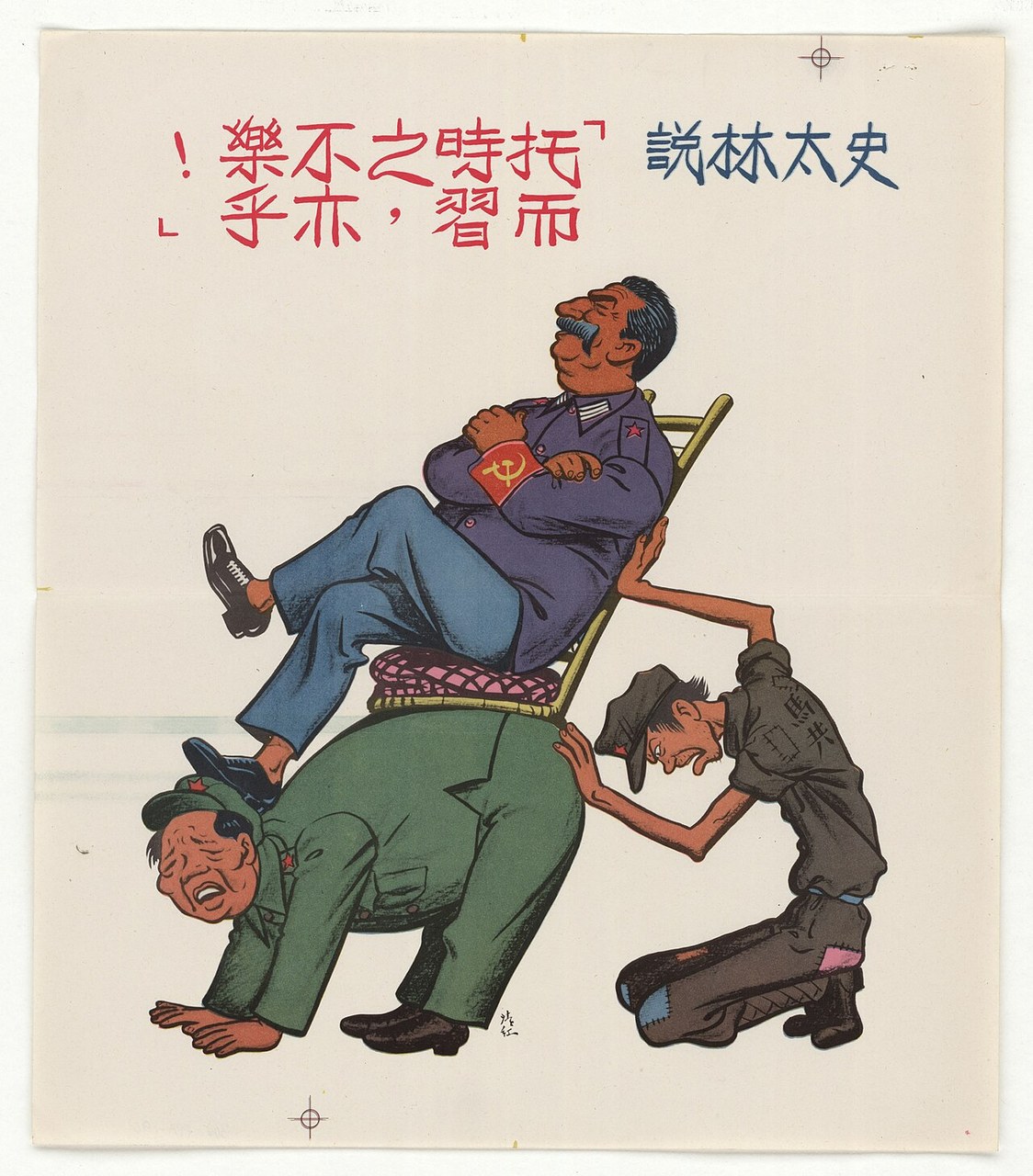
史太林說「學而時習之,不亦樂乎!」 (Stalin Says: "To Study and Practise in Due Time, Is That Not a Pleasure?"), U.S. cartoon poster
A Chinese-language cartoon headed 'Stalin says'. A Soviet-uniformed figure with a red-star collar tab and hammer-and-sickle armband lounges in a chair whose seat is the back of a bent, grimacing Mao figure in a green uniform, while a gaunt patched peasant in a cap props the chair from behind. Over it runs the Confucian line 'To study and practise in due time, is that not a pleasure?'. The loaded picture (leader as footstool, people as prop) and the borrowed saying do the labelling in place of any argument (name-calling).
Propaganda techniques used in this poster
- Date
- September 5, 1952
- Period
- Cold War
- Made by
- U.S. Department of State, International Information and Educational Exchange Program (records later held by the U.S. Information Agency)
Full record
Region, Country, Medium, Issuer type, Regime, Leader, Audience, Purpose, Theme, Event, Source, Rights
- Region
- North America
- Country
- United States
- Medium
- Poster
- Issuer type
- State
- Regime
- Truman Administration
- Leader
- Harry S. Truman
- Audience
- Foreign public
- Purpose
- Demonize
- Theme
- Elections and party politics
- Event
- Cold War
- Source
- Unidentified Source blurred: contractors, cutouts, buried disclosure
- Source
- Wikimedia Commons (from U.S. National Archives, RG 306, NAID 5730089), retrieved October 2, 2026
- Rights
- Public domain (U.S. government work; Commons PD-USGov, NARA RG 306)
U.S. Department of State / U.S. Information Agency, 1952. National Archives, Record Group 306 (NAID 5730089, 306-PPA-190).
Text on the object
Original (Chinese (traditional characters)) · read from the image, not independently checked
史太林說
「學而時習之,不亦樂乎!」
共
Stalin says
"To study and at due times practise it, is that not a pleasure?"
[Gong] ('Communist'/'together')
The saying is lettered in two rows read in columns, right to left, top to bottom. One or two glyphs on the peasant's patched shirt are read only as 共 and the rest is illegible; a small artist's mark near the central figure's shoe is illegible. Translation by Claude, not verified by a fluent reader.