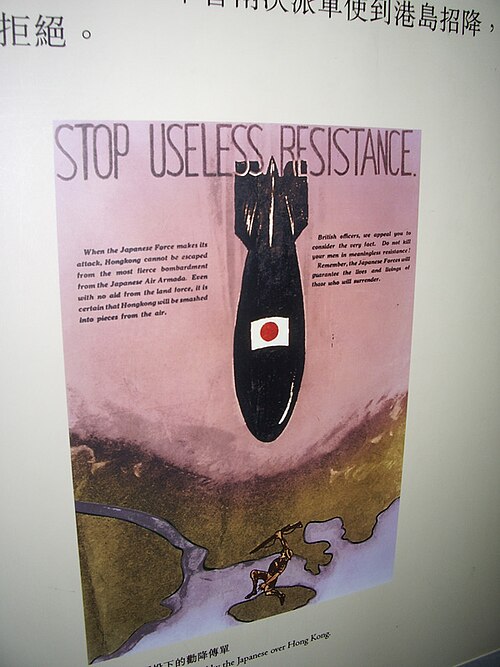
'Stop useless resistance' (Japanese leaflet to the Hong Kong garrison)
A pink-toned English-language leaflet headed 'STOP USELESS RESISTANCE.' A black bomb marked with the Japanese sun disc falls toward a map of Hong Kong island and the coast, where a tiny figure stands on the island. Two text blocks warn of bombardment from the air, then appeal to British officers to spare their men and promise that surrendering troops will be guaranteed their lives and livings. The tell is the staged annihilation paired with one prescribed way out.
- Date
- 1941
- Period
- Second World War
- Made by
- Imperial Japanese forces (as attributed in the Hong Kong Museum of History display)
- Region
- East Asia
- Country
- Empire of Japan
- Medium
- Leaflet
- Issuer type
- Military
- Regime
- Showa Japan
- Leader
- Hideki Tojo
- Audience
- Enemy forces
- Purpose
- Mobilize or secure compliance
- Theme
- War and the military
- Event
- World War II
- Techniques
- Fear appeal
- Regime
- Empire of Japan, 1937 to 1945
- Leader
- Hideki Tōjō
- Source
- Identified Openly sourced: the speaker is who they say they are
- Source
- Wikimedia Commons (photograph from Flickr, Hong Kong Museum of History display), retrieved September 29, 2026
- Rights
- CC BY-SA 2.0 (photograph by InSapphoWeTrust on Commons; 1941 wartime leaflet)
Photo: InSapphoWeTrust (Los Angeles), CC BY-SA 2.0, via Wikimedia Commons; display at the Hong Kong Museum of History.
Text on the object
STOP USELESS RESISTANCE.

When the Japanese Force makes its attack, Hongkong cannot be escaped from the most fierce bombardment from the Japanese Air Armado. Even with no aid from the land force, it is certain that Hongkong will be smashed into pieces from the air.

British officers, we appeal you to consider the very fact. Do not kill your men in meaningless resistance ! Remember, the Japanese Forces will guarantee the lives and livings of those who will surrender.

[museum display caption text, partly cropped at top and bottom edges of the photograph, not part of the leaflet]
.jpg)