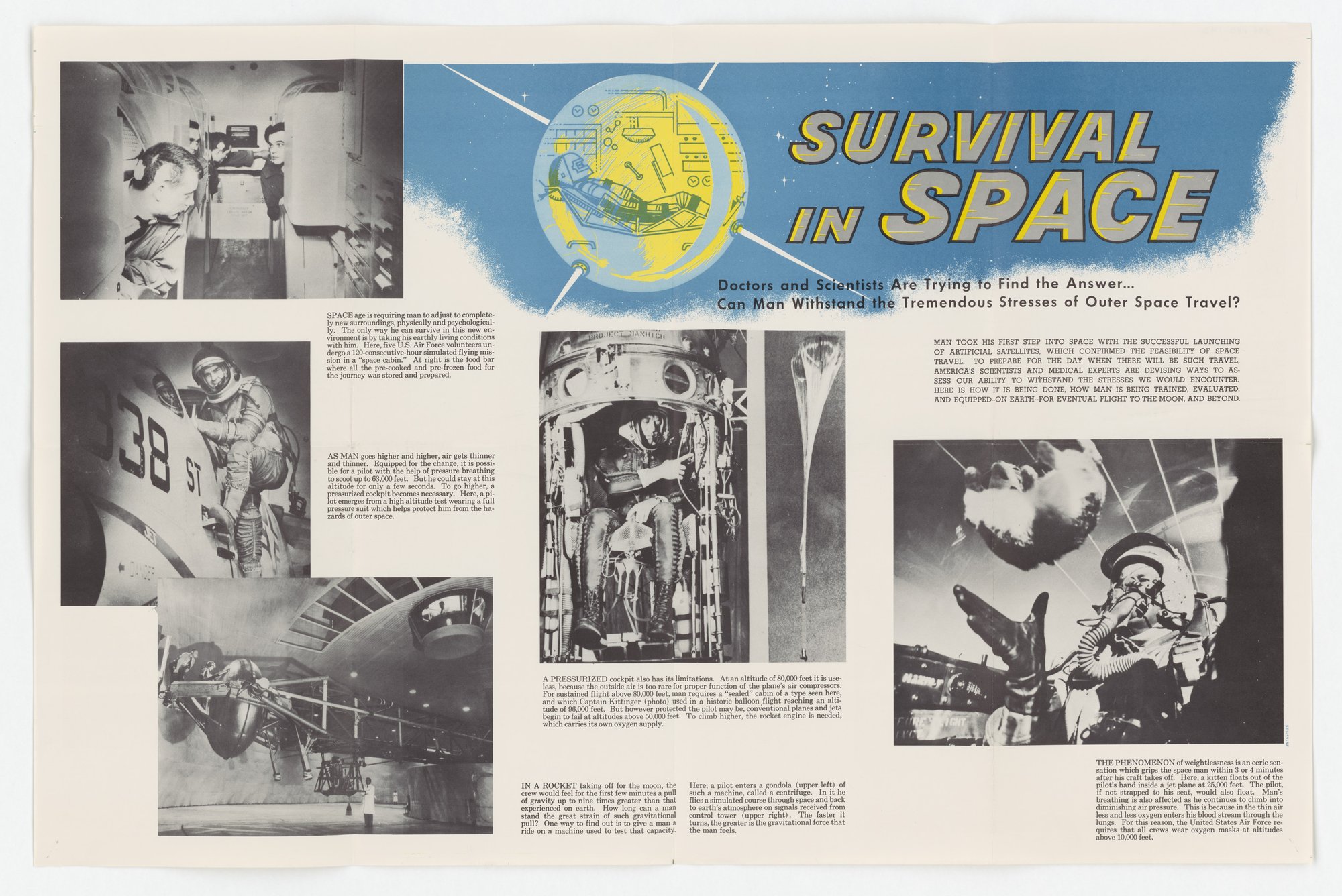
Survival in Space poster, English edition (English poster distributed in Asia)
A two-page photo spread in English on United States research into human survival in space. Photographs show Air Force volunteers in a simulated 'space cabin', a pressure suit, a sealed balloon capsule, a centrifuge and a kitten floating in weightlessness. The text says American scientists are preparing for spaceflight. The tell is transfer: the prestige of science and of the Air Force programme is attached to the United States.
Propaganda techniques used in this poster
- Date
- October 30, 1958
- Period
- Cold War
- Made by
- U.S. Information Agency (predecessor: State Department International Information and Educational Exchange Program), Propaganda Posters Distributed in Asia, Latin America and the Middle East series
- Region
- North America
- Country
- United States
- Medium
- Poster
- Issuer type
- State
- Regime
- Eisenhower Administration
- Leader
- Dwight D. Eisenhower
- Audience
- Foreign public
- Purpose
- Warn or inform
- Themes
- Science and technology, War and the military
- Event
- Cold War
- Source
- Unidentified Source blurred: contractors, cutouts, buried disclosure
- Source
- U.S. National Archives (NARA), Record Group 306, Posters in Asia, Latin America, Middle East, retrieved October 4, 2026
- Rights
- Public domain (U.S. government work; NARA RG 306)
U.S. Information Agency / Department of State, October 30, 1958. National Archives, Record Group 306 (NAID 6949103, 306-PPB-196).
Text on the object
SURVIVAL IN SPACE
Doctors and Scientists Are Trying to Find the Answer... Can Man Withstand the Tremendous Stresses of Outer Space Travel?
MAN TOOK HIS FIRST STEP INTO SPACE WITH THE SUCCESSFUL LAUNCHING OF ARTIFICIAL SATELLITES, WHICH CONFIRMED THE FEASIBILITY OF SPACE TRAVEL. TO PREPARE FOR THE DAY WHEN THERE WILL BE SUCH TRAVEL, AMERICA'S SCIENTISTS AND MEDICAL EXPERTS ARE DEVISING WAYS TO ASSESS OUR ABILITY TO WITHSTAND THE STRESSES WE WOULD ENCOUNTER. HERE IS HOW IT IS BEING DONE, HOW MAN IS BEING TRAINED, EVALUATED, AND EQUIPPED--ON EARTH--FOR EVENTUAL FLIGHT TO THE MOON, AND BEYOND.
SPACE age is requiring man to adjust to completely new surroundings, physically and psychologically. The only way he can survive in this new environment is by taking his earthly living conditions with him. Here, five U.S. Air Force volunteers undergo a 120-consecutive-hour simulated flying mission in a "space cabin." At right is the food bar where all the pre-cooked and pre-frozen food for the journey was stored and prepared.
AS MAN goes higher and higher, air gets thinner and thinner. Equipped for the change, it is possible for a pilot with the help of pressure breathing to scoot up to 63,000 feet. But he could stay at this altitude for only a few seconds. To go higher, a pressurized cockpit becomes necessary. Here, a pilot emerges from a high altitude test wearing a full pressure suit which helps protect him from the hazards of outer space.
A PRESSURIZED cockpit also has its limitations. At an altitude of 80,000 feet it is useless, because the outside air is too rare for proper function of the plane's air compressors. For sustained flight above 80,000 feet, man requires a "sealed" cabin of a type seen here, and which Captain Kittinger (photo) used in a historic balloon flight reaching an altitude of 96,000 feet. But however protected the pilot may be, conventional planes and jets begin to fail at altitudes above 50,000 feet. To climb higher, the rocket engine is needed, which carries its own oxygen supply.
IN A ROCKET taking off for the moon, the crew would feel for the first few minutes a pull of gravity up to nine times greater than that experienced on earth. How long can a man stand the great strain of such gravitational pull? One way to find out is to give a man a ride on a machine used to test that capacity.
Here, a pilot enters a gondola (upper left) of such a machine, called a centrifuge. In it he flies a simulated course through space and back to earth's atmosphere on signals received from control tower (upper right). The faster it turns, the greater is the gravitational force that the man feels.
THE PHENOMENON of weightlessness is an eerie sensation which grips the space man within 3 or 4 minutes after his craft takes off. Here, a kitten floats out of the pilot's hand inside a jet plane at 25,000 feet. The pilot, if not strapped to his seat, would also float. Man's breathing is also affected as he continues to climb into diminishing air pressure. This is because in the thin air less and less oxygen enters his blood stream through the lungs. For this reason, the United States Air Force requires that all crews wear oxygen masks at altitudes above 10,000 feet.
Photograph labels (for example PROJECT MANHIGH on the capsule) are not transcribed.