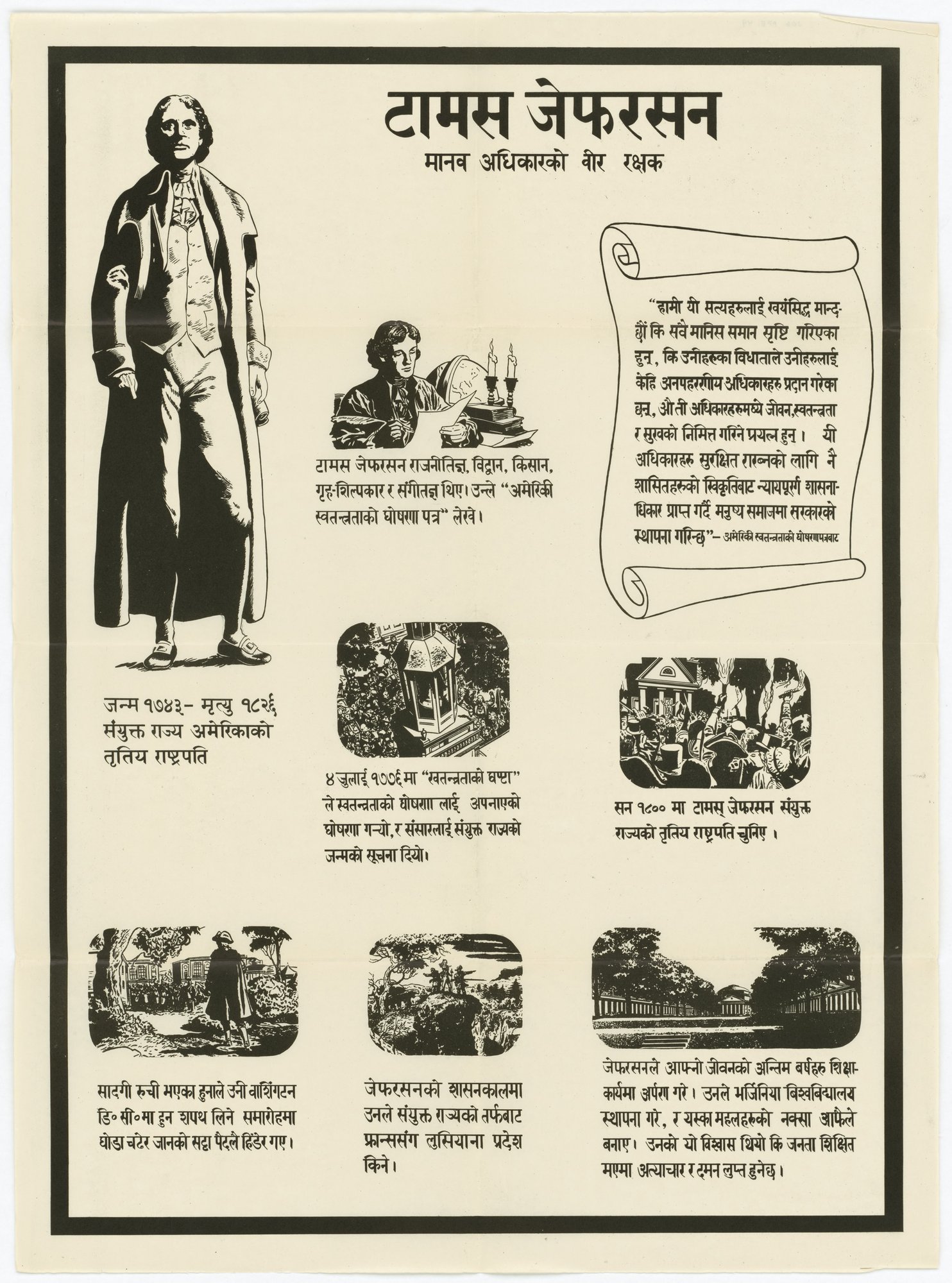
Thomas Jefferson poster, 49: Defender of Human Rights (Nepali poster distributed in Asia)
A Nepali-language biographical poster on Thomas Jefferson, 1743 to 1826, third U.S. president, titled 'Brave Defender of Human Rights'. A standing figure is set beside a scroll quoting the Declaration of Independence on equality and unalienable rights, with scenes of the Liberty Bell in 1776, his 1800 election, walking to his inauguration, the Louisiana Purchase and founding the University of Virginia. The tell is glittering-generalities, with a quoted founding text as testimonial.
Propaganda techniques used in this poster
- Date
- 1956
- Period
- Cold War
- Made by
- U.S. Information Agency (predecessor: State Department IIEP), Propaganda Posters Distributed in Asia, Latin America and the Middle East series
- Region
- North America
- Country
- United States
- Medium
- Poster
- Issuer type
- State
- Regime
- Eisenhower Administration
- Leader
- Dwight D. Eisenhower
- Audience
- Foreign public
- Purpose
- Persuade or win support
- Theme
- Elections and party politics
- Event
- Cold War
- Source
- Unidentified Source blurred: contractors, cutouts, buried disclosure
- Source
- U.S. National Archives (NARA), RG 306, Propaganda Posters Distributed in Asia, Latin America and the Middle East, retrieved October 4, 2026
- Rights
- Public domain (U.S. government work; NARA RG 306)
U.S. Information Agency / Department of State, c. 1956 (undated). National Archives, Record Group 306 (NAID 6948838, 306-PPB-49).
Text on the object
टामस जेफरसन
मानव अधिकारको वीर रक्षक

जन्म १७४३- मृत्यु १८२६
संयुक्त राज्य अमेरिकाको तृतिय राष्ट्रपति

टामस जेफरसन राजनीतिज्ञ, विद्वान, किसान, गृह-शिल्पकार र संगीतज्ञ थिए। उनले "अमेरिकी स्वतन्त्रताको घोषणा पत्र" लेखे।

"हामी यी सत्यहरुलाई स्वयंसिद्ध मान्दछौं कि सबै मानिस समान सृष्टि गरिएका हुन्, कि उनीहरुका विधातान उनीहरुलाई केही अनपहरणीय अधिकारहरु प्रदान गरेका छन्, औं ती अधिकारहरुमध्ये जीवन, स्वतन्त्रता र सुखको निमित्त गरिने प्रयत्न हुन्। यी अधिकारहरु सुरक्षित राख्नको लागि नै शासितहरुको स्विकृतिबाट न्यायपूर्ण शासनाधिकार प्राप्त गर्दै मनुष्य समाजमा सरकारको स्थापना गरिन्छ" - अमेरिकी स्वतन्त्रताको घोषणापत्रबाट

४ जुलाई १७७६ मा "स्वतन्त्रताको घण्टा" ले स्वतन्त्रताको घोषणालाई अपनाएको घोषणा गर्यो, र संसारलाई संयुक्त राज्यको जन्मको सूचना दियो।

सन १८०० मा टामस जेफरसन संयुक्त राज्यको तृतिय राष्ट्रपति चुनिए।

सादगी रुची भएका हुनाले उनी वाशिंगटन डि० सी०मा हुन शपथ लिने समारोहमा घोडा चढेर जानको सट्टा पैदले हिंडेर गए।

जेफरसनको शासनकालमा उनले संयुक्त राज्यको तर्फबाट फ्रान्ससँग लुसियाना प्रदेश किने।

जेफरसनले आफ्नो जीवनको अन्तिम वर्षहरु शिक्षा-कार्यमा अर्पण गरे। उनले भर्जिनिया विश्वविद्यालय स्थापना गरे, र यस्का महलहरुको नक्सा आफैले बनाए। उनको यो विश्वास थियो कि जनता शिक्षित भएमा अत्याचार र दमन लुप्त हुनेछ।
Thomas Jefferson
Brave Defender of Human Rights

Born 1743 - died 1826
Third President of the United States of America

Thomas Jefferson was a statesman, scholar, farmer, architect and musician. He wrote the 'Declaration of American Independence'.

"We hold these truths to be self-evident, that all men are created equal, that they are endowed by their Creator with certain unalienable Rights, that among these are Life, Liberty and the pursuit of Happiness. That to secure these rights, Governments are instituted among Men, deriving their just powers from the consent of the governed" - from the American Declaration of Independence

On July 4, 1776, the 'Liberty Bell' proclaimed the adoption of the Declaration of Independence and announced to the world the birth of the United States.

In 1800 Thomas Jefferson was elected third President of the United States.

Because of his taste for simplicity, he walked to the swearing-in ceremony in Washington, D.C. instead of riding a horse.

During Jefferson's term he bought the Louisiana territory from France on behalf of the United States.

Jefferson devoted the last years of his life to education. He founded the University of Virginia and drew the plans of its buildings himself. He believed that if people were educated, tyranny and oppression would disappear.
Devanagari reading is careful but some words in the quoted scroll are uncertain; the translation follows the standard English wording of the Declaration for the quotation.