Trị, Thiên vùng dậy (booklet text page: from Tet 1968 to the 1972 offensive)
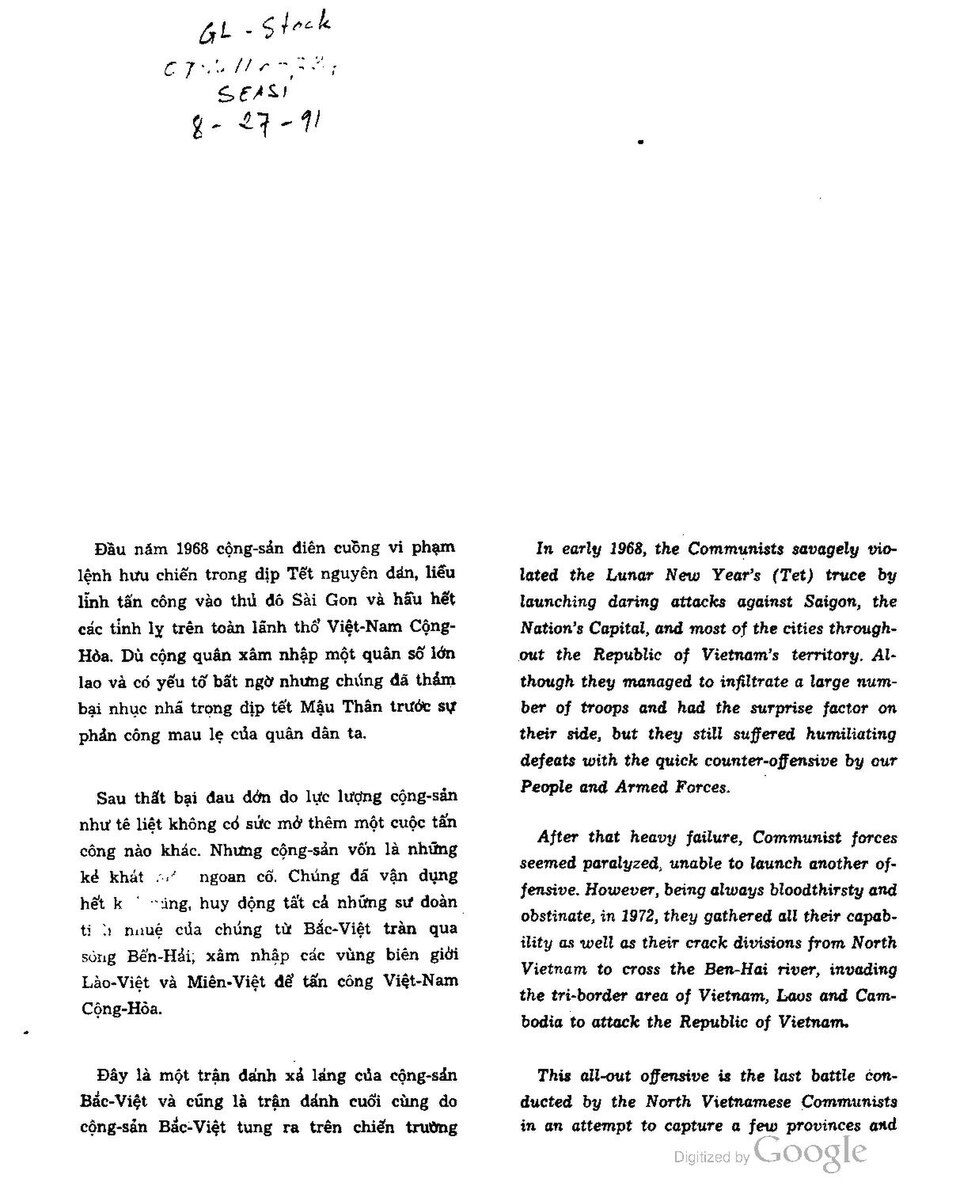
A bilingual text page from the booklet 'Trị, Thiên vùng dậy' gives the booklet's version of 1968 to 1972, in Vietnamese on the left and English on the right. It calls the opposing side 'bloodthirsty and obstinate' and describes Tet 1968 as 'humiliating defeats' for them. The tell is a one-sided summary that treats the 1972 offensive as 'the last battle'.
- Date
- 1972
- Period
- Cold War
- Made by
- Psychological Warfare Department (Cục Tâm-lý-chiến), Republic of Vietnam Armed Forces
- Region
- Southeast Asia
- Country
- South Vietnam
- Medium
- Books and pamphlets
- Issuer type
- Military
- Regime
- Thieu Government
- Leader
- Nguyen van Thieu
- Audience
- Foreign public
- Purpose
- Persuade or win support
- Theme
- War and the military
- Event
- Vietnam War
- Techniques
- Name-callingCard stacking
- Source
- Identified Openly sourced: the speaker is who they say they are
- Source
- Wikimedia Commons, retrieved October 2, 2026
- Rights
- Public domain (Commons: PD-South VietnamGov, PD-Layout)
Psychological Warfare Department (Cục Tâm-lý-chiến), Republic of Vietnam, 1972; scan from Google Books (digitized by Google) via Wikimedia Commons.
Text on the object
Đầu năm 1968 cộng-sản điên cuồng vi phạm lệnh hưu chiến trong dịp Tết nguyên đán, liều lĩnh tấn công vào thủ đô Sài Gòn và hầu hết các tỉnh lỵ trên toàn lãnh thổ Việt-Nam Cộng-Hòa. Dù cộng quân xâm nhập một quân số lớn lao và có yếu tố bất ngờ nhưng chúng đã thảm bại nhục nhã trong dịp tết Mậu Thân trước sự phản công mau lẹ của quân dân ta.

Sau thất bại đau đớn do lực lượng cộng-sản như tê liệt không có sức mở thêm một cuộc tấn công nào khác. Nhưng cộng-sản vốn là những kẻ khát [illegible] ngoan cố. Chúng đã vận dụng hết k[illegible]ũng, huy động tất cả những sư đoàn ti[illegible] nhuệ của chúng từ Bắc-Việt tràn qua sông Bến-Hải, xâm nhập các vùng biên giới Lào-Việt và Miền-Việt để tấn công Việt-Nam Cộng-Hòa.

Đây là một trận đánh xả láng của cộng-sản Bắc-Việt và cũng là trận đánh cuối cùng do cộng-sản Bắc-Việt tung ra trên chiến trường

In early 1968, the Communists savagely violated the Lunar New Year's (Tet) truce by launching daring attacks against Saigon, the Nation's Capital, and most of the cities throughout the Republic of Vietnam's territory. Although they managed to infiltrate a large number of troops and had the surprise factor on their side, but they still suffered humiliating defeats with the quick counter-offensive by our People and Armed Forces.

After that heavy failure, Communist forces seemed paralyzed, unable to launch another offensive. However, being always bloodthirsty and obstinate, in 1972, they gathered all their capability as well as their crack divisions from North Vietnam to cross the Ben-Hai river, invading the tri-border area of Vietnam, Laos and Cambodia to attack the Republic of Vietnam.

This all-out offensive is the last battle conducted by the North Vietnamese Communists in an attempt to capture a few provinces and
In early 1968 the communists madly violated the cease-fire order during the Lunar New Year holiday, recklessly attacking the capital Saigon and nearly all the provincial capitals across the whole territory of the Republic of Vietnam. Although the communist troops infiltrated a huge number of men and had the element of surprise, they were shamefully and disastrously defeated at Tet Mau Than before the swift counter-attack of our soldiers and people.

After the painful defeat the communist forces were as if paralysed, without the strength to launch any other attack. But the communists are by nature those who thirst [illegible] and are obstinate. They used all [illegible], mobilised all their elite divisions from North Vietnam, who swept across the Ben Hai river and entered the Laos-Vietnam and Cambodia-Vietnam border regions to attack the Republic of Vietnam.

This is a reckless battle of the North Vietnamese communists and is also the last battle launched by the North Vietnamese communists on the battlefield

[The English column printed on the right of the page is the booklet's own English version.]
Vietnamese column on the left and English column on the right, as printed; the English column breaks off mid-sentence at the foot of the page and continues overleaf. Two Vietnamese words are damaged in the scan and marked [illegible]. The translation of the Vietnamese column is FRAME's own literal rendering, machine-assisted and not verified by a fluent reader. Handwritten library marks at upper left are not transcribed.