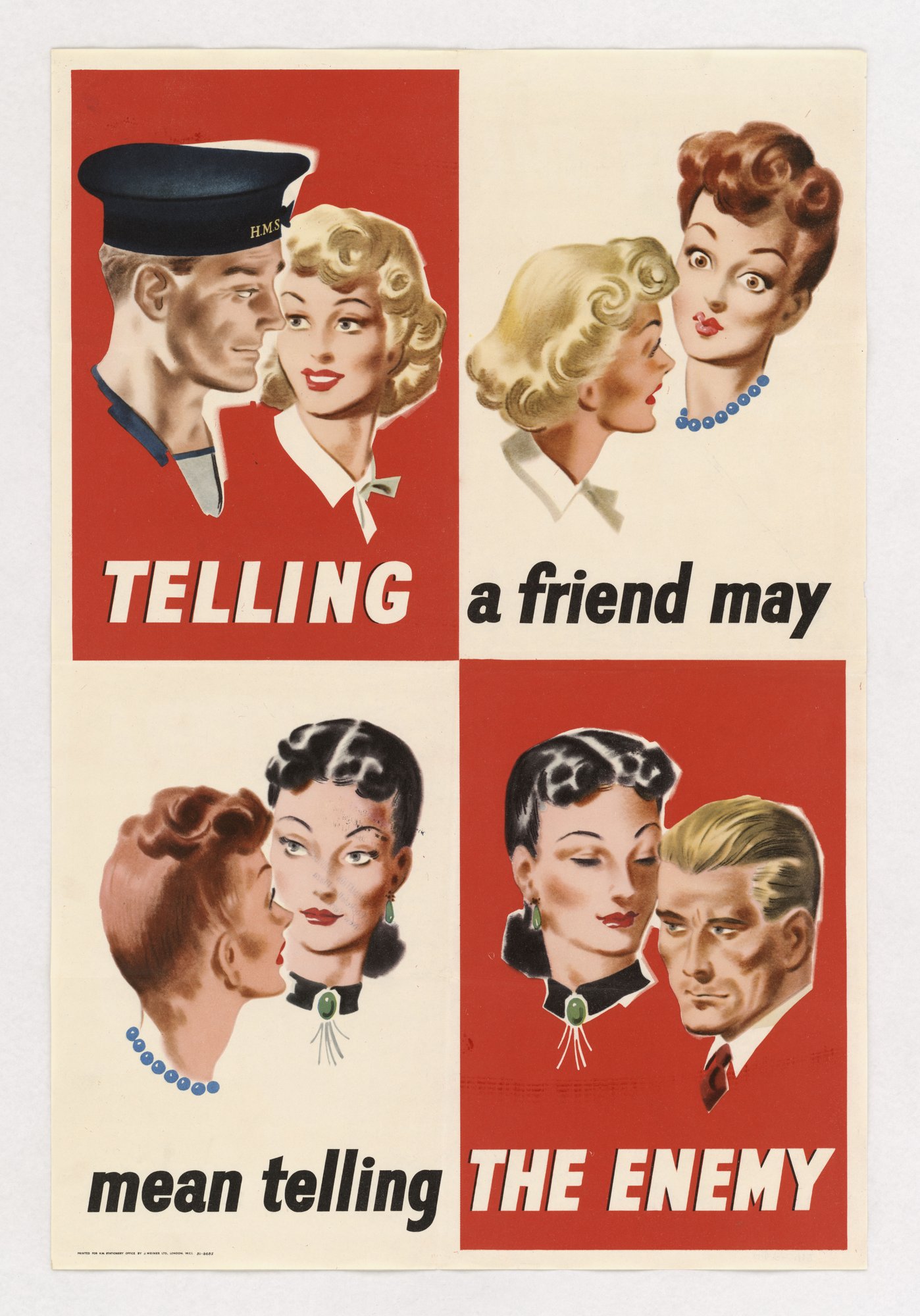
Telling a Friend May Mean Telling the Enemy
Four painted head-pairs in a red and cream chequerboard: a sailor and a woman, two women whispering, then the same dark-haired woman and a man with a sly look, spelling out the slogan. The tell for fear-appeal is the switch from a trusted friend to a smiling listener, so that an ordinary conversation is framed as a leak to the enemy.
Propaganda techniques used in this poster
- Date
- 1939
- Period
- Second World War
- Made by
- H.M. Stationery Office (careless-talk security poster); printed by J. Weiner Ltd., London
- Region
- Western and Central Europe
- Country
- United Kingdom
- Medium
- Poster
- Issuer type
- State
- Regime
- Churchill Government
- Leader
- Winston Churchill
- Audience
- Domestic public
- Purpose
- Warn or inform
- Themes
- Security and surveillance, Home front
- Event
- World War II
- Leader
- Winston Churchill
- Source
- Identified Openly sourced: the speaker is who they say they are
- Source
- U.S. National Archives and Records Administration, Record Group 44, World War II Foreign Posters, retrieved October 3, 2026
- Rights
- Public domain (UK Crown copyright, 50 years from publication, expired before 1996; no URAA restoration)
H.M. Stationery Office (careless-talk security poster), c. 1939-1945. U.S. National Archives, Record Group 44 (NARA ID 44267137).
Text on the object
TELLING
a friend may
mean telling
THE ENEMY

[cap tally:] H.M.S.

Printed for H.M. Stationery Office by J. Weiner Ltd., London, W.C.1. [job number illegible]