U.N. Day Poster #2: U.N. Technical Assistance Exchanges People's Knowledge (Japanese poster distributed in Asia)
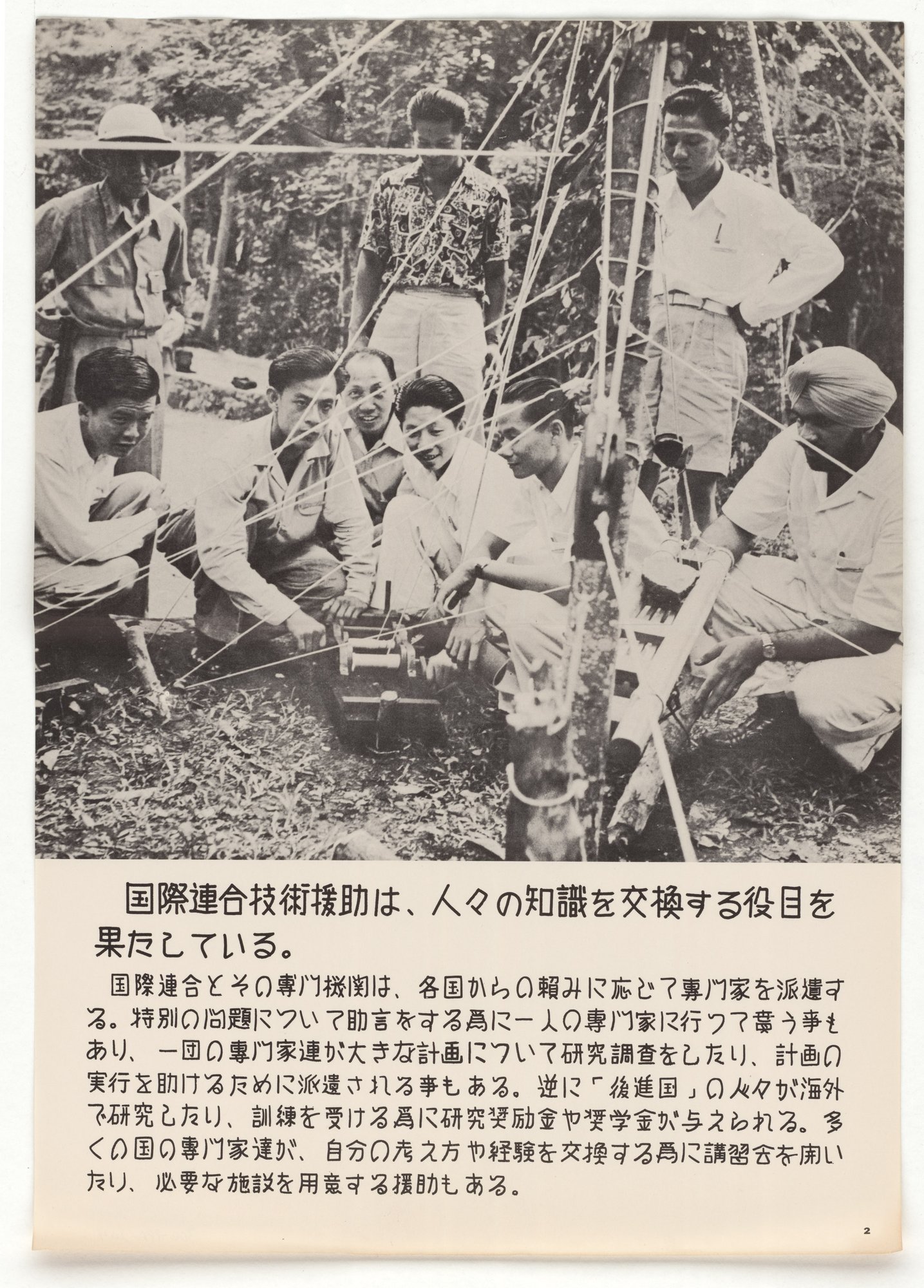
A photograph of men in light shirts, one in a turban and one in a pith helmet, crouching and standing around a small winding machine under a rope-strung frame in a wooded clearing. Japanese text says U.N. technical assistance exchanges knowledge: the United Nations and its agencies send experts on request, 'less developed' countries' people receive fellowships and scholarships to study abroad, and seminars and facilities are provided. The tell is transfer: the photograph of a shared task is offered as the picture of what the UN programme does.
Propaganda techniques used in this poster
- Date
- September 14, 1953
- Period
- Cold War
- Made by
- U.S. Information Agency (predecessor: State Department International Information and Educational Exchange Program), Propaganda Posters Distributed in Asia series
- Region
- North America
- Country
- United States
- Medium
- Poster
- Issuer type
- State
- Regime
- Eisenhower Administration
- Leader
- Dwight D. Eisenhower
- Audience
- Foreign public
- Purpose
- Persuade or win support
- Themes
- Economy and finance, Science and technology
- Event
- Cold War
- Source
- Unidentified Source blurred: contractors, cutouts, buried disclosure
- Source
- U.S. National Archives (NARA), Record Group 306, Propaganda Posters Distributed in Asia, retrieved October 3, 2026
- Rights
- Public domain (U.S. government work; NARA RG 306)
U.S. Information Agency / Department of State, September 14, 1953. National Archives, Record Group 306 (NAID 5730104, 306-PPA-204).
Text on the object
国際連合技術援助は、人々の知識を交換する役目を果たしている。

国際連合とその専門機関は、各国からの頼みに応じて専門家を派遣する。特別の問題について助言をする為に一人の専門家に行つて貰う事もあり、一団の専門家連が大きな計画について研究調査をしたり、計画の実行を助けるために派遣される事もある。逆に「後進国」の人々が海外で研究したり、訓練を受ける為に研究奨励金や奨学金が与えられる。多くの国の専門家達が、自分の考え方や経験を交換する為に講習会を開いたり、必要な施設を用意する援助もある。

2
United Nations technical assistance serves the role of exchanging people's knowledge.

The United Nations and its specialised agencies send experts in response to requests from countries. Sometimes a single expert is sent to advise on a particular problem; sometimes a group of experts is sent to research and survey a large plan or to help carry it out. Conversely, fellowships and scholarships are given so that people of 'backward countries' can study and receive training abroad. Experts from many countries also hold seminars to exchange their ideas and experience, and help by providing needed facilities.

2
'後進国' is translated literally as 'backward countries', as printed.