This Is Poland: One of the United Nations
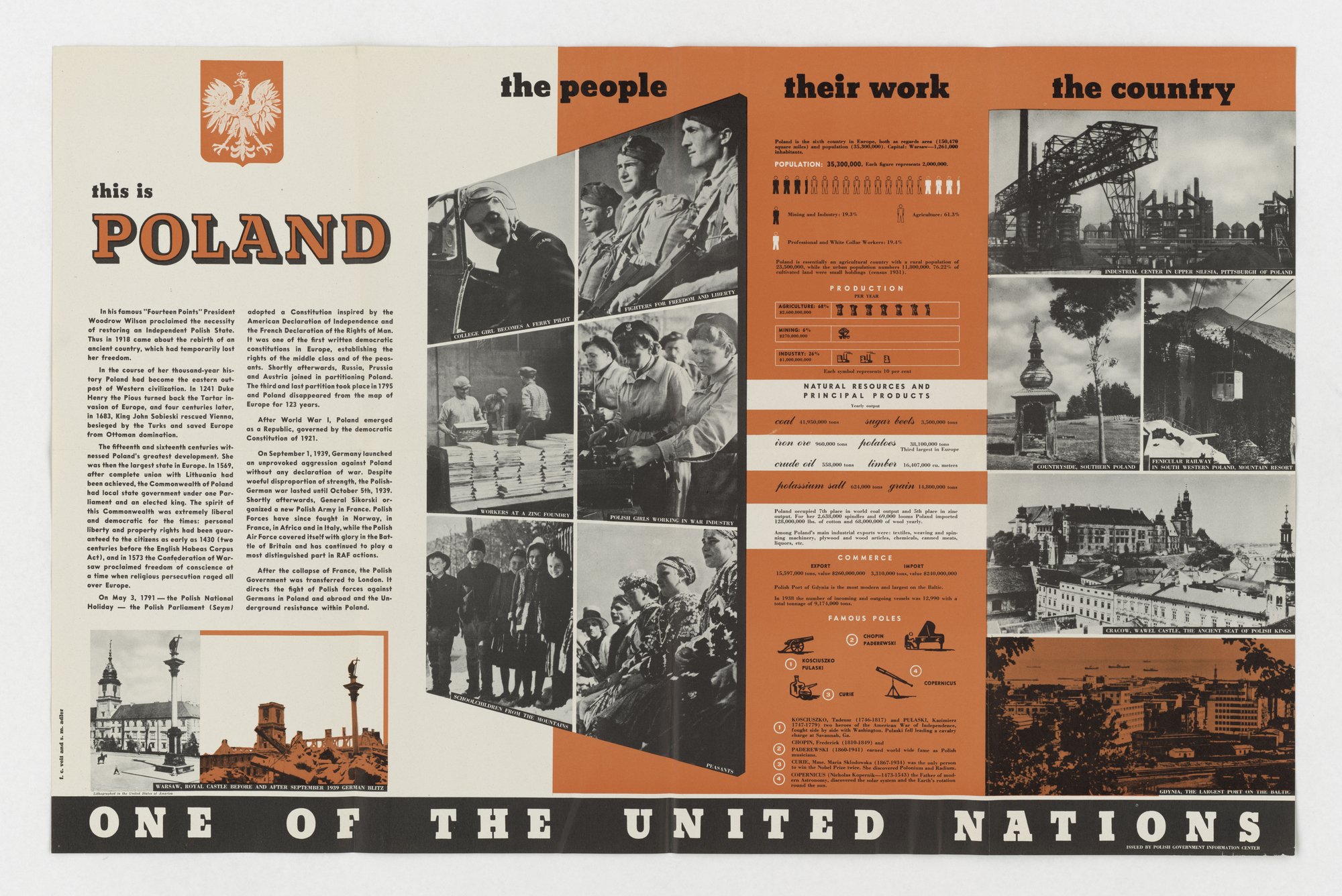
A folded information sheet headed 'this is POLAND' combines a history text, captioned photographs of Polish airwomen, soldiers, workers and peasants, statistics on population, production and trade, and a before-and-after view of Warsaw's Royal Castle. The tells are card-stacking, in the selection of democratic traditions, resistance and the 1939 German attack with no unfavourable material, and glittering generalities, in terms such as 'freedom and liberty'.
Propaganda techniques used in this poster
- Date
- 1939
- Period
- Second World War
- Made by
- Polish Government Information Center (issuer); lithographed in the United States by F. C. Veit and S. M. Adler
- Region
- Eastern Europe and Eurasia
- Country
- Poland
- Medium
- Poster
- Issuer type
- State
- Regime
- Polish Government in Exile
- Leader
- Wladyslaw Raczkiewicz
- Audience
- Foreign public
- Purpose
- Persuade or win support
- Themes
- War and the military, Home front
- Event
- World War II
- Source
- Identified Openly sourced: the speaker is who they say they are
- Source
- U.S. National Archives and Records Administration, Record Group 44, World War II Foreign Posters, retrieved October 3, 2026
- Rights
- Held by NARA, Unrestricted; hosted by owner decision (foreign-government sheet, 1939-45)
Polish Government Information Center; lithographed by F. C. Veit and S. M. Adler. National Archives and Records Administration, 44-PF-899m.
Text on the object
this is
POLAND

the people  their work  the country

In his famous "Fourteen Points" President Woodrow Wilson proclaimed the necessity of restoring an Independent Polish State. Thus in 1918 came about the rebirth of an ancient country, which had temporarily lost her freedom.

In the course of her thousand-year history Poland had become the eastern outpost of Western civilization. In 1241 Duke Henry the Pious turned back the Tartar invasion of Europe, and four centuries later, in 1683, King John Sobieski rescued Vienna, besieged by the Turks and saved Europe from Ottoman domination.

[...] On September 1, 1939, Germany launched an unprovoked aggression against Poland without any declaration of war. Despite woeful disproportion of strength, the Polish-German war lasted until October 5th, 1939. Shortly afterwards, General Sikorski organized a new Polish Army in France. Polish Forces have since fought in Norway, in France, in Africa and in Italy, while the Polish Air Force covered itself with glory in the Battle of Britain and has continued to play a most distinguished part in RAF actions.

After the collapse of France, the Polish Government was transferred to London. It directs the fight of Polish forces against Germans in Poland and abroad and the Underground resistance within Poland.

Captions: COLLEGE GIRL BECOMES A FERRY PILOT / FIGHTERS FOR FREEDOM AND LIBERTY / WORKERS AT A ZINC FOUNDRY / POLISH GIRLS WORKING IN WAR INDUSTRY / SCHOOLCHILDREN FROM THE MOUNTAINS / PEASANTS / WARSAW, ROYAL CASTLE BEFORE AND AFTER SEPTEMBER 1939 GERMAN BLITZ / INDUSTRIAL CENTER IN UPPER SILESIA, PITTSBURGH OF POLAND / COUNTRYSIDE, SOUTHERN POLAND / CRACOW, WAWEL CASTLE, THE ANCIENT SEAT OF POLISH KINGS / GDYNIA, THE LARGEST PORT ON THE BALTIC

POPULATION: 35,300,000. [statistics panels on production, natural resources, commerce and 'Famous Poles' omitted from this transcription; the long history text is abridged where marked [...]]

ONE OF THE UNITED NATIONS

[imprint:] f. c. veit and s. m. adler / Lithographed in the United States of America / ISSUED BY POLISH GOVERNMENT INFORMATION CENTER