This Is Yugoslavia: One of the United Nations
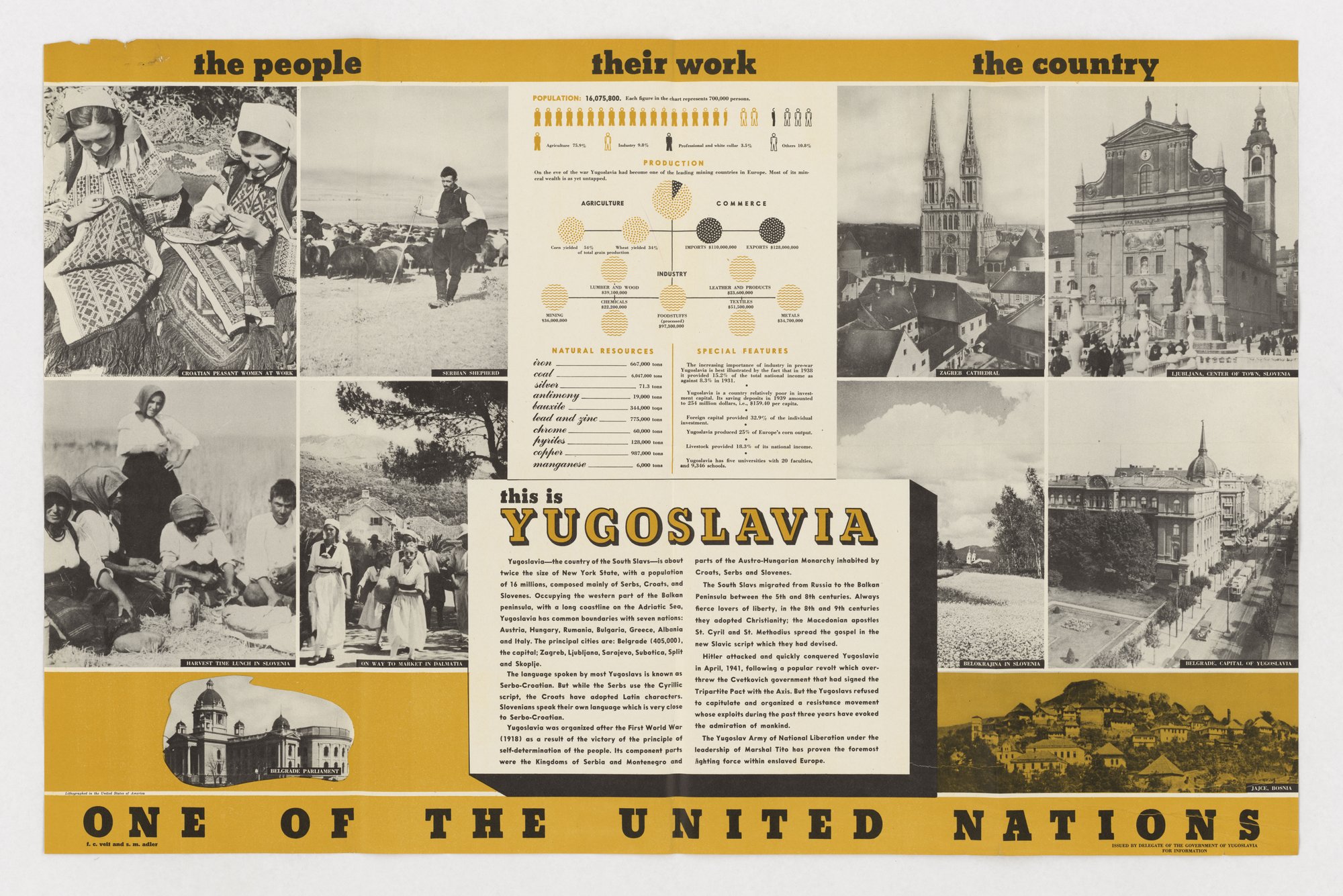
A folded information sheet headed 'this is YUGOSLAVIA' combines a country history, captioned photographs of peasants, towns and cathedrals, and charts of population, production and resources. The tells are card-stacking, in a selection that ends with the resistance under Marshal Tito and carries no unfavourable material, and glittering generalities, in phrases such as 'always fierce lovers of liberty' and 'the admiration of mankind'.
Propaganda techniques used in this poster
- Date
- 1944
- Period
- Second World War
- Made by
- Delegate of the Government of Yugoslavia for Information (issuer); lithographed in the United States by F. C. Veit and S. M. Adler
- Region
- Eastern Europe and Eurasia
- Country
- Yugoslavia
- Medium
- Poster
- Issuer type
- State
- Regime
- National Committee for the Liberation of Yugoslavia
- Leader
- Josip Broz Tito
- Audience
- Foreign public
- Purpose
- Persuade or win support
- Themes
- War and the military, Home front
- Event
- World War II
- Source
- Identified Openly sourced: the speaker is who they say they are
- Source
- U.S. National Archives and Records Administration, Record Group 44, World War II Foreign Posters, retrieved October 3, 2026
- Rights
- Held by NARA, Unrestricted; hosted by owner decision (foreign-government sheet, 1939-45)
Delegate of the Government of Yugoslavia for Information; lithographed by F. C. Veit and S. M. Adler. National Archives and Records Administration, 44-PF-899n.
Text on the object
the people  their work  the country

this is
YUGOSLAVIA

Yugoslavia-the country of the South Slavs-is about twice the size of New York State, with a population of 16 millions, composed mainly of Serbs, Croats, and Slovenes. Occupying the western part of the Balkan peninsula, with a long coastline on the Adriatic Sea, Yugoslavia has common boundaries with seven nations: Austria, Hungary, Rumania, Bulgaria, Greece, Albania and Italy. The principal cities are: Belgrade (405,000), the capital; Zagreb, Ljubljana, Sarajevo, Subotica, Split and Skoplje.

[...] Hitler attacked and quickly conquered Yugoslavia in April, 1941, following a popular revolt which overthrew the Cvetkovich government that had signed the Tripartite Pact with the Axis. But the Yugoslavs refused to capitulate and organized a resistance movement whose exploits during the past three years have evoked the admiration of mankind.

The Yugoslav Army of National Liberation under the leadership of Marshal Tito has proven the foremost fighting force within enslaved Europe.

Captions: CROATIAN PEASANT WOMEN AT WORK / SERBIAN SHEPHERD / ZAGREB CATHEDRAL / LJUBLJANA, CENTER OF TOWN, SLOVENIA / HARVEST TIME LUNCH IN SLOVENIA / ON WAY TO MARKET IN DALMATIA / BELOKRAJINA IN SLOVENIA / BELGRADE, CAPITAL OF YUGOSLAVIA / BELGRADE PARLIAMENT / JAJCE, BOSNIA

POPULATION: 16,075,800. [statistics panels on production and natural resources omitted from this transcription; the history text is abridged where marked [...]]

ONE OF THE UNITED NATIONS

[imprint:] f. c. veit and s. m. adler / Lithographed in the United States of America / ISSUED BY DELEGATE OF THE GOVERNMENT OF YUGOSLAVIA FOR INFORMATION