Dili Na Kami Mga Tawo! ("We Are No Longer Human Beings!") (Cebuano poster distributed in the Philippines)
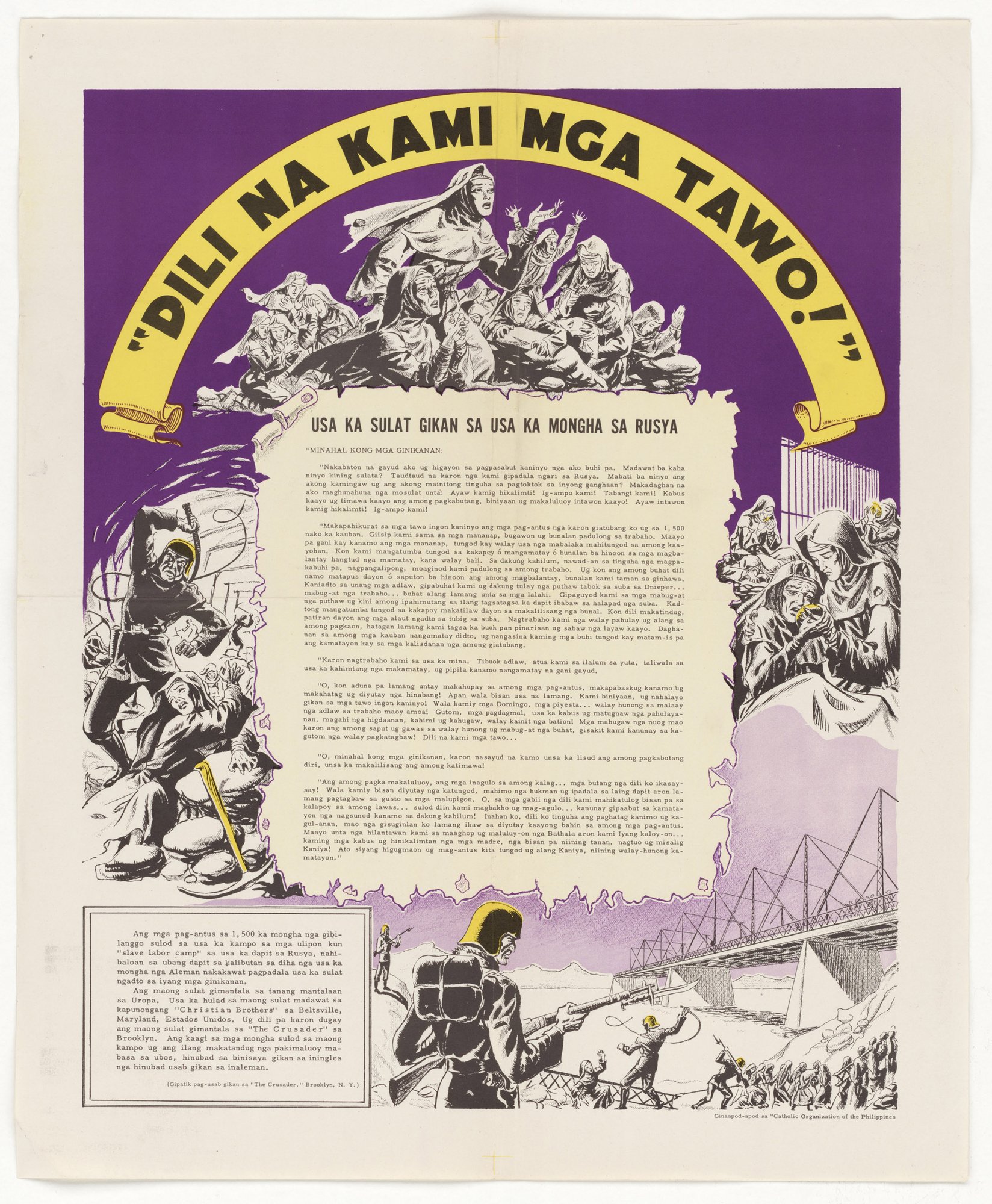
A letter attributed to a nun held in a Soviet forced-labour camp is printed beside comic-style drawings of hooded women crowded together, guards in helmets with whips and bayonets, a pickaxe, and a bridge over a river. The headline is the letter's cry that the women are 'no longer human beings'. The sheet argues that 1,500 German nuns are held in a Soviet camp. The tell is fear-appeal and testimonial: a first-person letter and scenes of suffering, with no corroboration printed on the sheet.
Propaganda techniques used in this poster
- Date
- June 8, 1951
- Period
- Cold War
- Made by
- U.S. Information Agency (predecessor: State Department International Information and Educational Exchange Program), Propaganda Posters Distributed in Asia series
- Region
- North America
- Country
- United States
- Medium
- Poster
- Issuer type
- State
- Regime
- Truman Administration
- Leader
- Harry S. Truman
- Audience
- Foreign public
- Purpose
- Demonize
- Themes
- Religion, War and the military
- Event
- Cold War
- Source
- Unidentified Source blurred: contractors, cutouts, buried disclosure
- Source
- U.S. National Archives (NARA), Record Group 306, Propaganda Posters Distributed in Asia, retrieved October 3, 2026
- Rights
- Public domain (U.S. government work; NARA RG 306)
U.S. Information Agency / Department of State, June 8, 1951. National Archives, Record Group 306 (NAID 5730159, 306-PPA-258).
Text on the object
"DILI NA KAMI MGA TAWO!"

USA KA SULAT GIKAN SA USA KA MONGHA SA RUSYA

"MINAHAL KONG MGA GINIKANAN:

"Nakabaton na gayud ako ug higayon sa pagpasabut kaninyo nga ako buhi pa. Madawat ba kaha ninyo kining sulata? Taudtaud na karon nga kami gipadala ngari sa Rusya. Mabati ba ninyo ang akong kamingaw ug ang akong mainitong tinguha sa pagtoktok sa inyong ganghaan? Makadaghan na ako maghunahuna nga mosulat unta! Ayaw kamig hikalimti! Ig-ampo kami! Tabangi kami! Kabus kaayo ug timawa kaayo ang among pagkabutang, biniyaan ug makaluluoy intawon kaayo! Ayaw intawon kamig hikalimti! Ig-ampo kami!

"Makapahikurat sa mga tawo ingon kaninyo ang mga pag-antus nga karon giatubang ko ug sa 1,500 nako ka kauban. [...]

[letter continues for several further paragraphs and ends with 'Dili na kami mga tawo...' and an appeal to God; remainder not transcribed]

[boxed note:] Ang mga pag-antus sa 1,500 ka mongha nga gibilanggo sulod sa usa ka kampo sa mga ulipon kun "slave labor camp" sa usa ka dapit sa Rusya, nahibaloan sa ubang dapit sa kalibutan sa diha nga usa ka mongha nga Aleman nakakawat pagpadala usa ka sulat ngadto sa iyang mga ginikanan.
Ang maong sulat gimantala sa tanang mantalaan sa Uropa. Usa ka hulad sa maong sulat madawat sa kapunongang "Christian Brothers" sa Beltsville, Maryland, Estados Unidos. Ug dili pa karon dugay ang maong sulat gimantala sa "The Crusader" sa Brooklyn. Ang kaagi sa mga mongha sulod sa maong kampo ug ang ilang makakatilaw pakimaluoy mabasa sa ubos, hinubad sa binisaya gikan sa iningles nga hinubad usab gikan sa inaleman.

(Gipatik pag-usab gikan sa "The Crusader," Brooklyn, N. Y.)

Ginaapod-apod sa "Catholic Organization of the Philippines"
"We are no longer human beings!" A letter from a nun in Russia. "My dear parents: I have at last had a chance to let you know that I am still alive. Will you receive this letter? We were sent to Russia long ago. Can you feel my loneliness and my fervent wish to knock at your door? ... Do not forget us! Pray for us! Help us! Our condition is very poor and wretched ..." [boxed note:] The sufferings of the 1,500 nuns imprisoned in a slave labour camp somewhere in Russia became known elsewhere in the world when a German nun managed to send a letter to her parents. The letter was published in all the newspapers of Europe; a copy reached the 'Christian Brothers' of Beltsville, Maryland, U.S.A., and was published in 'The Crusader', Brooklyn. [Imprint:] Distributed by the 'Catholic Organization of the Philippines'. (Translation is literal and partial; the omitted letter body is not translated.)
Body of the letter transcribed only in part (about the first two paragraphs); the rest is marked as not transcribed.