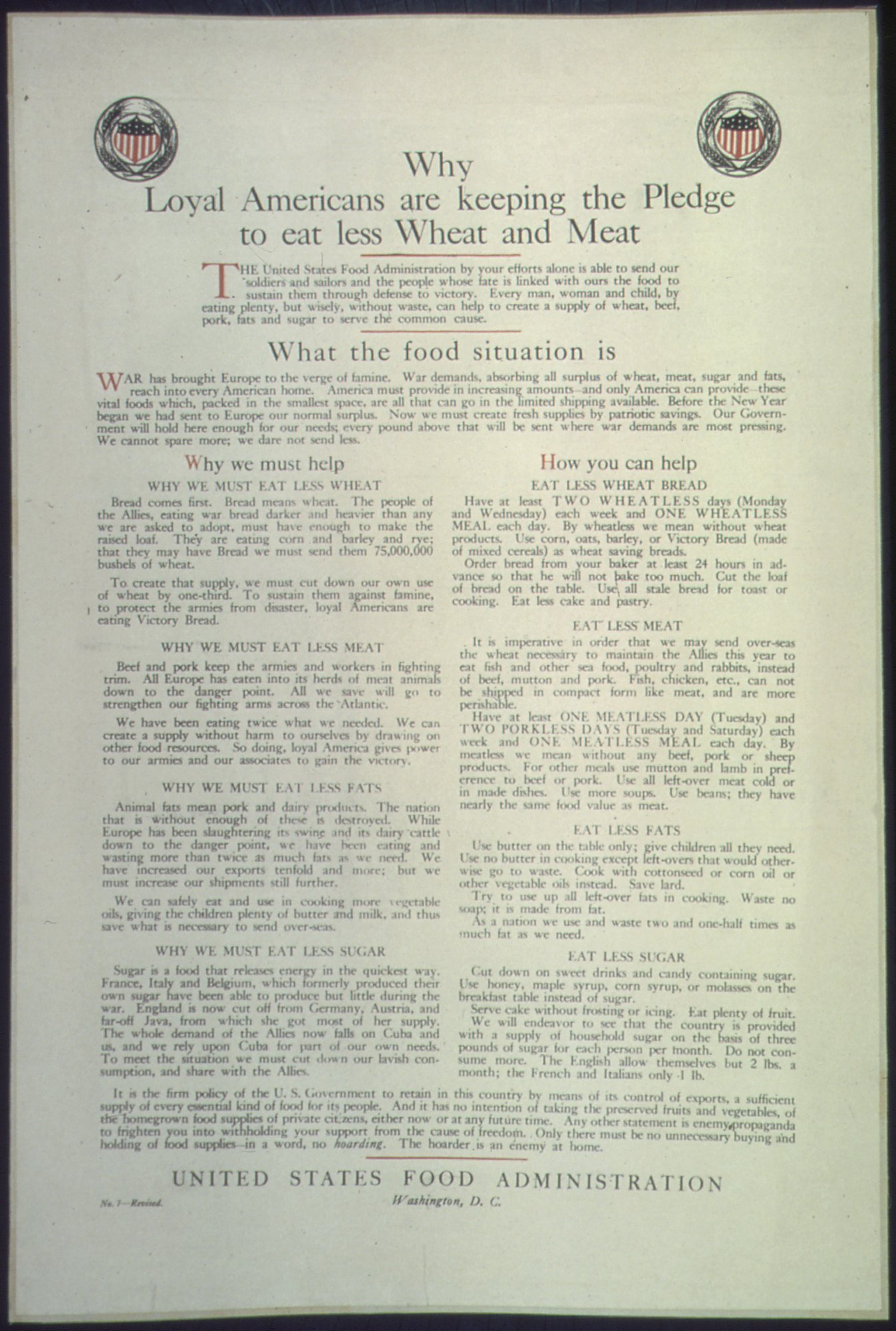
Why Loyal Americans Are Keeping the Pledge to Eat Less Wheat and Meat
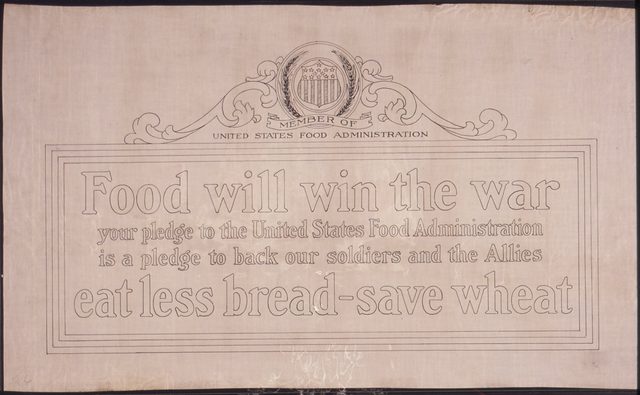
A text-only sheet under two shield emblems sets out the food situation and then lists reasons and instructions for eating less wheat, meat, fats and sugar, such as wheatless and meatless days and a sugar allowance of three pounds per person per month. The wording labels those who keep the pledge 'loyal Americans' and calls the hoarder 'an enemy at home', and it describes any contrary statement as enemy propaganda. The tell is the pairing of a loyalty label for compliance with an enemy label for its opposite.
Propaganda techniques used in this poster
- Date
- 1918
- Period
- First World War
- Made by
- U.S. Food Administration
- Region
- North America
- Country
- United States
- Medium
- Poster
- Issuer type
- State
- Regime
- Wilson Administration
- Leader
- Woodrow Wilson
- Audience
- Domestic public
- Purpose
- Mobilize or secure compliance
- Themes
- Home front, War and the military, Economy and finance
- Event
- World War I
- Regime
- Wilson administration
- Leader
- Woodrow Wilson
- Source
- Identified Openly sourced: the speaker is who they say they are
- Source
- U.S. National Archives (NARA), RG 4 (U.S. Food Administration), World War I Posters (NAID 512439), retrieved October 3, 2026
- Rights
- NARA Unrestricted; hosted by owner decision
U.S. Food Administration. National Archives and Records Administration, 4-P-140.
Text on the object
Why
Loyal Americans are keeping the Pledge
to eat less Wheat and Meat

THE United States Food Administration by your efforts alone is able to send our soldiers and sailors and the people whose fate is linked with ours the food to sustain them through defense to victory. Every man, woman and child, by eating plenty, but wisely, without waste, can help to create a supply of wheat, beef, pork, fats and sugar to serve the common cause.

What the food situation is

WAR has brought Europe to the verge of famine. War demands, absorbing all surplus of wheat, meat, sugar and fats, reach into every American home. America must provide in increasing amounts--and only America can provide--these vital foods which, packed in the smallest space, are all that can go in the limited shipping available. Before the New Year began we had sent to Europe our normal surplus. Now we must create fresh supplies by patriotic savings. Our Government will hold here enough for our needs; every pound above that will be sent where war demands are most pressing. We cannot spare more; we dare not send less.

Why we must help

WHY WE MUST EAT LESS WHEAT
Bread comes first. Bread means wheat. The people of the Allies, eating war bread darker and heavier than any we are asked to adopt, must have enough to make the raised loaf. They are eating corn and barley and rye; that they may have Bread we must send them 75,000,000 bushels of wheat.

To create that supply, we must cut down our own use of wheat by one-third. To sustain them against famine, to protect the armies from disaster, loyal Americans are eating Victory Bread.

WHY WE MUST EAT LESS MEAT
Beef and pork keep the armies and workers in fighting trim. All Europe has eaten into its herds of meat animals down to the danger point. All we save will go to strengthen our fighting arms across the Atlantic.

We have been eating twice what we needed. We can create a supply without harm to ourselves by drawing on other food resources. So doing, loyal America gives power to our armies and our associates to gain the victory.

WHY WE MUST EAT LESS FATS
Animal fats mean pork and dairy products. The nation that is without enough of these is destroyed. While Europe has been slaughtering its swine and its dairy cattle down to the danger point, we have been eating and wasting more than twice as much fats as we need. We have increased our exports tenfold and more; but we must increase our shipments still further.

We can safely eat and use in cooking more vegetable oils, giving the children plenty of butter and milk, and thus save what is necessary to send over-seas.

WHY WE MUST EAT LESS SUGAR
Sugar is a food that releases energy in the quickest way. France, Italy and Belgium, which formerly produced their own sugar have been able to produce but little during the war. England is now cut off from Germany, Austria, and far-off Java, from which she got most of her supply. The whole demand of the Allies now falls on Cuba and us, and we rely upon Cuba for part of our own needs. To meet the situation we must cut down our lavish consumption, and share with the Allies.

How you can help

EAT LESS WHEAT BREAD
Have at least TWO WHEATLESS days (Monday and Wednesday) each week and ONE WHEATLESS MEAL each day. By wheatless we mean without wheat products. Use corn, oats, barley, or Victory Bread (made of mixed cereals) as wheat saving breads.
Order bread from your baker at least 24 hours in advance so that he will not bake too much. Cut the loaf of bread on the table. Use all stale bread for toast or cooking. Eat less cake and pastry.
Truncated at the schema limit of 4000 characters; the remainder of the sheet (the rest of the 'How you can help' column, the closing paragraph beginning 'It is the firm policy of the U. S. Government', the imprint 'UNITED STATES FOOD ADMINISTRATION, Washington, D. C.' and 'No. 7--Revised.') is not transcribed here. Two shield-and-wreath emblems flank the title; they are not text.