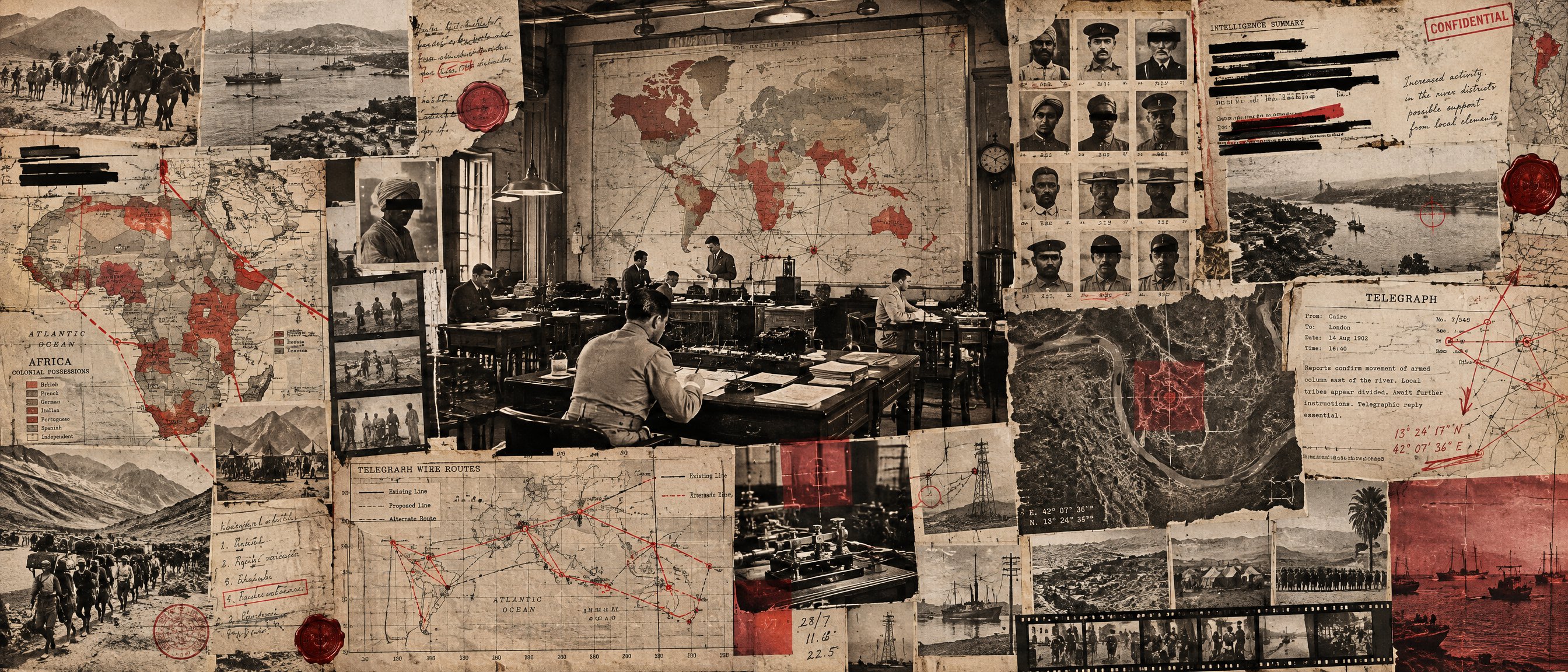
In one line: the Republican James A. Garfield beat the Democrat Winfield S. Hancock by 214 electoral votes to 155 in one of the narrowest popular-vote results on record, in a campaign remembered for a forged letter, the Civil War records of both major nominees, and a third-party Greenback-Labor ticket led by James B. Weaver.
Context
The Republican convention met at Chicago in June 1880 and nominated Garfield, an Ohio congressman and Union general, for president, with Chester A. Arthur of New York, a former customs collector and ally of Senator Roscoe Conkling, for vice president. The convention contest included a bid to nominate former president Ulysses S. Grant for a third term, as the June Puck cover below shows. The Democrats met at Cincinnati later that month and nominated Winfield S. Hancock, a career army officer and Gettysburg general, with William H. English of Indiana for vice president. Weaver of Iowa headed the Greenback-Labor ticket [1].
The Miller Center describes the campaign as revealing few differences between the candidates apart from the tariff; Hancock dismissed the tariff as "a local question", Democrats attacked Garfield over the Credit Mobilier scandal, and Garfield kept a low profile [1]. In the count, Garfield received 4,453,611 votes (48.3 percent) and Hancock 4,445,256 (48.2 percent) out of 9,220,197 cast; the Electoral College vote was 214 to 155, with 369 votes cast and 185 needed [2][3]. Weaver received no electoral votes [2]. The Library of Congress guide calls Garfield's popular margin under 10,000 votes [4]; the Miller Center gives it as 7,368 [1].
A forged letter dominated the last fortnight. It purported to be from Garfield to "H. L. Morey" of an Employers' Union in Lynn, Massachusetts, and suggested he favoured continued Chinese immigration at a time when Chinese immigration was a contested issue between and within the parties. A New York paper, Truth, published it in late October; Garfield denied writing it, and it was widely later judged a forgery [5]. Separately, Puck's July cover on the anti-Chinese planks of both parties shows that the issue was already in play before the letter.
Every object below is a printed 1880 item from the Library of Congress, public domain by age. Each candidate section is split between literature made in support and literature made against, so that the same technique definitions can be applied to every side. The page does not say which side was right.
James A. Garfield and Chester A. Arthur (Republican)
In support
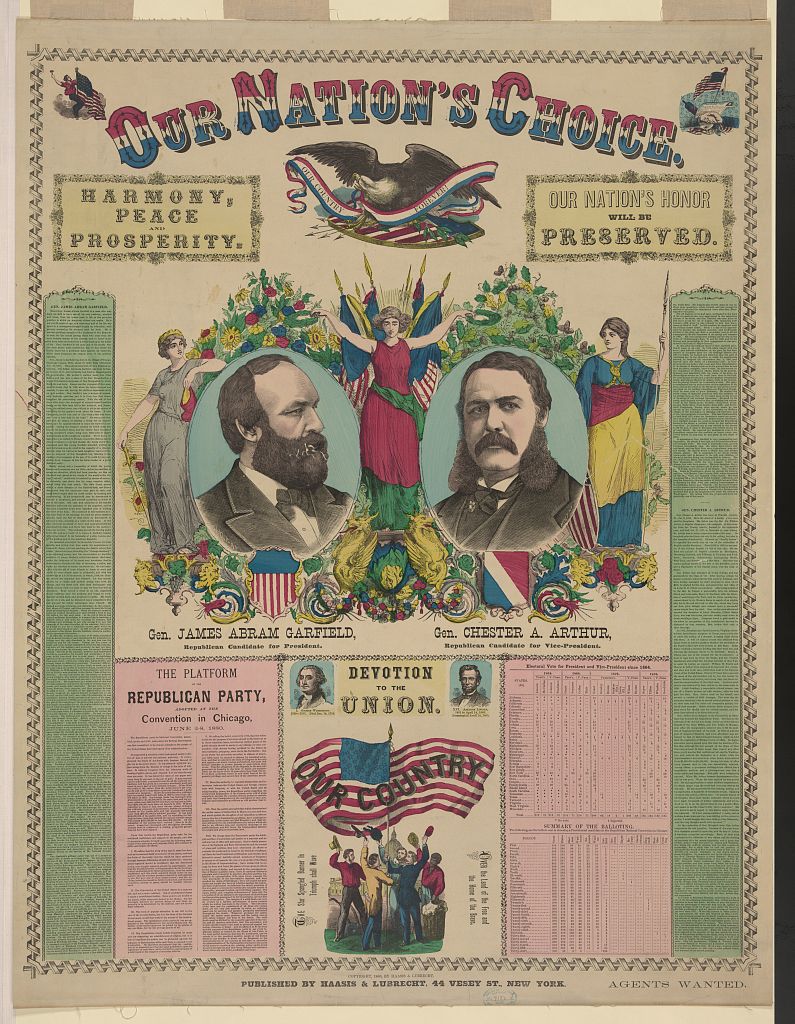
Our Nation's Choice: Gen. James Abram Garfield and Gen. Chester A. Arthur (Haasis & Lubrecht). Haasis & Lubrecht, New York, 1880. Public domain by age; Library of Congress. A poster of portraits, allegorical women, flags, Washington and Lincoln, the Republican platform and a table of past presidential votes. It borrows the prestige of national symbols and of two earlier presidents (Transfer) and sets virtue words in banners ("Harmony, Peace and Prosperity", "Our Nation's Honor Will Be Preserved") (Glittering generalities).
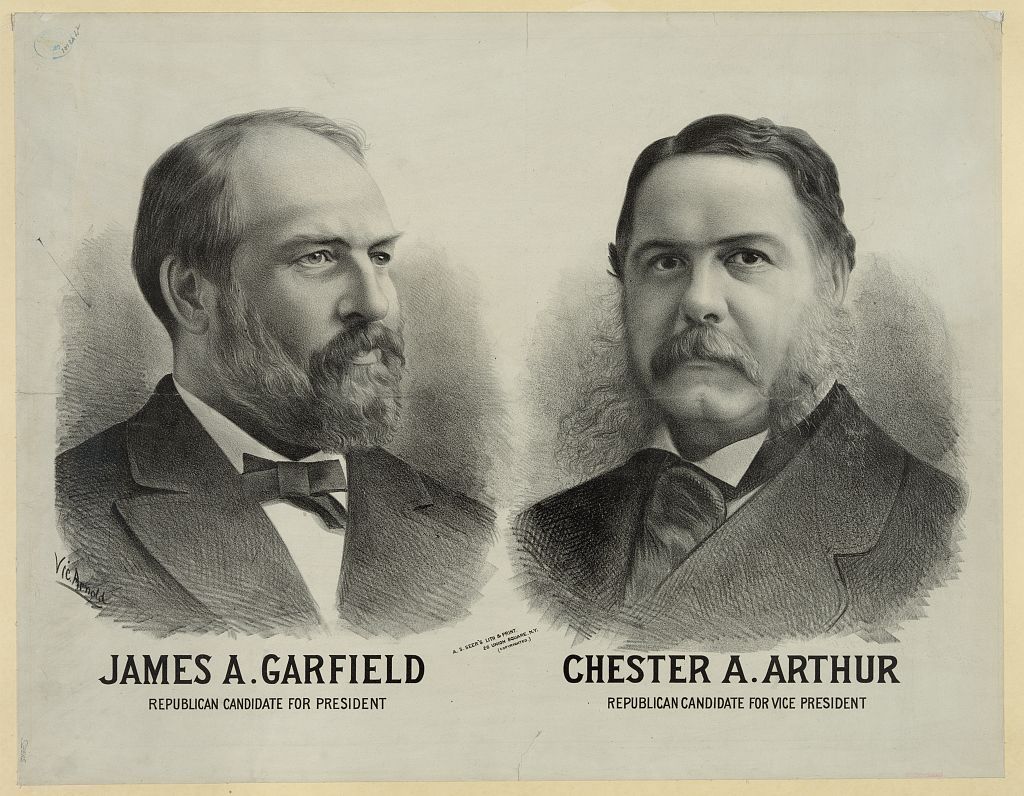
Republican Candidates: James A. Garfield and Chester A. Arthur (A. S. Seer lithograph). Vic Arnold for A. S. Seer's, New York, c. 1880. Public domain by age; Library of Congress. A bare portrait pair with name and party label and no slogan. The only Transfer is the candidates' own standing carried by their likeness and the word "Republican".
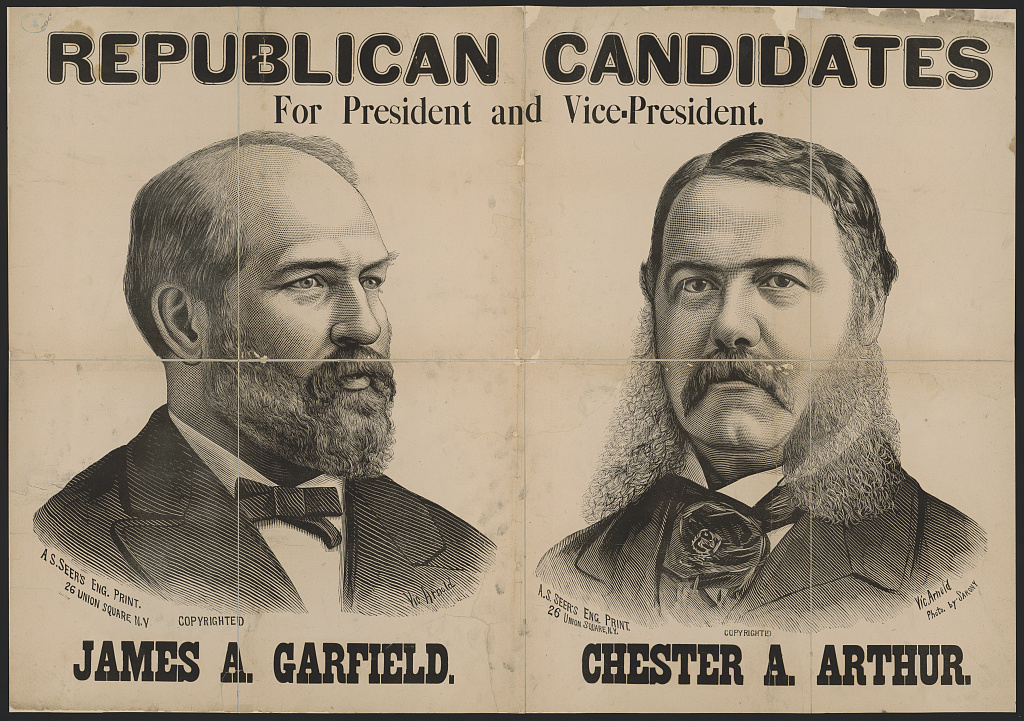
Republican Candidates for President and Vice-President: James A. Garfield, Chester A. Arthur (A. S. Seer engraving). A. S. Seer's Eng. Print, New York, 1880, after a Sarony photograph. Public domain by age; Library of Congress. A larger engraved version of the same idea, with fold lines from circulation; again name, likeness and party label (Transfer).
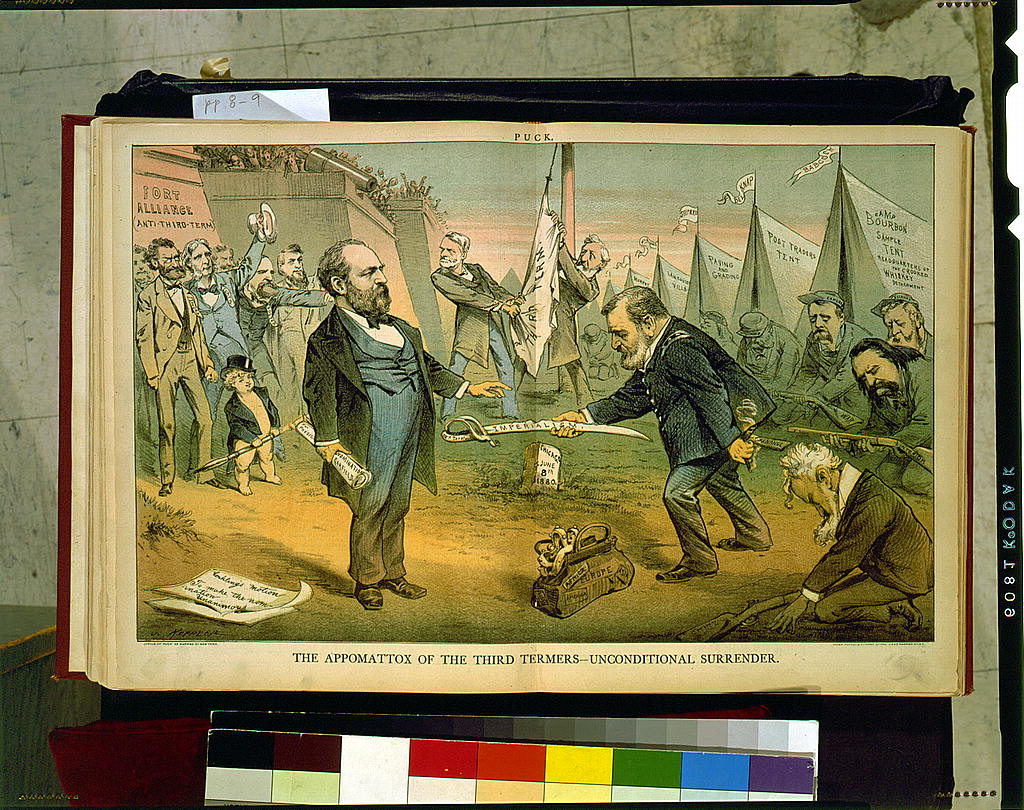
The Appomattox of the Third Termers: Unconditional Surrender (Puck cover, 16 June 1880). Joseph Keppler in Puck, 16 June 1880. Public domain by age; Library of Congress. Not a party document: a New York humour weekly's cover on the convention result. Grant hands a sword labelled "IIId term imperialism" to Garfield under a title that echoes Lee's surrender, a stigma-and-prestige pairing (Transfer) that applies a loaded label to the third-term effort (Name-calling).
In opposition
Content note: anti-Chinese immigration appeal built on a letter that was a forgery; the sheet itself says Garfield denied writing it.
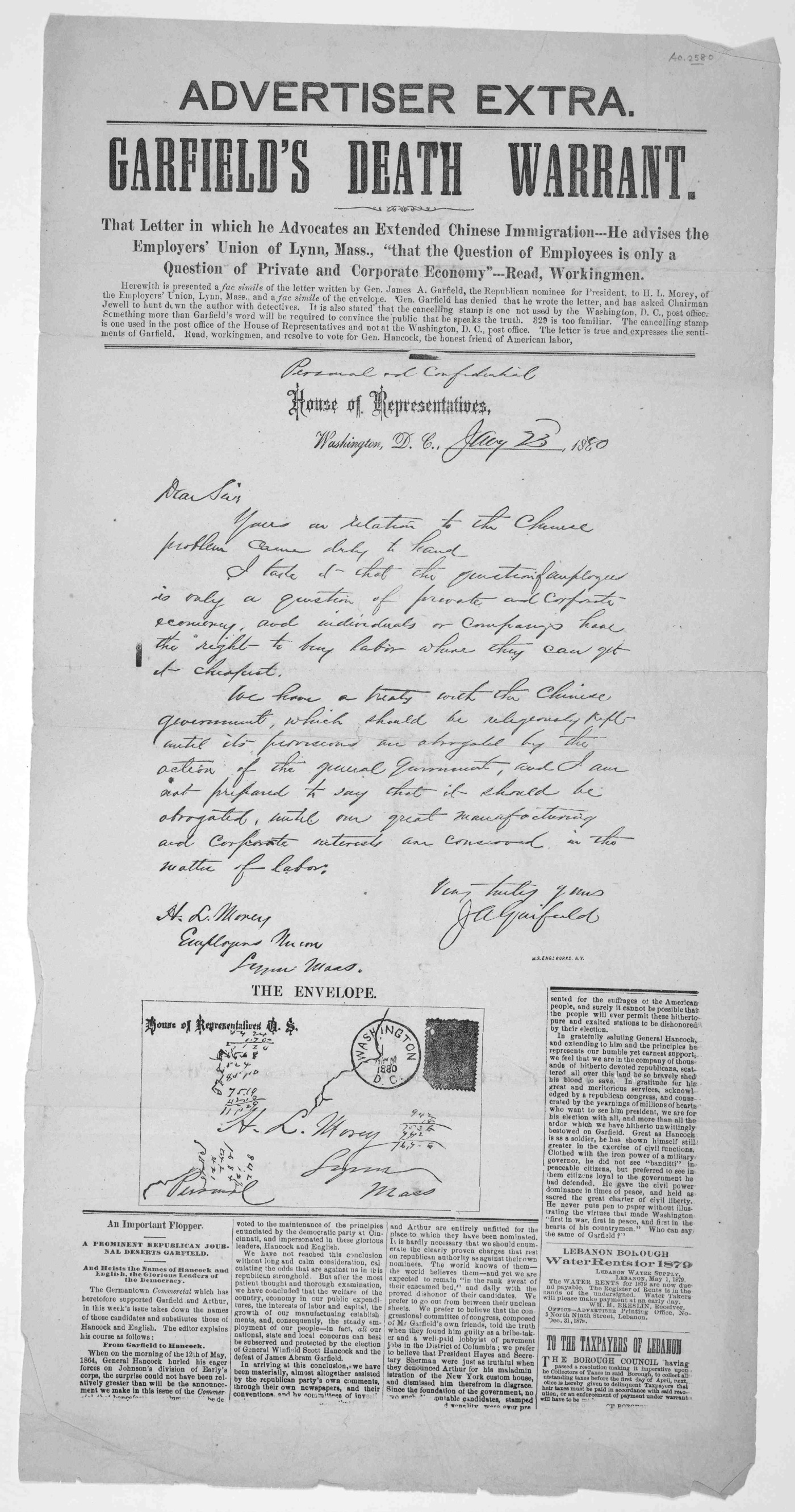
Garfield's Death Warrant: 'Advertiser Extra' reproducing the Morey letter (1880). An "Advertiser Extra", publisher not named on the sheet, 1880. Public domain by age; Library of Congress, Printed Ephemera Collection. The sheet prints a facsimile of the Morey letter and an envelope, states that Garfield "has denied that he wrote the letter" and that it is "true", and tells workingmen to "resolve to vote for Gen. Hancock". It stages a threat to wage-earners from Chinese labour (Fear appeal) and names an out-group as the source of the harm (Scapegoating). The letter was a forgery [5]; whether the sheet's printers knew this is not recorded in the sheet.
Winfield S. Hancock and William H. English (Democratic)
In support
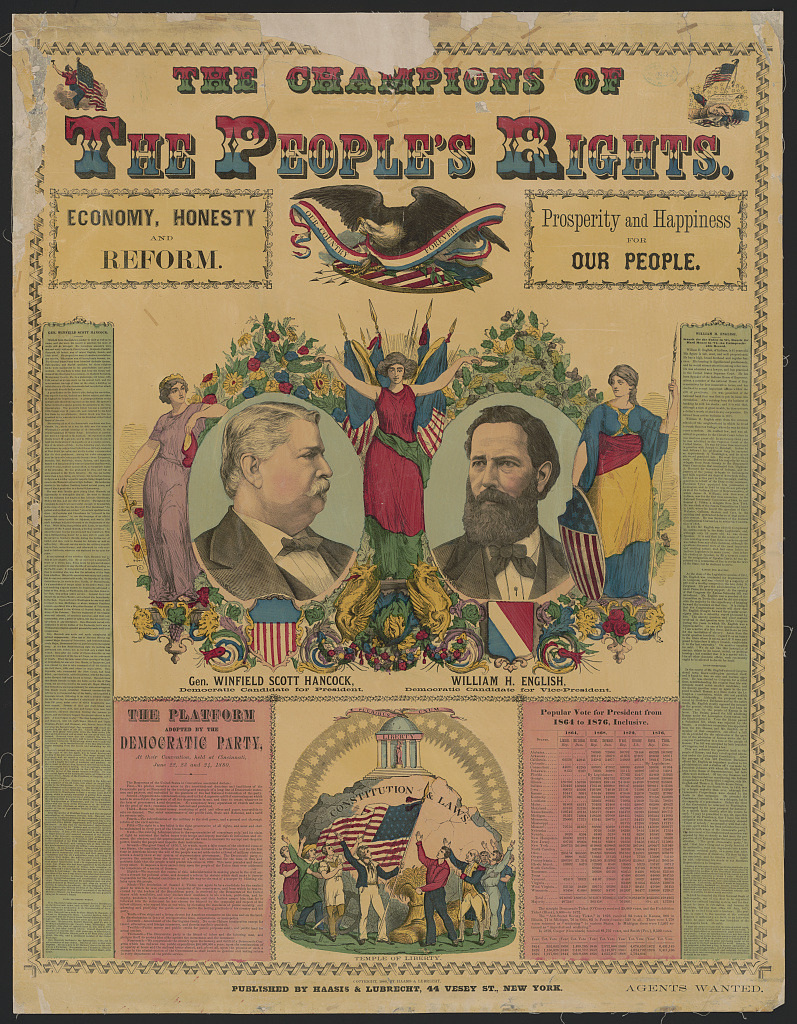
The Champions of the People's Rights: Gen. Winfield Scott Hancock and William H. English. Haasis & Lubrecht, New York, 1880. Public domain by age; Library of Congress. The same publisher and nearly the same layout as the Republican poster: oval portraits, allegorical women, flags, the Democratic platform, a "Temple of Liberty" vignette and a table of past votes. Slogans read "Economy, Honesty and Reform" and "Prosperity and Happiness for Our People" (Glittering generalities); flags and the temple supply the national symbols (Transfer).
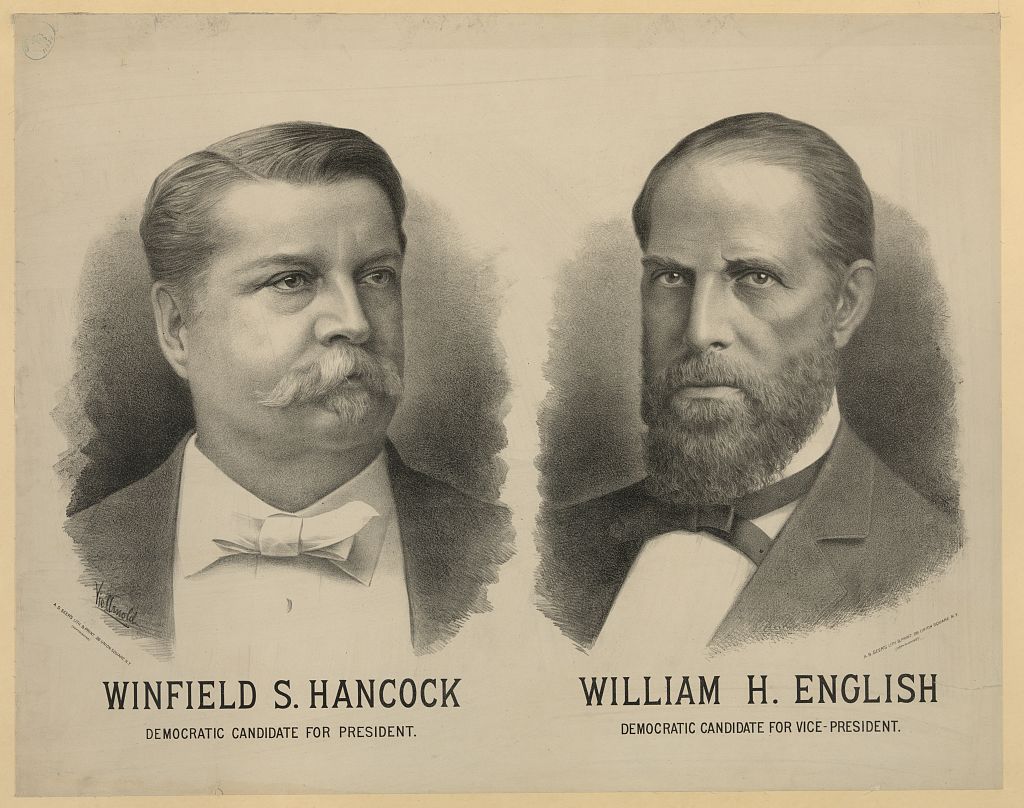
Democratic Candidates: Winfield S. Hancock and William H. English (A. S. Seer lithograph). Vic Arnold for A. S. Seer's, New York, c. July 1880. Public domain by age; Library of Congress. The Democratic counterpart of the Seer's Garfield sheet, same printer and layout: name, likeness and party label (Transfer).
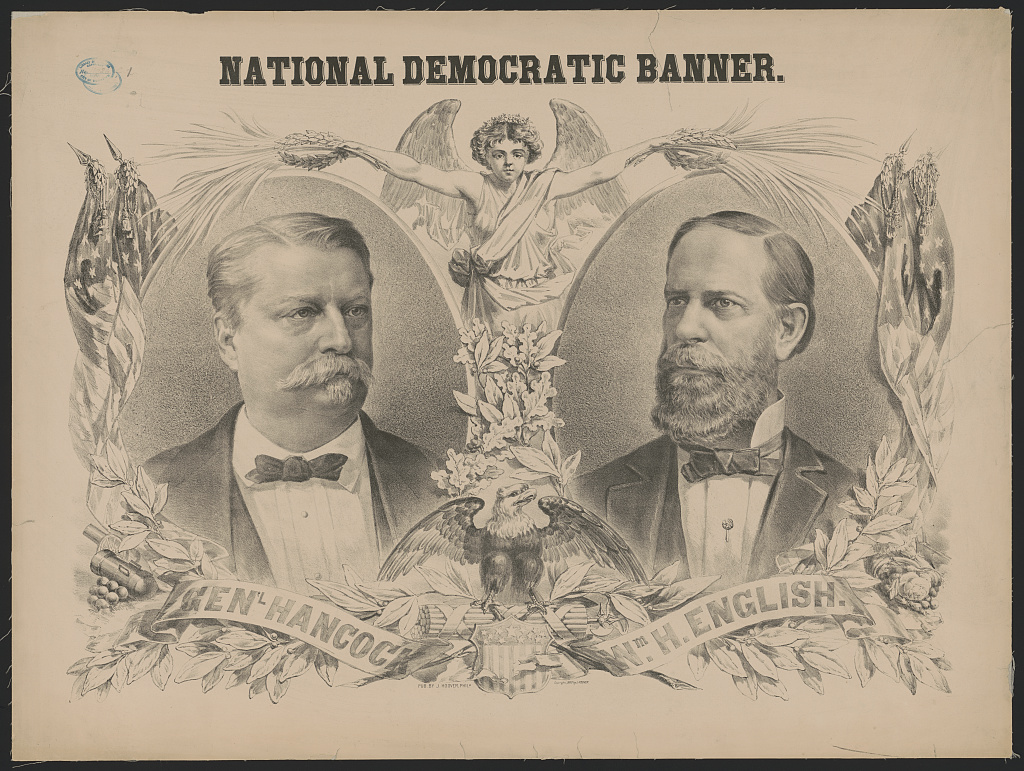
National Democratic Banner: Gen'l Hancock, Wm. H. English. Joseph Hoover, Philadelphia, 1880. Public domain by age; Library of Congress. Portraits framed by flags, an eagle, a shield and a winged figure with wreaths (Transfer).
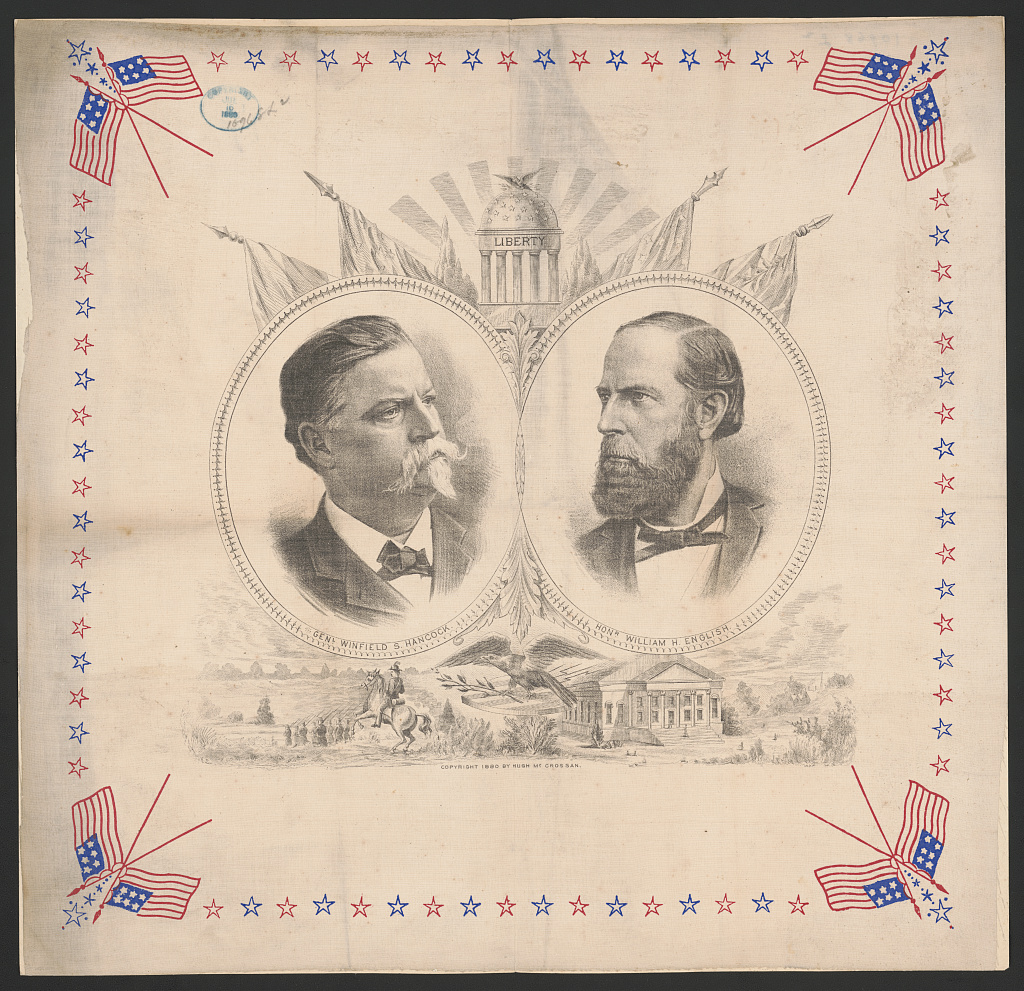
Gen. Winfield S. Hancock and Hon. William H. English (campaign handkerchief, Hugh McCrossan). Hugh McCrossan, copyright 1880, printed on cloth. Public domain by age; Library of Congress. A handkerchief with a mounted-general vignette that carries Hancock's military record into a household object (Transfer).
In opposition
Content note: slavery-era objects and a racial caricature of a Black head appear among the "curiosities".
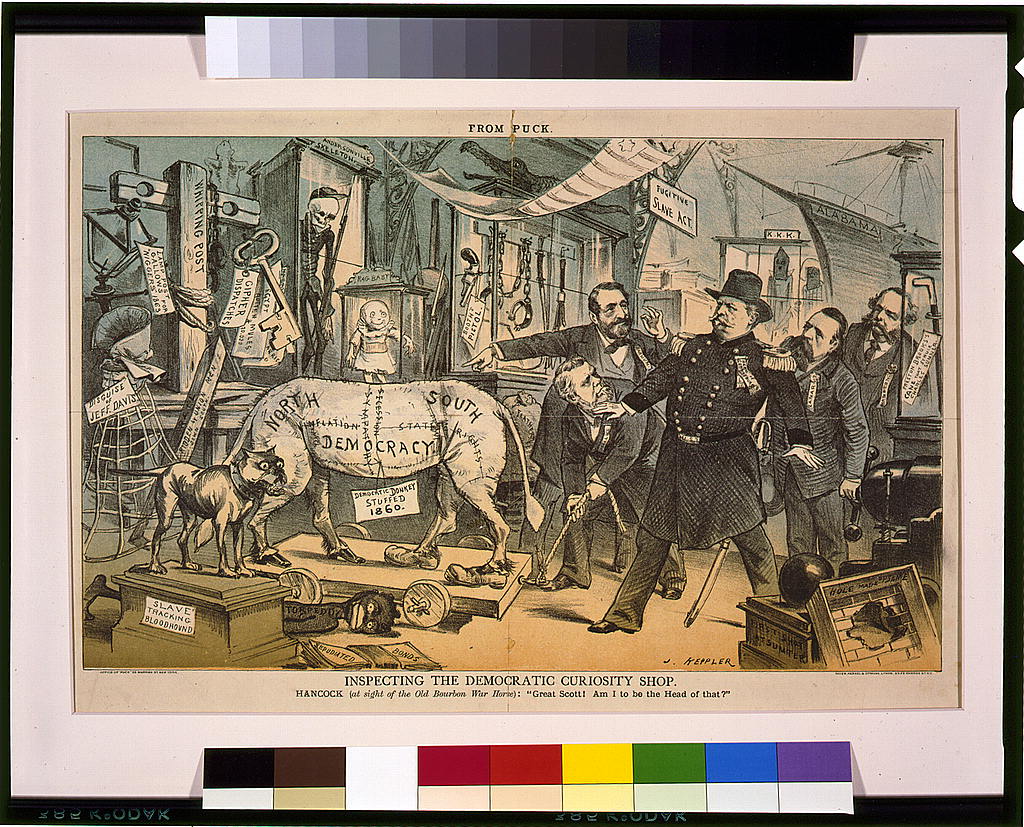
Inspecting the Democratic Curiosity Shop (Puck cartoon, c. 1880). Joseph Keppler in Puck, c. 1880. Public domain by age; Library of Congress. Hancock exclaims "Great Scott! Am I to be the Head of that?" before a stuffed donkey labelled "Democracy", among a whipping post, a "Fugitive Slave Act" sign, a "Slave Tracking Bloodhound", "K.K.K." and "Repudiated Bonds". Past stigma is pasted onto the party behind the nominee (Transfer) under a labelling frame (Name-calling).
James B. Weaver (Greenback-Labor)
No Greenback-Labor party poster, badge or broadside of the 1880 campaign is in the archive yet, and none turned up in the Library of Congress holdings searched. The two objects below are press items, one portrait and one cartoon, so this section has fewer than three party-made objects. Weaver received no electoral votes [2].
In support
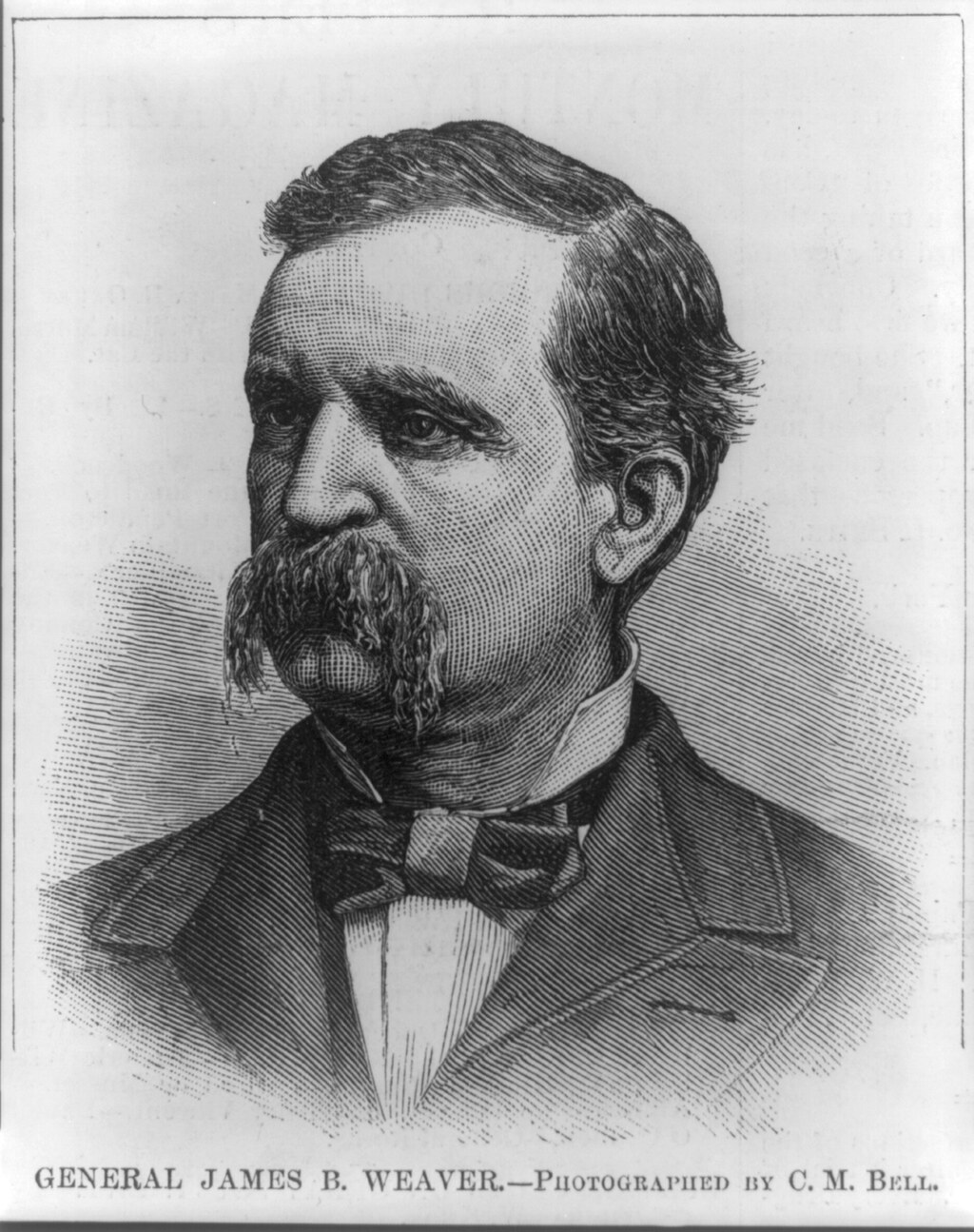
General James B. Weaver, photographed by C. M. Bell (Harper's Weekly, 3 July 1880). Harper's Weekly, 3 July 1880, after a C. M. Bell photograph. Public domain by age; Library of Congress. A news portrait, not a party sheet. The rank "General" carries Weaver's Union Army record into the caption (Transfer), as the other tickets' sheets do with "Gen." for Garfield and Hancock.
In opposition
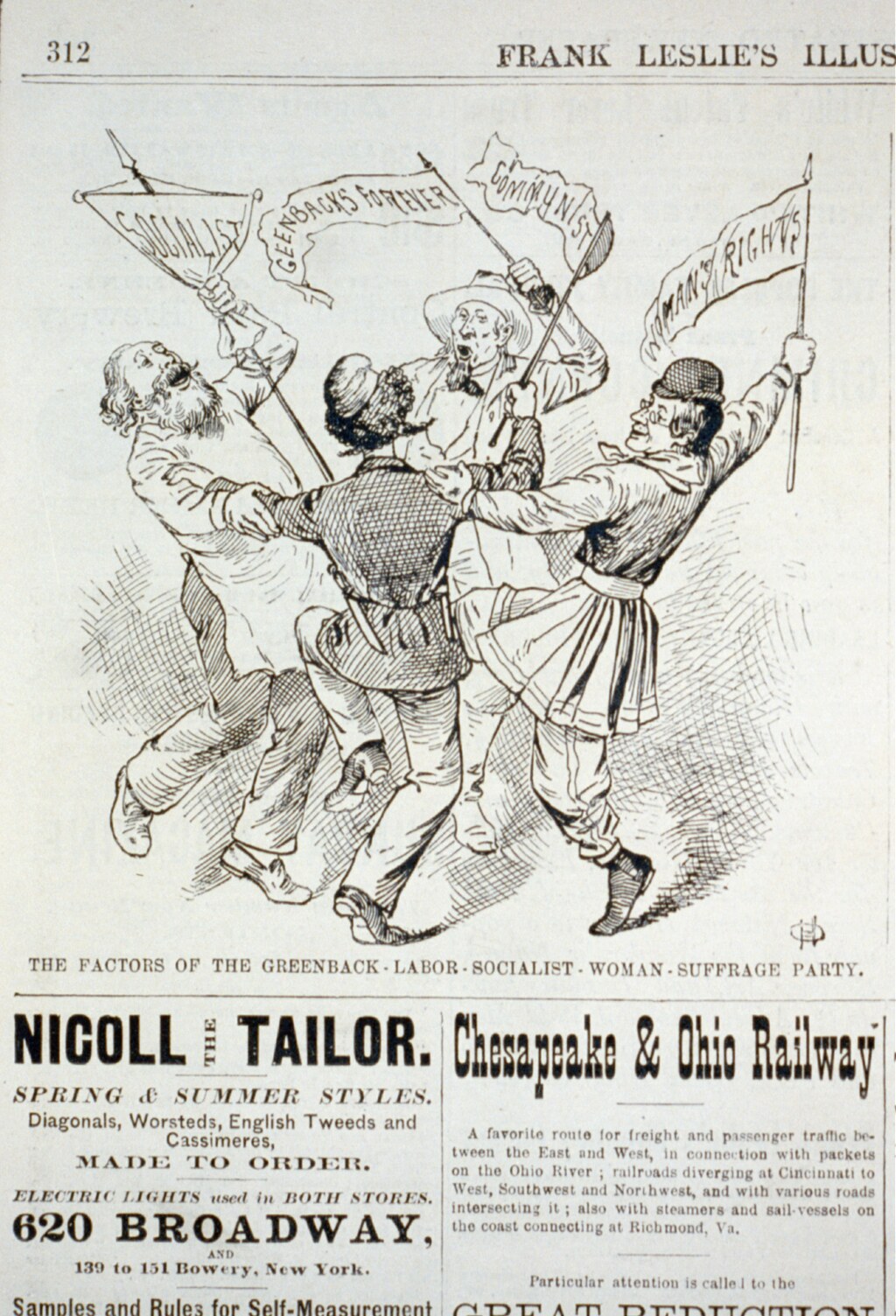
The Factors of the Greenback-Labor-Socialist-Woman-Suffrage Party (Frank Leslie's, 3 July 1880). Frank Leslie's Illustrated Newspaper, 3 July 1880. Public domain by age; Library of Congress. The caption calls the men the "factors" of a "Greenback-Labor-Socialist-Woman-Suffrage Party", with banners reading "Socialist" and "Communist". Loaded labels are fixed to a party by the cartoon's own wording (Name-calling).
Cartoons about both major tickets
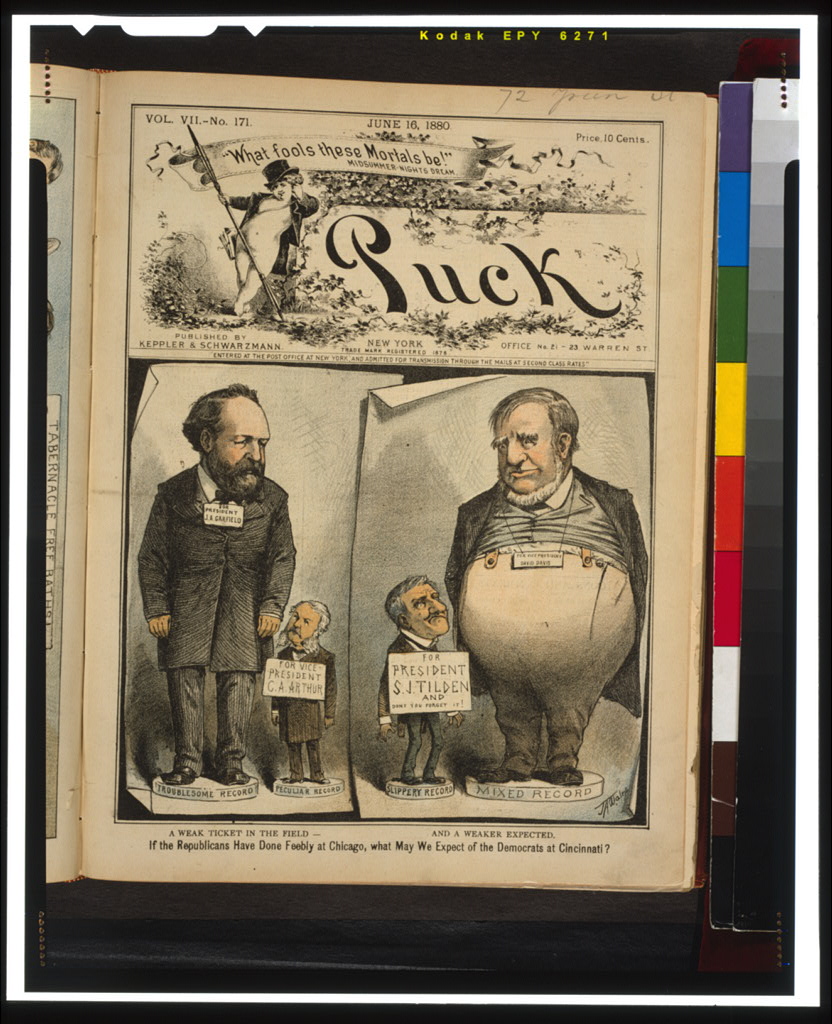
A Weak Ticket in the Field and a Weaker Expected (Puck cover, 16 June 1880). J. A. Wales in Puck, 16 June 1880. Public domain by age; Library of Congress. Each side gets a label, "Troublesome" and "Peculiar" for the Republican pair, "Slippery" and "Mixed" for two Democratic names floated before Cincinnati (Name-calling). The Democratic nominees were not yet chosen when it ran.
Content note: period racial caricature of a Chinese man.
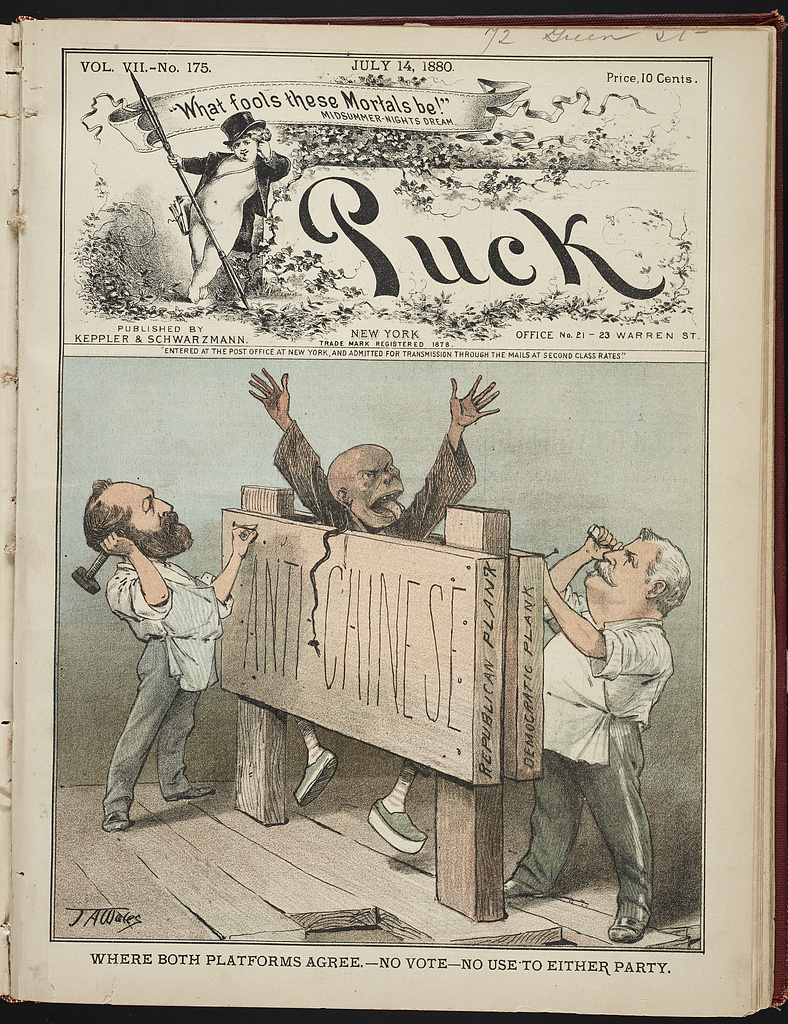
Where Both Platforms Agree: No Vote, No Use to Either Party (Puck cover, 14 July 1880). J. A. Wales in Puck, 14 July 1880. Public domain by age; Library of Congress. Both candidates hammer boards labelled "Republican Plank" and "Democratic Plank" around a figure drawn in racial caricature, under a caption saying the man has "no vote" and is of "no use to either party". The cartoon's target is both platforms; its central figure is the out-group those platforms addressed (Scapegoating).
Techniques visible
- Transfer appears on every side: flags, eagles, allegorical figures and, on the Republican and Democratic posters, past presidents, party and military titles. The two Haasis & Lubrecht posters use nearly the same layout for the two tickets.
- Glittering generalities appears on both major-party posters ("Harmony, Peace and Prosperity" and "Economy, Honesty and Reform"), as slogans with no testable claim.
- Name-calling is used in Puck and Frank Leslie's cartoons against the Republican third-term effort, the Democratic party, both tickets and the Greenback-Labor ticket.
- Fear appeal and Scapegoating are in the Morey-letter broadside, which targets Garfield for a letter that was forged, and in the July Puck cover, which depicts both parties' anti-Chinese planks. The first was made to win votes; the second criticises the parties. Both carry material that would be offensive today, as does the curiosity-shop cartoon, and all three are shown complete.
- The archive holds no Greenback-Labor party material for 1880; the Greenback-Labor section rests on two press items, and that is a gap in the collection, not evidence about the campaign.
Sources
- Miller Center, University of Virginia, "James A. Garfield: Campaigns and Elections", https://millercenter.org/president/garfield/campaigns-and-elections
- National Archives, "Electoral College: 1880 Election", https://www.archives.gov/electoral-college/1880
- The American Presidency Project, "1880 Presidential Election", https://www.presidency.ucsb.edu/statistics/elections/1880
- Library of Congress, "Presidential Election of 1880: A Resource Guide", https://guides.loc.gov/presidential-election-1880
- Wikipedia, "Morey letter", https://en.wikipedia.org/wiki/Morey_letter (secondary source, used for the date and outcome of the letter; the object itself is at https://www.loc.gov/item/2020781913/)