In one line: the Democratic ticket of Grover Cleveland and Thomas A. Hendricks narrowly beat the Republican ticket of James G. Blaine and John A. Logan, 219 electoral votes to 182, in a campaign dominated by each side's attacks on the other candidate's personal record: Blaine's railroad dealings and the Mulligan letters, and Cleveland's acknowledged relationship with Maria Halpin.
Context
The Republican National Convention met in Chicago on 3-6 June 1884 and nominated Blaine, the former senator and secretary of state from Maine, over the incumbent Chester A. Arthur, who lost on the fourth ballot, with Logan of Illinois as his running mate [3][5]. The Democrats met in Chicago from 8 July and named Cleveland, governor of New York, on 11 July, with Hendricks of Indiana [6]. Blaine made tariff protection the centre of his campaign; Cleveland stressed honest administration and civil service reform [3][4]. A group of reform Republicans, the "Mugwumps", refused to support Blaine and backed Cleveland, and were ridiculed by regular Republicans for it [3]. Seven parties nominated candidates; HarpWeek's overview names two as thought able to affect the result, the Greenback-Labor party's Benjamin F. Butler and the Prohibition party's John P. St. John [3].
The result was close. The National Archives records 219 electoral votes for Cleveland and 182 for Blaine (401 cast, 201 needed) [1]. The Library of Congress research guide gives popular votes of 4,915,586 for Cleveland and 4,852,916 for Blaine and notes that Cleveland carried New York by just over 1,000 votes, which supplied his margin in the Electoral College [2]; the American Presidency Project's state table puts the New York count at 563,048 to 562,001 [7]. HarpWeek puts Butler's share at 1.8 per cent and St. John's at 1.5 per cent [3].
The campaign was personal. HarpWeek summarises it as one in which Democrats made Blaine's corruption the focus, while Republicans used the Halpin story against Cleveland; it also records that Blaine's own marriage dates were attacked in turn [3]. Because the Library of Congress's digitised holdings are dominated by one magazine, Puck, which ran cartoons against Blaine, the hosted material is uneven; the page says where.
Campaign literature
| Side | Objects embedded below | Objects further down | Kind |
|---|---|---|---|
| Blaine and Logan (Republican) | 6 | 0 | five ticket prints, broadsides and banners; one cartoon against Cleveland |
| Cleveland and Hendricks (Democratic) | 6 | 8 more (listed in a table below) | three ticket prints; three Puck cartoons |
| Butler (Greenback-Labor) | 3 | 0 | one portrait print by his side; two cartoons against him |
| St. John (Prohibition) | 0 | 0 | none found in digitised public holdings at readable size |
The two big parties' printed ticket portraits are alike in layout, symbols and mottoes; the cartoons differ in kind. The imbalance in count is plain: every 1884 cartoon of this campaign that we could host at readable size and from a verified public-domain source is from Puck, and Puck's cartoons ran against Blaine and Butler. The one Republican-voiced cartoon found, a Judge cover, is hosted; searches of the Library of Congress's online prints turned up no other Republican-voiced 1884 campaign cartoon at readable size.
James G. Blaine and John A. Logan (Republican)
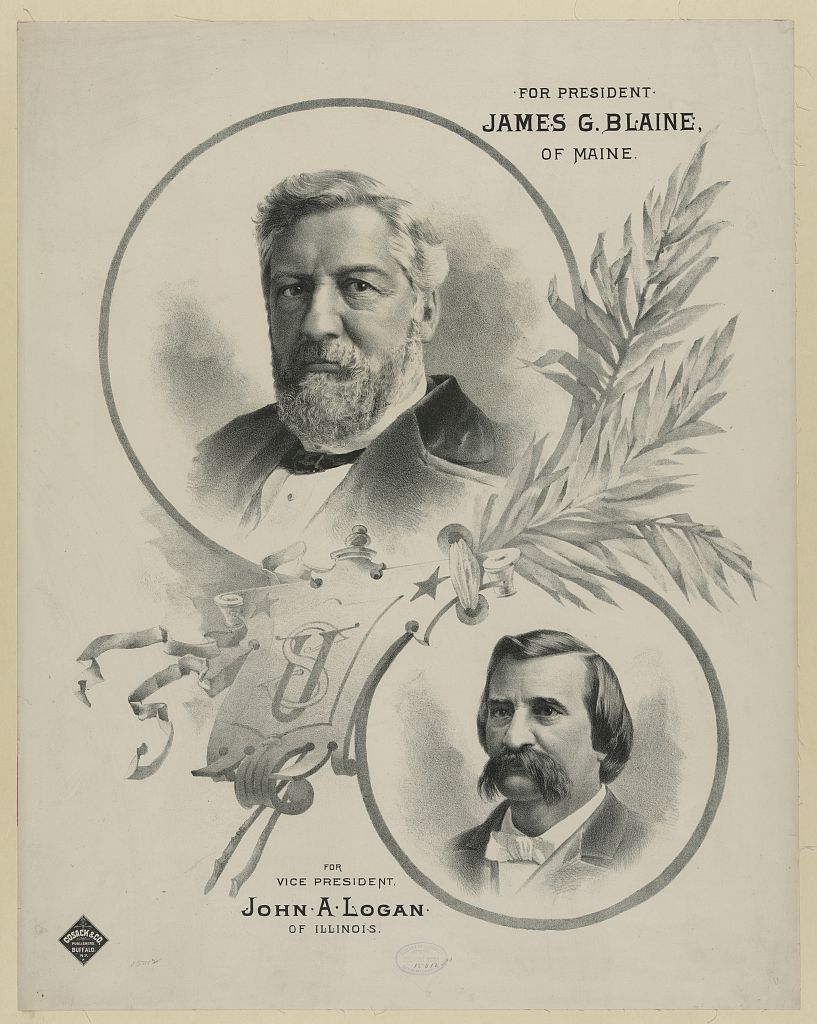
For president James G. Blaine, of Maine - for vice president John A. Logan, of Illinois. Cosack & Co., Buffalo, 24 July 1884. Public domain by age; Library of Congress.
Two roundel portraits linked by a ribbon and a shield lettered "US". The only text is the names and offices; the shield and branches are the sole symbol, which is Transfer at its lightest [8].
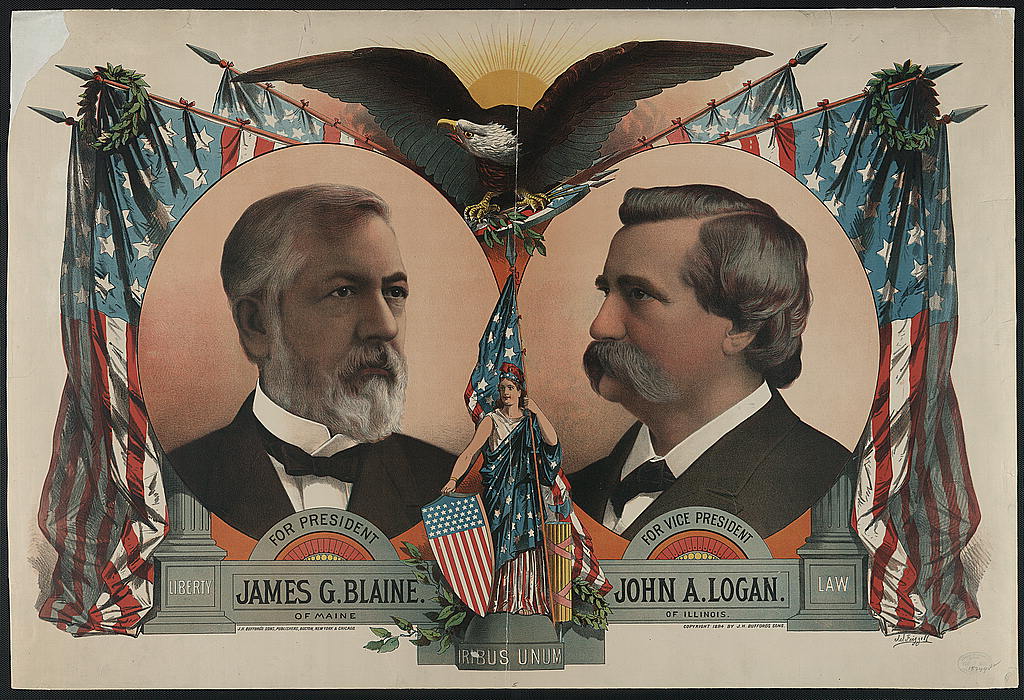
For president, James G. Blaine. For vice president, John A. Logan. J.H. Bufford's Sons, Boston, 1884. Public domain by age; Library of Congress.
Blaine and Logan in ovals under an eagle and draped flags, with a Liberty figure between them and the mottoes "Liberty" and "Law". The flags and Liberty borrow the nation's symbols for the ticket (Transfer); the one-word mottoes name values, not positions (Glittering generalities) [9].
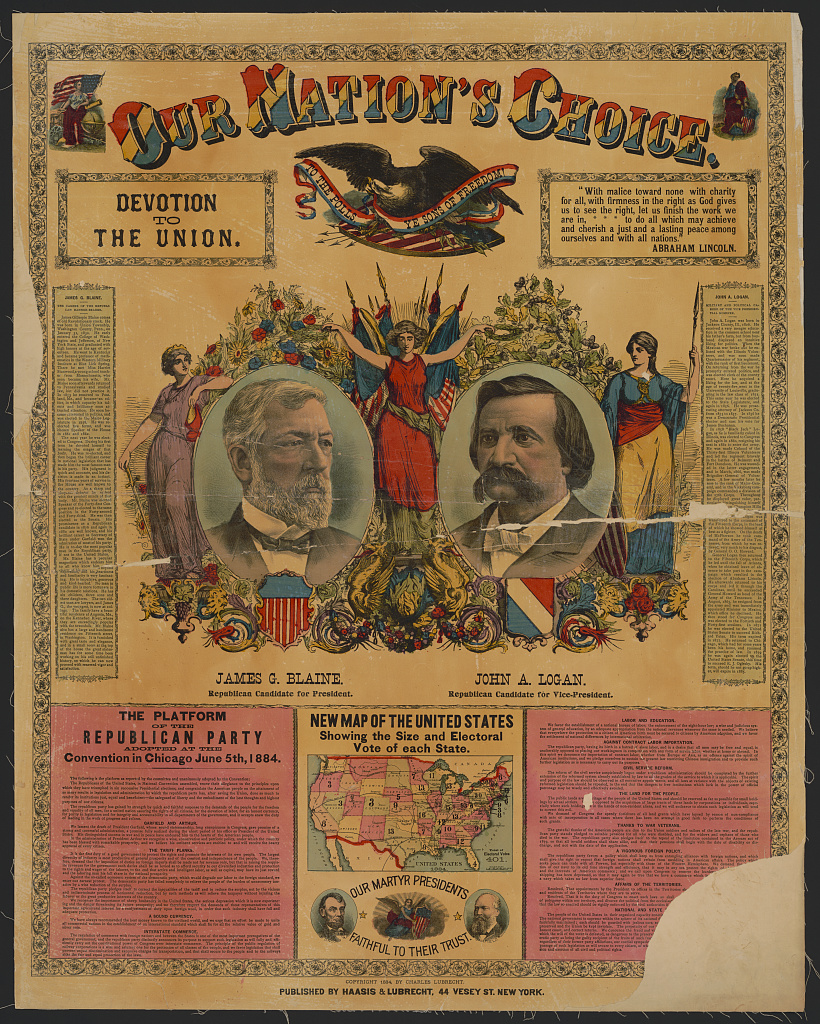
Our nation's choice, James G. Blaine, John A. Logan. Haasis & Lubrecht, New York, 1884. Public domain by age; Library of Congress.
A broadside headed "Devotion to the Union", with a Lincoln quotation, the ticket, biographies, the platform adopted at Chicago, an electoral-vote map and portraits of Lincoln and Garfield as "Our Martyr Presidents". The martyred presidents and the Lincoln quotation borrow prestige (Transfer); "Devotion to the Union" is a virtue phrase (Glittering generalities) [10].
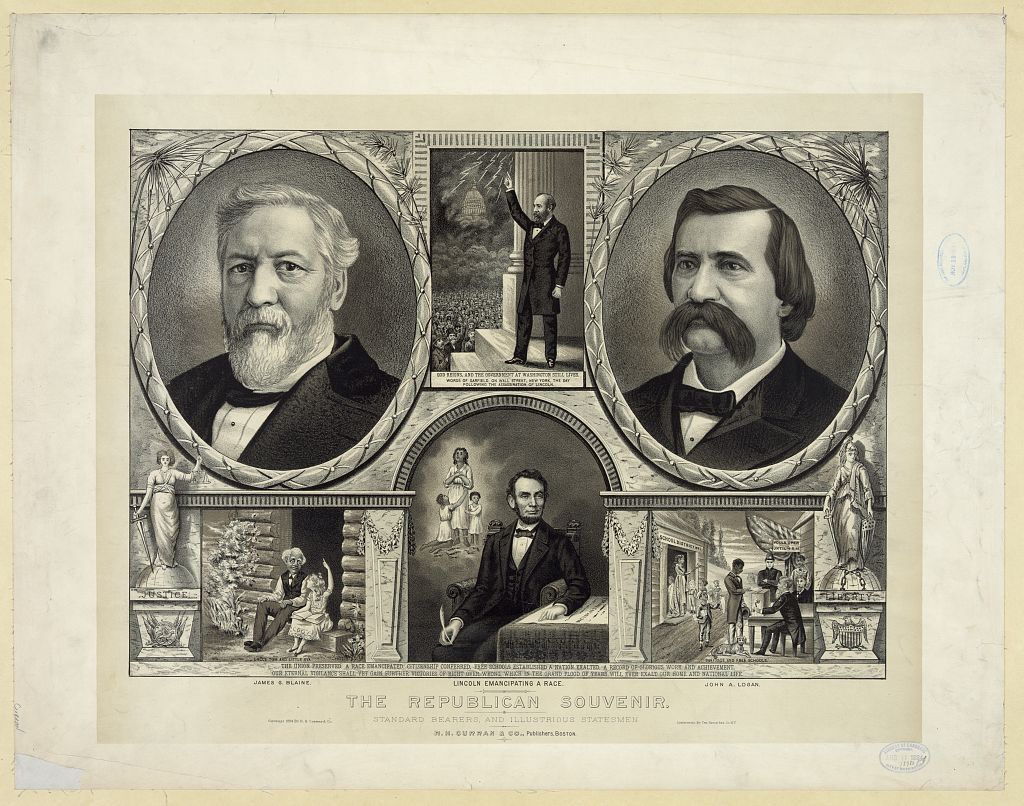
The Republican souvenir. R. H. Curran & Co., Boston, 14 August 1884. Public domain by age; Library of Congress.
Blaine and Logan are set around Garfield speaking after Lincoln's assassination and a seated Lincoln, with the printed legend "The Union preserved, a race emancipated, citizenship conferred, free schools established". The party's founding-era and wartime record is attached to the 1884 ticket (Transfer); the statues of Justice and Liberty are Glittering generalities. Two vignettes show Black Americans in the period's illustrative style [11].
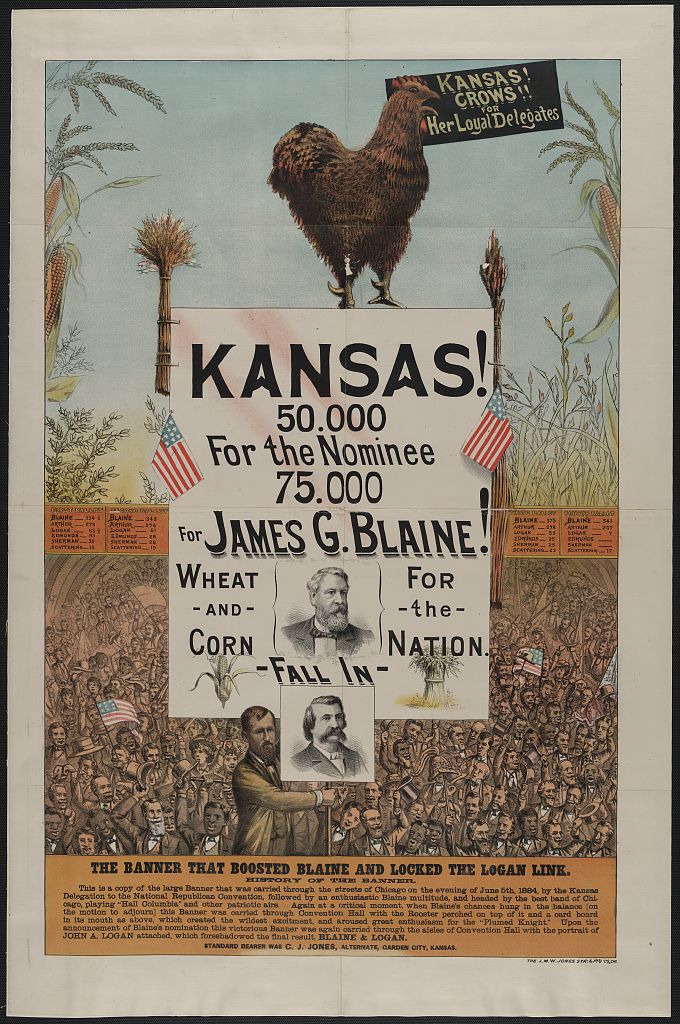
The banner that boosted Blaine and locked the Logan link. J.M.W. Jones Stationery & Printing Co., Chicago, 1884. Public domain by age; Library of Congress.
A reproduction of the Kansas delegation's convention banner: a rooster, corn and wheat, "50,000 for the Nominee, 75,000 for James G. Blaine!", a crowd, and a printed history of how it was carried into the hall. The vote totals and the crowd say "fall in" (Bandwagon); the farm imagery presents the ticket as ordinary Kansas farmers' choice (Plain folks) [12].
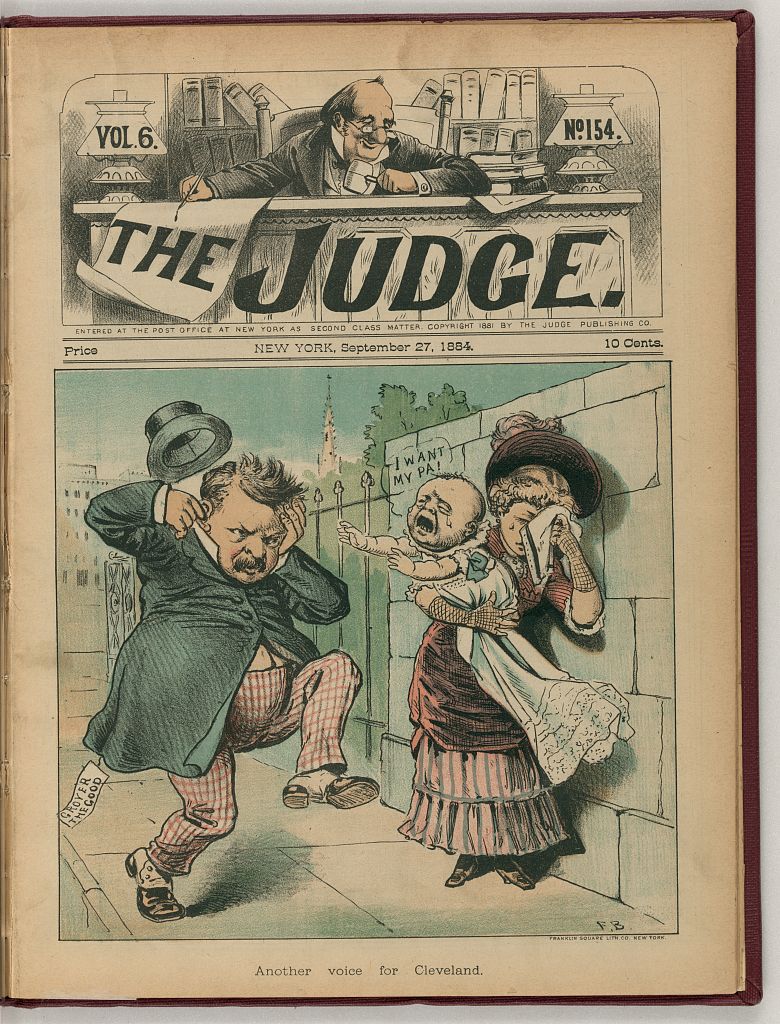
Another voice for Cleveland. Frank Beard, in Judge, 27 September 1884. Public domain by age; Library of Congress.
A crying woman and a baby calling "I want my pa!" confront a flustered man labelled "Grover the Good". The allegation behind it was documented: Cleveland admitted the relationship with Maria Halpin, and is reported to have told his managers to "tell the truth" [3][4]. The cartoon itself does no more than mock, with an ironic label doing the work of an argument (Name-calling) [13]. It alludes to a paternity allegation.
Grover Cleveland and Thomas A. Hendricks (Democratic)
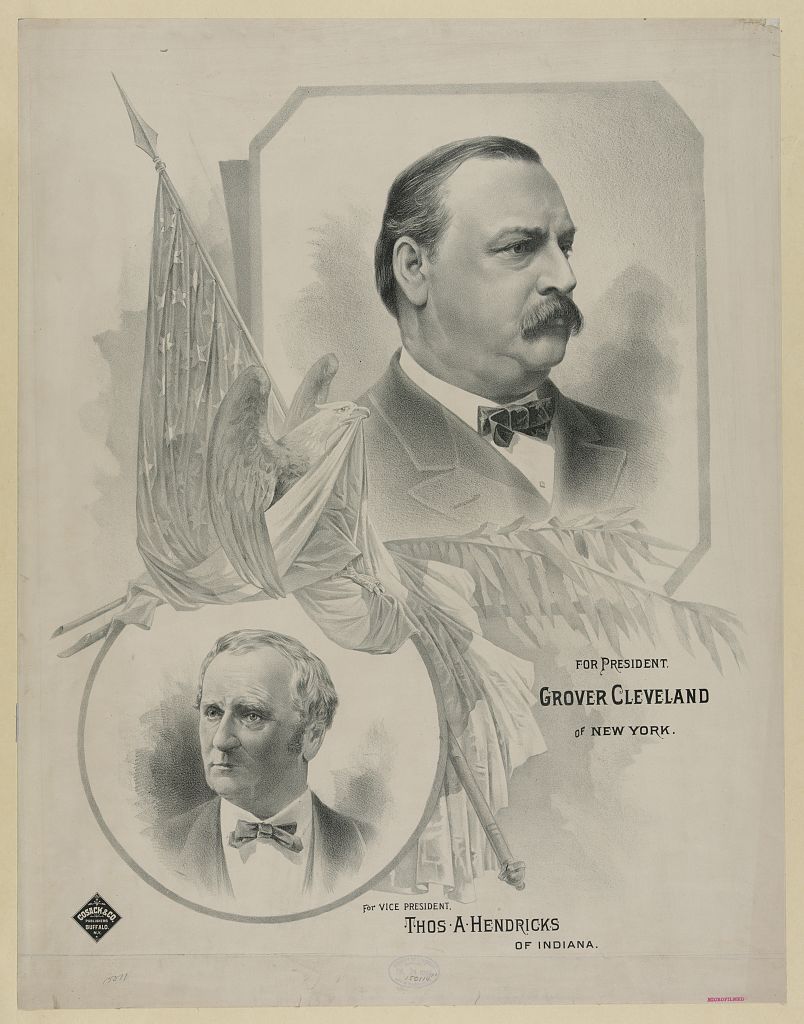
For president Grover Cleveland, of New York - for vice president Thos. A. Hendricks, of Indiana. Cosack & Co., Buffalo, 24 July 1884. Public domain by age; Library of Congress.
The same publisher's matching print: a bust of Cleveland and a roundel of Hendricks, with a flag, an eagle and two branches. As on the Blaine and Logan print, the symbols are the only appeal (Transfer) [14].
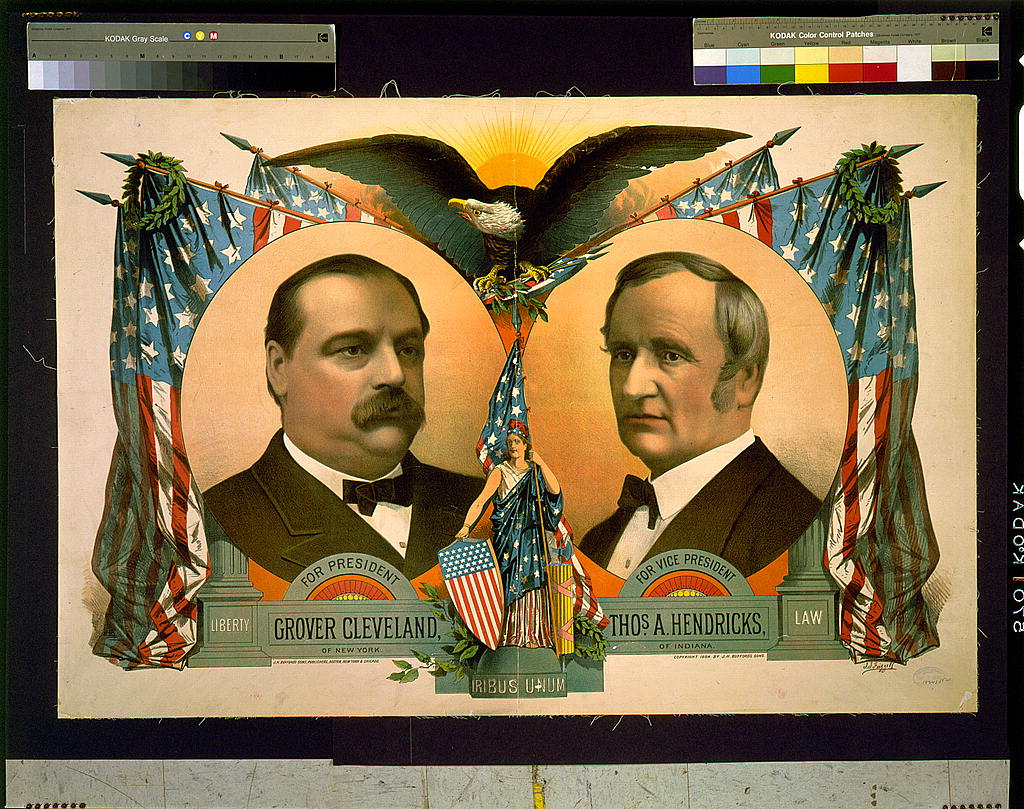
For president, Grover Cleveland of New York. For vice president, Thos. A. Hendricks, of Indiana. J.H. Bufford's Sons, Boston, 1884. Public domain by age; Library of Congress.
The same firm, artist, layout and mottoes as the Republican Bufford poster: ovals under an eagle and flags, a Liberty figure, "Liberty" and "Law". The same two techniques apply on the same definitions: Transfer and Glittering generalities [15].
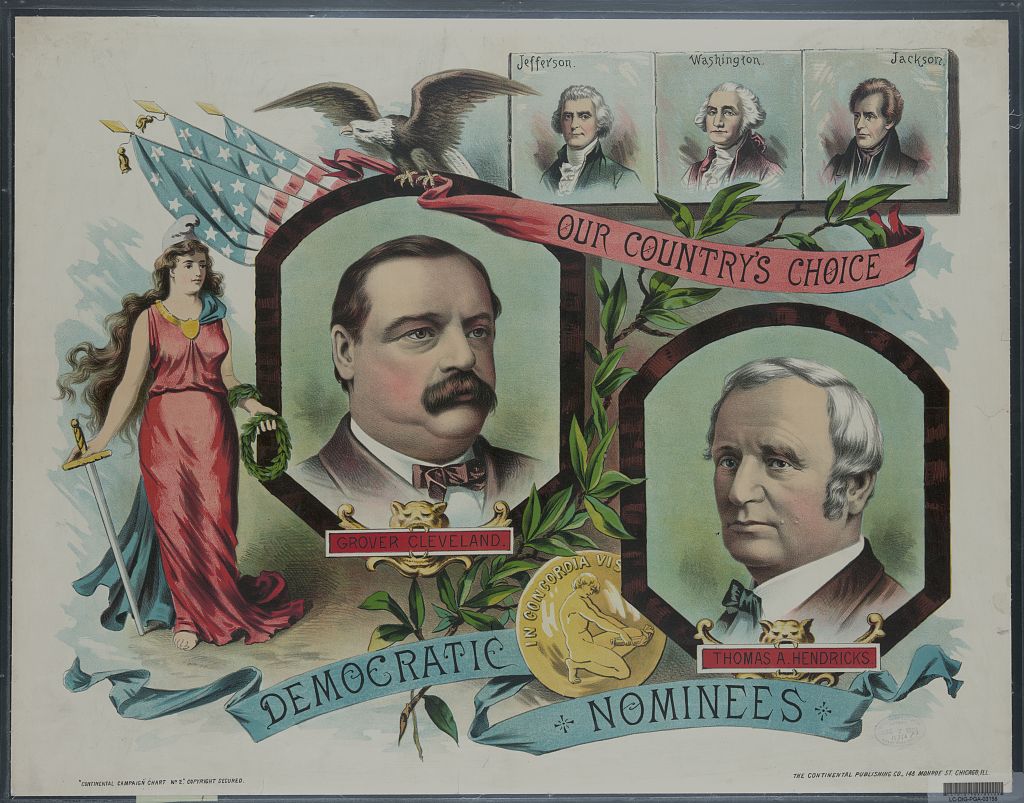
Our country's choice--Democratic nominees. Continental Publishing Co., Chicago, 2 August 1884. Public domain by age; Library of Congress.
Cleveland and Hendricks beside a Liberty figure, with Jefferson, Washington and Jackson across the top. The earlier presidents lend the ticket a lineage (Transfer), as Lincoln and Garfield do on the Republican broadside [16].
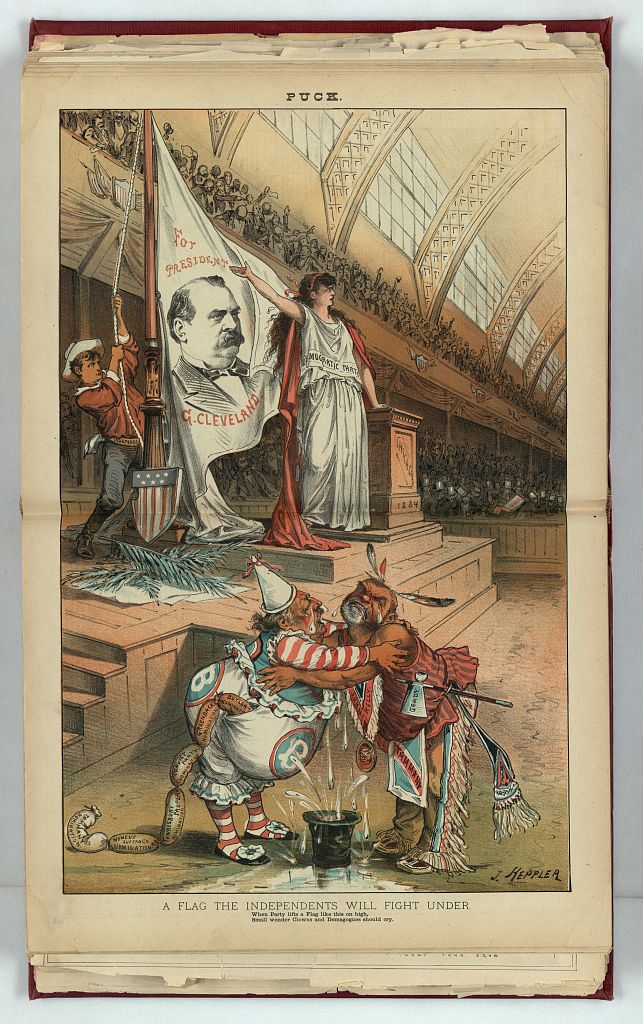
A flag the Independents will fight under. Joseph Keppler, in Puck, 16 July 1884. Public domain by age; Library of Congress.
A Democratic Party figure points to a banner "For President G. Cleveland" while Butler as a clown and John Kelly of Tammany Hall as a Native American weep in the foreground. Two opponents of Cleveland's nomination are shown as a clown and an Indian chief, which is Name-calling; the banner and the party figure put the Independents' choice at the centre (Transfer) [17]. The Kelly figure uses a stock Native American caricature.
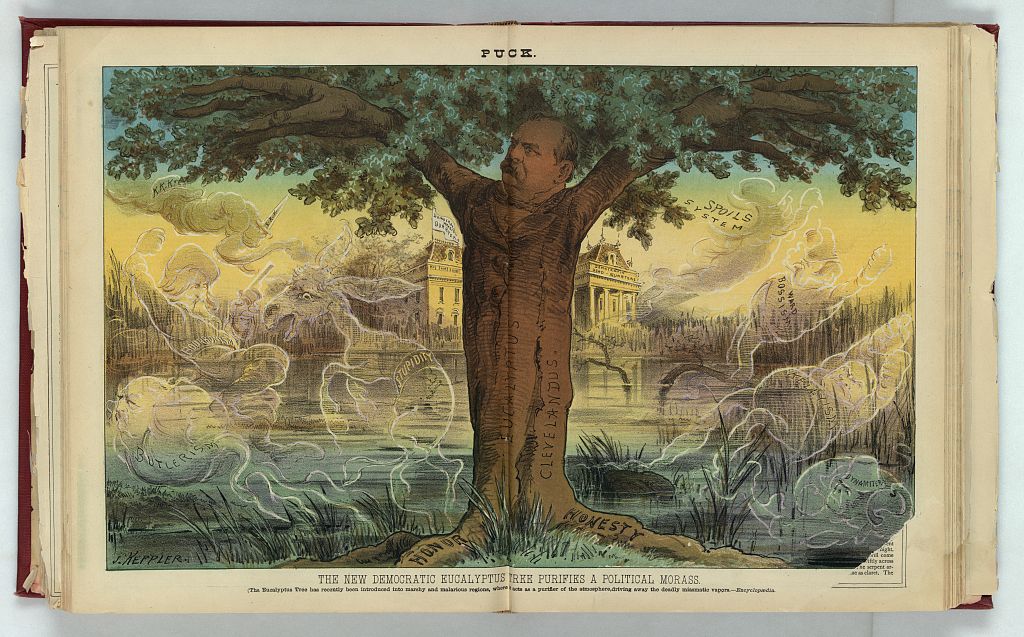
The new Democratic eucalyptus tree purifies a political morass. Joseph Keppler, in Puck, 27 August 1884. Public domain by age; Library of Congress.
Cleveland as a tree whose roots read "Honor" and "Honesty", clearing a swamp of vapours labelled "K.K.K.", "Bourbonism", "Butlerism", "Kellyism" and "Spoils System". The virtue words on the roots stand in for any record (Glittering generalities); the tree borrows the eucalyptus's reputation as a swamp-drainer (Transfer) [18].
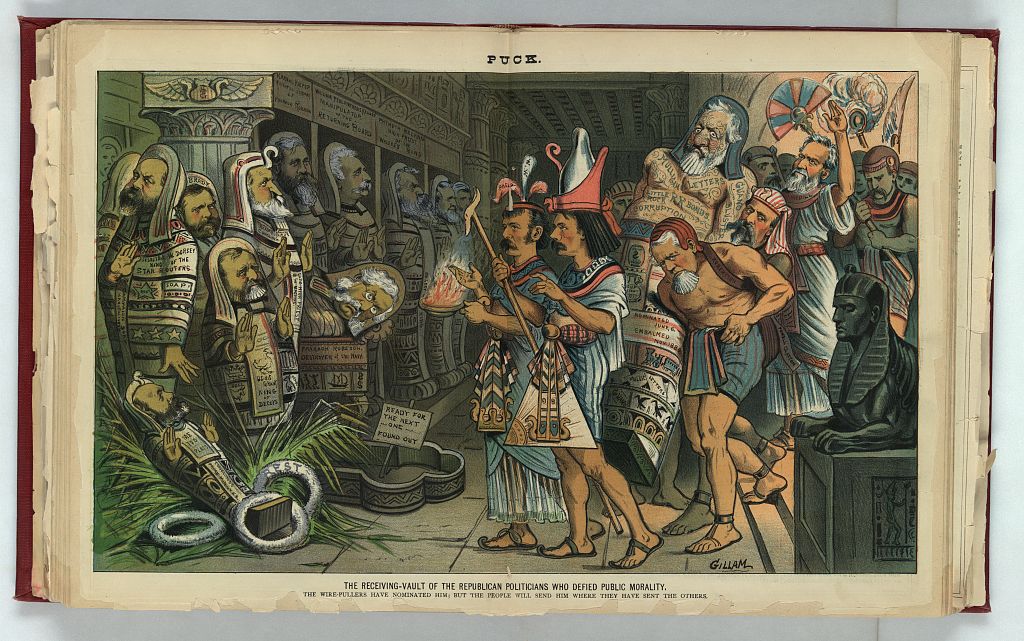
The receiving-vault of the Republican politicians who defied public morality. Bernhard Gillam, in Puck, 11 June 1884. Public domain by age; Library of Congress.
Blaine, "Nominated June 6, Embalmed Nov. 1884", is carried into an Egyptian tomb whose mummies include Grant, Conkling, Dorsey, Brady, Belknap and Robeson. Naming earlier Republicans beside him attaches their stigma to him (Transfer), and "defied public morality" is a label (Name-calling); it is a Democratic-side counterpart of the Judge cover above, with a different target [19].
Further Democratic-side objects in the archive (not embedded)
The archive also hosts eight further 1884 prints, seven of them Puck cartoons and one a Bowman lithograph, all against Blaine or celebrating Cleveland. They are listed, not embedded, so that the two big parties keep equal space on the page. All are public domain by age, Library of Congress.
| Entry | Maker, date | What it shows |
|---|---|---|
| Blaine O'Maine | Keppler, Puck, 23 April 1884 | Blaine chasing a "Presidency" firefly through a swamp, with his "Bad Political Record" and the Mulligan letters trailing behind. |
| With Puck's compliments to the Democratic National Convention at Chicago - 1884 | Graetz, Puck, 9 July 1884 | Tilden and Hancock portraits, with their New York results credited to John Kelly's stance. |
| "Blaine will be vindicated in November" -- N.Y. Tribune | Gillam, Puck, 24 September 1884 | Blaine as a Roman statesman beside Tweed's ghost and named wrongdoers. |
| The "three honest men" of Wall Street declare for Blaine | Opper, Puck, 18 June 1884 | Sage, Gould and Field as swordsmen for Blaine. |
| The end of the republican party After "The Destruction of Jerusalem" by Kaulbach | M. P. Bowman, c1884 | Cleveland as a Roman victor over a ruined Republican party. |
| Shylock's bad bargain | Gillam, Puck, 12 November 1884 | Jay Gould as Shylock, run off by voting blocs after the vote. Contains an antisemitic caricature. |
| "The Mulligan guard lies, but - surrenders" | Keppler, Puck, 19 November 1884 | Blaine's backers flattened by an explosion at the "Claim Agency". |
| "The Germans supported me nobly" -- J.G. Blaine | Opper, Puck, 26 November 1884 | Blaine under three men with "C. & H." pins, including Carl Schurz. |
The entries apply the same definitions as above: Transfer and Name-calling where a cartoon pastes another man's stigma or a label on its target, Card stacking where a list of episodes or two numbers is set out to push one reading.
Benjamin F. Butler (Greenback-Labor)
Butler's side has one hosted object of its own and two made against him. HarpWeek's overview says Republican operatives were thought to have secretly funded his campaign because it was expected to draw from the Democrats, and that the Democratic party secretly funded the Prohibition party's campaign in upstate New York; both are given there as the overview's account and are not checked here against other sources [3].
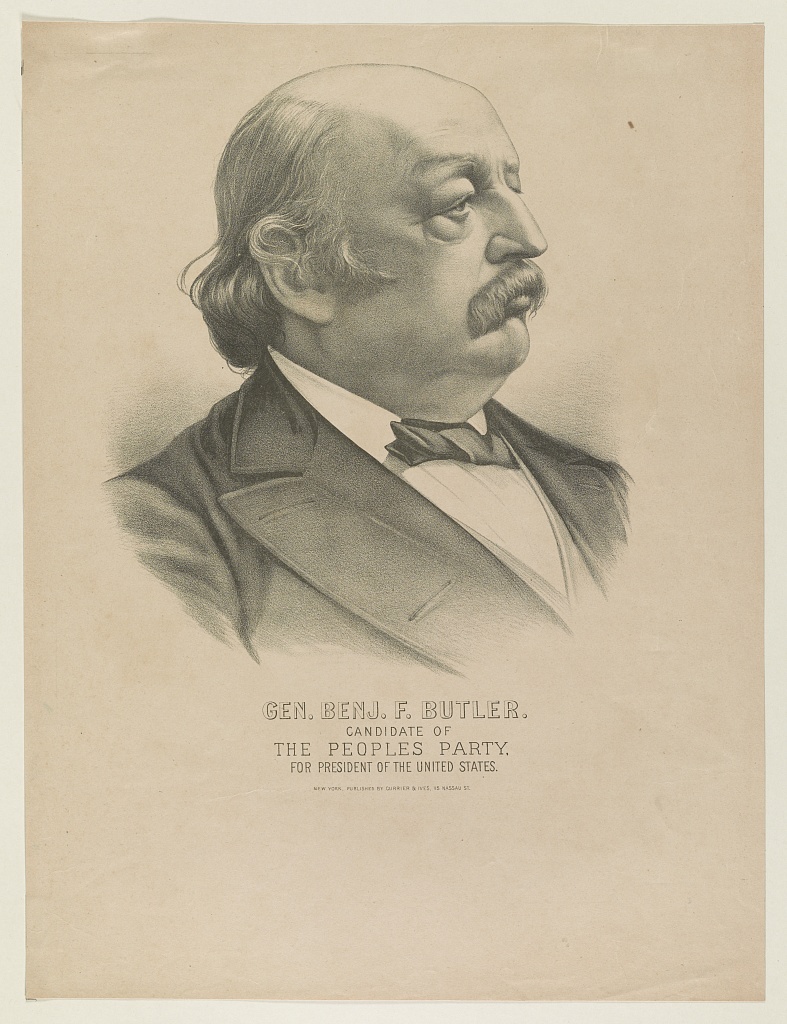
Gen. Benj. F. Butler: candidate of the Peoples Party, for president of the United States. Currier & Ives, New York, [1884?]. Public domain by age; Library of Congress.
A bust portrait in profile, lettered "Candidate of the Peoples Party, for President of the United States". There are no symbols or slogans beyond the party name, so the only appeal is the label (Glittering generalities) [20]. Library of Congress queries the date.
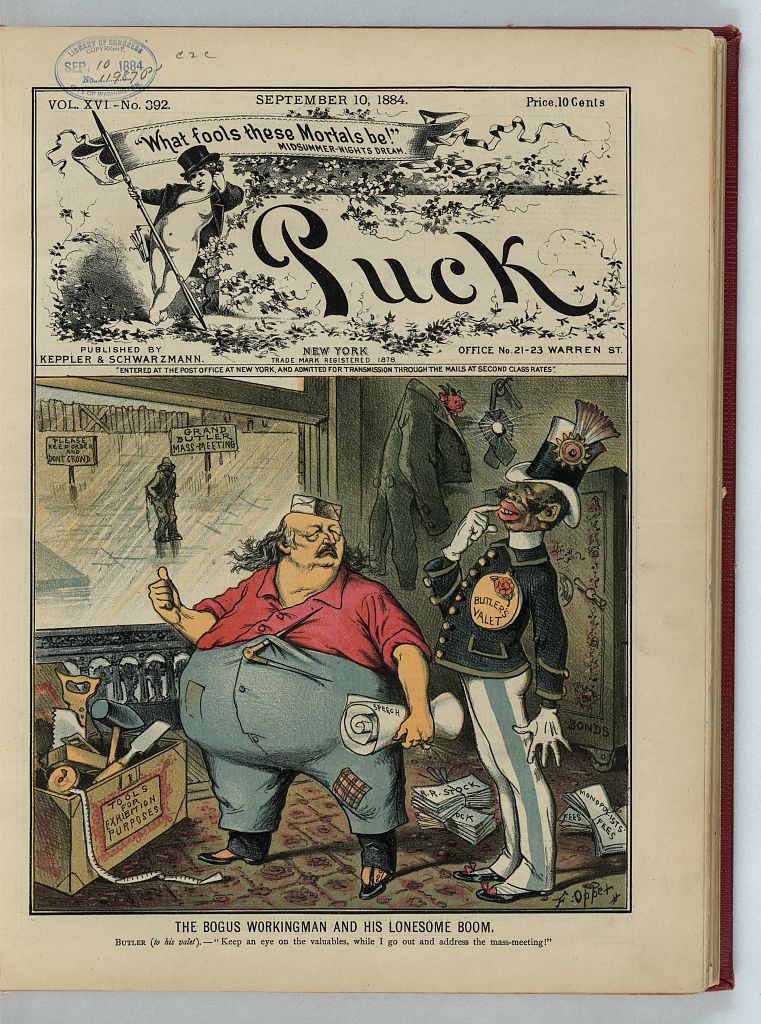
The bogus workingman and his lonsome boom. Frederick Burr Opper, in Puck, 10 September 1884. Public domain by age; Library of Congress.
Butler in a patched workman's shirt beside a box of "Tools for Exhibition Purposes" tells his valet to "keep an eye on the valuables" while he addresses the mass-meeting. The cartoon accuses him of performing a working-class identity (Plain folks) and relies on a label, "bogus" (Name-calling) [21]. The valet is drawn as a Black man in a minstrel-style caricature.
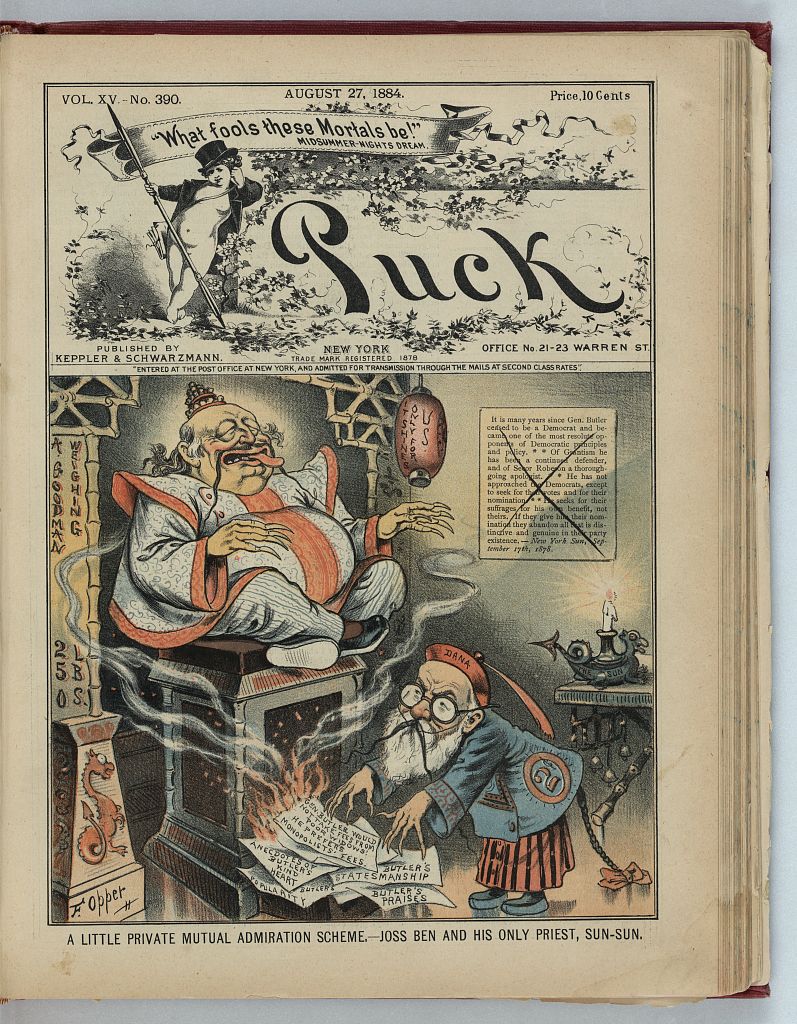
A little private mutual admiration scheme, - Joss Ben and his only priest, Sun-Sun. Frederick Burr Opper, in Puck, 27 August 1884. Public domain by age; Library of Congress.
Butler as a seated Chinese idol and Charles A. Dana as his "only priest" burning papers praising Butler. The idol-and-priest frame is a label that does the work of an argument (Name-calling) [22]. Chinese people are drawn in period caricature.
John P. St. John (Prohibition)
No St. John object is hosted. The only related print found in the Library of Congress's online holdings was "Prohibition party leaders of 1884", dated c1887, and no 1884 St. John campaign print turned up, so there is nothing to embed. HarpWeek records that his candidacy worried Republicans, who tried to persuade him to withdraw, and that his New York vote was harmful to Blaine [3].
Techniques visible
The two big parties' printed tickets use the same few techniques. Both Cosack prints use Transfer only through a flag or shield; both Bufford posters pair Transfer with the one-word mottoes "Liberty" and "Law" (Glittering generalities); the Haasis & Lubrecht broadside and the Continental chart each borrow earlier presidents (Lincoln and Garfield on the Republican sheet; Jefferson, Washington and Jackson on the Democratic one). On the Republican side the banner adds Bandwagon and Plain folks; on the Democratic side the Puck cartoons add Glittering generalities ("Honor", "Honesty").
The attacks on the other side's candidate are where the campaign differs from 1876. Both sides used a personal scandal: Republican material used the documented Halpin allegation against Cleveland, and Democratic material used Blaine's documented railroad dealings and the Mulligan letters against him. In each, mockery and labels do most of the work (Name-calling) and earlier scandals are attached to the target (Transfer). The count differs and is stated plainly: the hosted Puck cartoons against Blaine outnumber the one Republican-voiced cartoon, which reflects what the Library of Congress has digitised, not the relative volume of attacks from each side, which this page cannot measure.
Sources
- National Archives, "1884 Electoral College Results", https://www.archives.gov/electoral-college/1884
- Library of Congress, "Presidential Election of 1884: A Resource Guide", https://guides.loc.gov/presidential-election-1884
- HarpWeek, "1884 Overview" (pages 1-4), https://elections.harpweek.com/1884/Overview-1884-1.htm
- Miller Center, University of Virginia, "Grover Cleveland: Campaigns and Elections", https://millercenter.org/president/cleveland/campaigns-and-elections
- Miller Center, University of Virginia, "Chester A. Arthur: Campaigns and Elections", https://millercenter.org/president/arthur/campaigns-and-elections
- Library of Congress, "1884 Presidential Election of Grover Cleveland: Topics in Chronicling America" (timeline), https://guides.loc.gov/chronicling-america-1884-presidential-election
- The American Presidency Project, "Presidential Election of 1884", https://www.presidency.ucsb.edu/statistics/elections/1884
- Library of Congress, Cosack & Co., "For president James G. Blaine, of Maine" (item 2012647277), https://www.loc.gov/item/2012647277/
- Library of Congress, J.H. Bufford's Sons, "For president, James G. Blaine" (item 2003688067), https://www.loc.gov/item/2003688067/
- Library of Congress, Haasis & Lubrecht, "Our nation's choice, James G. Blaine, John A. Logan" (item 2018695395), https://www.loc.gov/item/2018695395/
- Library of Congress, "The republican souvenir" (item 2012647245), https://www.loc.gov/item/2012647245/
- Library of Congress, "The banner that boosted Blaine and locked the Logan link" (item 2004670607), https://www.loc.gov/item/2004670607/
- Library of Congress, "Another voice for Cleveland" (Judge, 27 September 1884; item 95522869), https://www.loc.gov/item/95522869/
- Library of Congress, Cosack & Co., "For president Grover Cleveland, of New York" (item 2012647278), https://www.loc.gov/item/2012647278/
- Library of Congress, J.H. Bufford's Sons, "For president, Grover Cleveland of New York" (item 97500909), https://www.loc.gov/item/97500909/
- Library of Congress, "Our country's choice--Democratic nominees" (item 93500893), https://www.loc.gov/item/93500893/
- Library of Congress, "A flag the Independents will fight under" (item 2012645250), https://www.loc.gov/item/2012645250/
- Library of Congress, "The new Democratic eucalyptus tree purifies a political morass" (item 2012645434), https://www.loc.gov/item/2012645434/
- Library of Congress, "The receiving-vault of the Republican politicians who defied public morality" (item 2012645208), https://www.loc.gov/item/2012645208/
- Library of Congress, "Gen. Benj. F. Butler: candidate of the peoples party" (item 2001699799), https://www.loc.gov/item/2001699799/
- Library of Congress, "The bogus workingman and his lonsome boom" (item 2011661825), https://www.loc.gov/item/2011661825/
- Library of Congress, "A little private mutual admiration scheme, - Joss Ben and his only priest, Sun-Sun" (item 2012645433), https://www.loc.gov/item/2012645433/