Also called Discounting-cue decay, Source amnesia
A discounted source is forgotten faster than the claim, so the claim later feels ownerless and true.
The tell
The story outlives the correction or the 'this is a state outlet' label.
Not this
A claim that remains well-sourced over time.
History and effect
Documented in Carl Hovland's Yale persuasion research: a message from a discredited source gains persuasive power over time as the audience forgets the source while keeping the claim.
It lets a claim outlive its own correction, because memory for the discounting cue decays faster than memory for the content.
Lineage: Hovland / Yale; discounting-cue decay
How it works
The sleeper effect describes what happens in an audience's memory over time, not a kind of message. A persuasive claim arrives together with a discounting cue: a known low-credibility source, a "state-affiliated media" label, a disclaimer, or a correction. At first the cue holds the claim's impact down. Over the following days and weeks, the cue and the claim can lose their hold on memory at different rates, or come apart so that the claim is recalled without the reason to doubt it. When the audience later thinks about the topic, the claim comes to mind as something they simply know, and its persuasive effect can end up larger than it was right after exposure.
Researchers distinguish two versions. In a relative sleeper effect, the gap between a credible and a discredited source closes over time, often mainly because the persuasive effect of the credible source fades. In an absolute sleeper effect, agreement with the discredited message actually rises over time. Only the absolute version would let a sender gain from being disbelieved, and it is the version that has proved hardest to produce reliably.
For a sender, the pattern implies that a claim does not need to be believed at first. It needs arguments or images with force of their own, while whatever discounts it (the outlet's reputation, the label, the correction) is weaker, less memorable, or arrives later. That is why FRAME places the sleeper effect next to Disclosure theater and Narrative laundering: a label can be present and still not travel with the claim in memory. It is also why the tag needs care. The effect is an outcome measured in audiences over time, so it cannot be diagnosed from a single poster or post, and the conditions under which it appears are narrower than popular accounts suggest.
Why it works
The research record runs in four stages, and it is more cautious than the term's reputation.
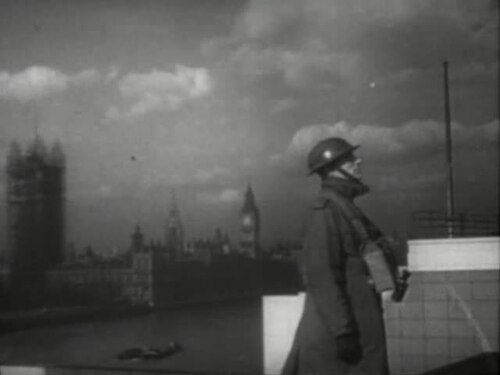
The effect was first named in the U.S. Army's wartime studies of Frank Capra's Why We Fight films. Carl Hovland, Arthur Lumsdaine and Fred Sheffield found that on some opinion items, soldiers who saw The Battle of Britain showed more change nine weeks after viewing than five days after. They suggested that viewers had initially discounted the film as propaganda and later forgot the discount while keeping the content (Hovland, Lumsdaine and Sheffield 1949). The archive's Why We Fight: The Battle of Britain (film frame) entry shows the film.
Hovland and Walter Weiss then tested the idea directly. They gave students identical articles attributed either to trusted sources or to distrusted ones; an article on the feasibility of an atomic-powered submarine, for instance, was credited either to J. Robert Oppenheimer or to Pravda. Right after reading, the trusted attributions produced more opinion change. Four weeks later the difference had largely disappeared: agreement had fallen in the trusted condition and risen in the distrusted one (Hovland and Weiss 1951). Most of the convergence came from the trusted sources losing force; the rise for the distrusted sources was smaller. Herbert Kelman and Hovland then showed that reminding people of the source at the delayed test restored the original difference, which suggested that the source had become disconnected from the message rather than erased (Kelman and Hovland 1953).
The second stage was failure. Paulette Gillig and Anthony Greenwald ran a series of experiments designed to produce the effect and could not, and asked in their title whether it was time to lay the sleeper effect to rest (Gillig and Greenwald 1974). Thomas Cook and colleagues replied that many null studies had not met the conditions the effect requires: a message with a strong initial impact, a cue strong enough to suppress it, and a delay long enough for the two to separate (Cook et al. 1979).
The third stage identified those conditions more exactly. Anthony Pratkanis and colleagues produced reliable sleeper effects when the discounting cue came after the message rather than before it, and proposed a "differential decay" account: the impact of the message and the impact of the cue fade at different rates, and when the cue fades faster, persuasion rises (Pratkanis et al. 1988). The fourth stage was synthesis. Tarcan Kumkale and Dolores Albarracín's meta-analysis found that the effect is real but conditional. It appeared most reliably when the cue followed the message and when recipients had the motivation or ability to think about the arguments, and it was weak or absent in many other conditions (Kumkale and Albarracín 2004). Most of this evidence comes from laboratory studies with student samples and delays of weeks, so how often it operates in real information environments is not well measured.
Neighbouring memory research explains why the mechanism is plausible. People are generally better at remembering what they learned than where they learned it, and source monitoring is an effortful judgment that fails under load and delay (Johnson, Hashtroudi and Lindsay 1993). Familiarity from earlier exposure raises later judgments of truth even when the original source is not recalled (Hasher, Goldstein and Toppino 1977; Begg, Anas and Farinacci 1992). FRAME's Learn library covers the familiarity effect in Illusory truth effect and the persistence of corrected claims in Continued influence effect.
Examples across eras and sides
- U.S. Army, Why We Fight (United States, 1943). The founding observation came from a government testing its own propaganda on its own soldiers. The Army Research Branch found that some opinion effects of The Battle of Britain grew between five days and nine weeks after viewing, and its researchers proposed that recruits forgot they had discounted the film as official propaganda (Sources: Hovland, Lumsdaine and Sheffield 1949). See Why We Fight: The Battle of Britain (film frame).
- A Soviet newspaper as the discounting cue (United States, 1951). In the early Cold War laboratory study, attribution to Pravda served as the low-credibility source for American students, and the discount it imposed had largely faded after four weeks (Sources: Hovland and Weiss 1951). The study used a real state outlet's reputation, though the articles themselves were written by the researchers, not by Pravda.
- Negative political advertising (United States, 1990s). Ruth Ann Weaver Lariscy and Spencer Tinkham tested attack advertisements, whose sponsor (the rival candidate) is an obvious reason to discount them, and reported that some of their effect on evaluations of the targeted candidate grew over a delay (Sources: Lariscy and Tinkham 1999). The study concerns the format, which candidates of both major parties use, not any one campaign.
- Retracted war claims (United States, Germany and Australia, 2003). Stephan Lewandowsky and colleagues asked people in three countries about claims from the invasion of Iraq that had later been retracted. Many U.S. respondents who remembered a retraction still believed the original claim, while German and Australian respondents were more skeptical overall (Sources: Lewandowsky et al. 2005). This is the continued influence effect rather than the sleeper effect in the strict sense, since many respondents remembered the correction; it is included because it shows the same outcome, a claim outliving its correction, in a democracy's wartime information environment.
- Fading fact-checks (United States, United Kingdom and Canada, 2020). John Carey and colleagues found that fact-checks reduced COVID-19 misperceptions, but that the effects were short-lived and largely gone within weeks (Sources: Carey et al. 2022). A related Australian study found that belief in corrected claims crept back up over time (Sources: Swire, Ecker and Lewandowsky 2017). These studies measure the decay of the correction rather than the forgetting of a source, the mirror image of the classic design, with the same practical result.
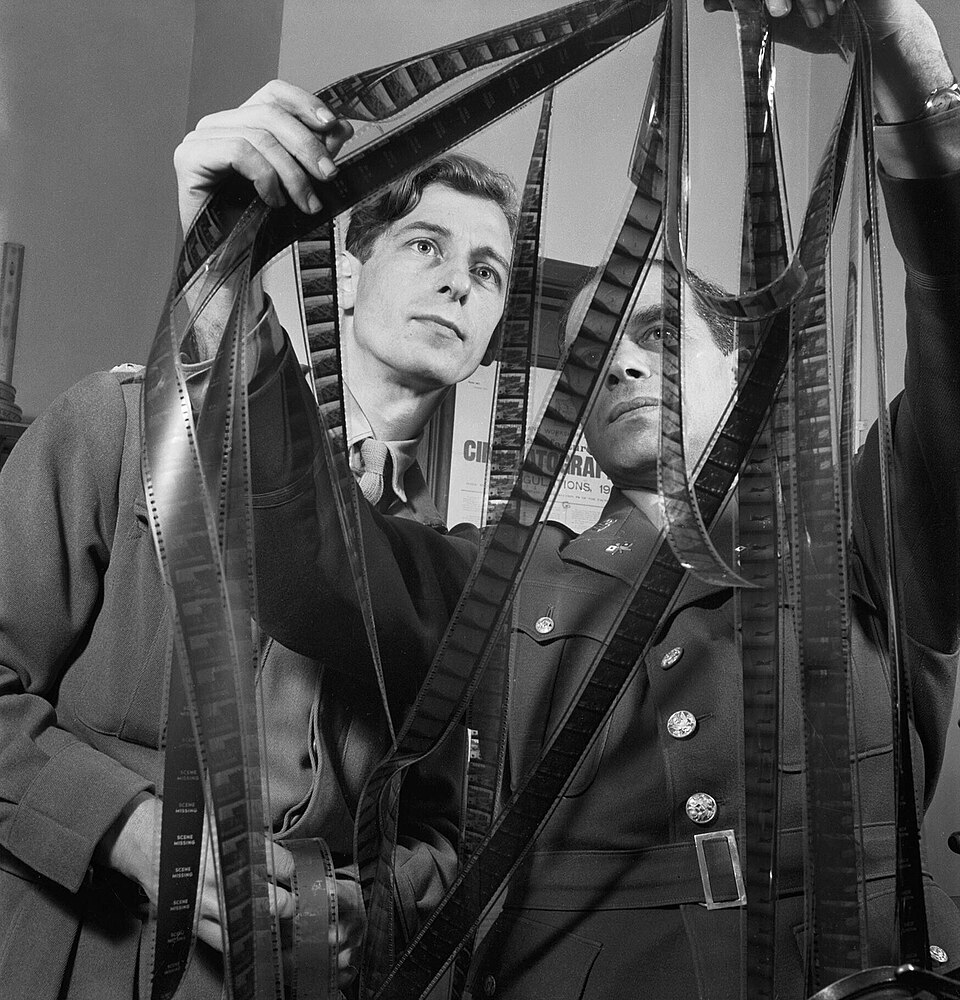
Colonel Frank Capra of the U.S. Army Signal Corps (right), who directed the Why We Fight series, with Captain Roy Boulting of the British Army Film Unit, examining film while editing Tunisian Victory, February 1944. The photograph is not of a Why We Fight film. Ministry of Information photograph, Imperial War Museums D 18377; public domain (Crown copyright expired for photographs taken before 1957, per the Commons record).
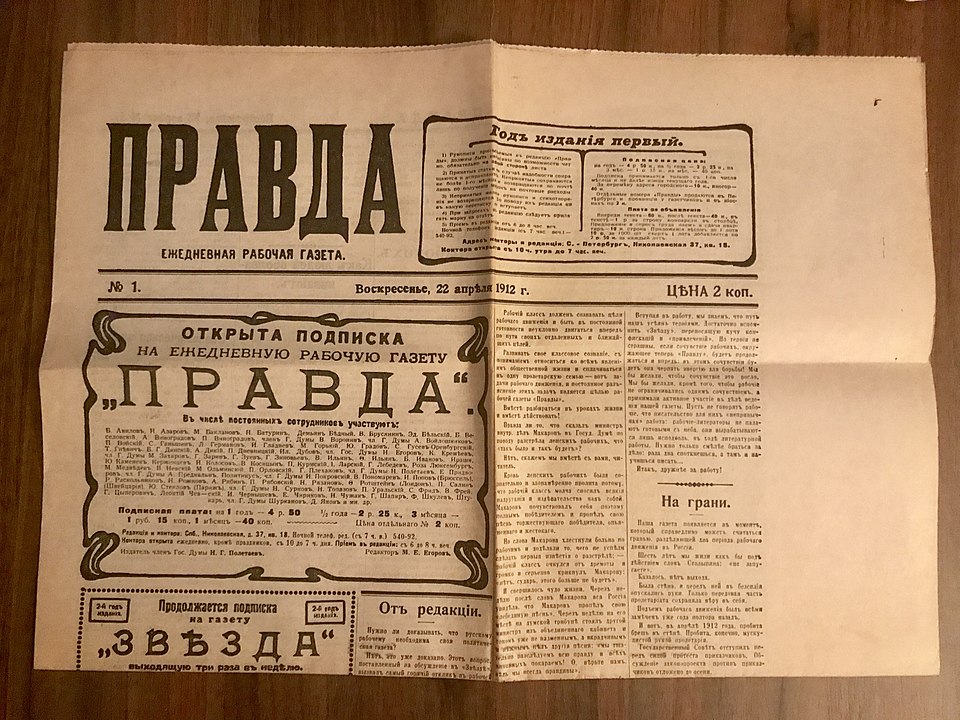
A copy of the first issue of Pravda, No. 1, dated Sunday 22 April 1912 (Old Style; 5 May in the modern calendar). Hovland and Weiss used the paper's reputation as their low-credibility source; this issue predates the Soviet state and is shown only to identify the newspaper. Photo: Tomas81j, 2017, Wikimedia Commons, CC BY-SA 4.0.
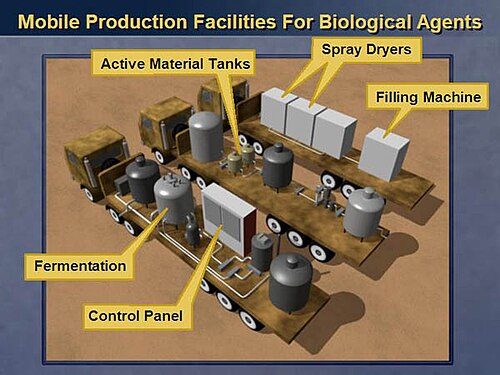
Slide from Secretary of State Colin Powell's presentation to the UN Security Council on 5 February 2003, showing an illustration labelled as mobile production facilities for biological agents. The allegation was later withdrawn; the Commons record describes it as subsequently shown to be incorrect. It illustrates the kind of retracted Iraq claim discussed above and is not identified here as one of the items in the Lewandowsky study. U.S. Department of State. Public domain (U.S. government work).
How to spot it
- You find you "know" a claim but cannot say where you first saw it, or whether that source was one you trusted.
- The claim circulates as a screenshot, clip or quote with the outlet's name, label or disclaimer cropped out.
- The correction came later and was less prominent than the original, or was published in a different place from where the claim spread.
- The discounting cue is small relative to the content: a text label on a vivid video, or a footnote under a strong headline.
- The claim reappears weeks later through a second-hand source (a friend, a forum, an aggregator) that does not carry the original warning.
- Apply the reinstatement check from Kelman and Hovland: remind yourself where the claim came from. If your confidence drops when the source is restored, the belief was resting on a forgotten discount.
Where it ends: edge cases and legitimate persuasion
The sleeper effect has close neighbours that are often confused with it. The continued influence effect is the persistence of a retracted claim even when the retraction is remembered (Johnson and Seifert 1994; Lewandowsky et al. 2012). The illusory truth effect is the rise in believability that comes from repetition alone, whoever said it. Source amnesia is the underlying memory failure. The sleeper effect proper requires all three pieces: a claim, a cue that initially discounted it, and a later gain once the cue loses force.
Among techniques, Narrative laundering is the sender-side counterpart that removes the discounting cue at the start rather than waiting for memory to lose it. The Soviet AIDS disinformation campaign, which began with an anonymous letter in the Indian newspaper Patriot in 1983 and was later repeated by Soviet outlets citing that paper as an independent source, is a documented example of laundering (Boghardt 2009); it is not evidence of a sleeper effect, which no one measured. Firehosing supplies the repetition that feeds illusory truth, and Disclosure theater describes labels that exist but do not travel with the claim.
The line with honest communication is this. A claim first heard from a doubted source, and later confirmed by independent evidence, is not a sleeper effect; that is updating on new information. A persuasive argument whose effect lasts because it is good, with its source still attached in memory, is ordinary persuasion. The test a reader can apply: restore the source and ask whether the claim has any support apart from it. If remembering where it came from would lower your confidence, and nothing else holds it up, the belief is running on a discount you have forgotten.
Sources
- Begg, Ian Maynard, Ann Anas, and Suzanne Farinacci. 1992. "Dissociation of Processes in Belief: Source Recollection, Statement Familiarity, and the Illusion of Truth." Journal of Experimental Psychology: General 121(4): 446-458.
- Boghardt, Thomas. 2009. "Soviet Bloc Intelligence and Its AIDS Disinformation Campaign." Studies in Intelligence 53(4): 1-24.
- Carey, John M., Andrew M. Guess, Peter J. Loewen, Eric Merkley, Brendan Nyhan, Joseph B. Phillips, and Jason Reifler. 2022. "The Ephemeral Effects of Fact-Checks on COVID-19 Misperceptions in the United States, Great Britain and Canada." Nature Human Behaviour 6: 236-243.
- Cook, Thomas D., Charles L. Gruder, Karen M. Hennigan, and Brian R. Flay. 1979. "History of the Sleeper Effect: Some Logical Pitfalls in Accepting the Null Hypothesis." Psychological Bulletin 86(4): 662-679.
- Gillig, Paulette M., and Anthony G. Greenwald. 1974. "Is It Time to Lay the Sleeper Effect to Rest?" Journal of Personality and Social Psychology 29(1): 132-139.
- Hasher, Lynn, David Goldstein, and Thomas Toppino. 1977. "Frequency and the Conference of Referential Validity." Journal of Verbal Learning and Verbal Behavior 16(1): 107-112.
- Hovland, Carl I., Arthur A. Lumsdaine, and Fred D. Sheffield. 1949. Experiments on Mass Communication. Princeton, NJ: Princeton University Press.
- Hovland, Carl I., and Walter Weiss. 1951. "The Influence of Source Credibility on Communication Effectiveness." Public Opinion Quarterly 15(4): 635-650.
- Johnson, Hollyn M., and Colleen M. Seifert. 1994. "Sources of the Continued Influence Effect: When Misinformation in Memory Affects Later Inferences." Journal of Experimental Psychology: Learning, Memory, and Cognition 20(6): 1420-1436.
- Johnson, Marcia K., Shahin Hashtroudi, and D. Stephen Lindsay. 1993. "Source Monitoring." Psychological Bulletin 114(1): 3-28.
- Kelman, Herbert C., and Carl I. Hovland. 1953. "'Reinstatement' of the Communicator in Delayed Measurement of Opinion Change." Journal of Abnormal and Social Psychology 48(3): 327-335.
- Kumkale, G. Tarcan, and Dolores Albarracín. 2004. "The Sleeper Effect in Persuasion: A Meta-Analytic Review." Psychological Bulletin 130(1): 143-172.
- Lariscy, Ruth Ann Weaver, and Spencer F. Tinkham. 1999. "The Sleeper Effect and Negative Political Advertising." Journal of Advertising 28(4): 13-30.
- Lewandowsky, Stephan, Ullrich K. H. Ecker, Colleen M. Seifert, Norbert Schwarz, and John Cook. 2012. "Misinformation and Its Correction: Continued Influence and Successful Debiasing." Psychological Science in the Public Interest 13(3): 106-131.
- Lewandowsky, Stephan, Werner G. K. Stritzke, Klaus Oberauer, and Michael Morales. 2005. "Memory for Fact, Fiction, and Misinformation: The Iraq War 2003." Psychological Science 16(3): 190-195.
- Pratkanis, Anthony R., Anthony G. Greenwald, Michael R. Leippe, and Michael H. Baumgardner. 1988. "In Search of Reliable Persuasion Effects: III. The Sleeper Effect Is Dead. Long Live the Sleeper Effect." Journal of Personality and Social Psychology 54(2): 203-218.
- Swire, Briony, Ullrich K. H. Ecker, and Stephan Lewandowsky. 2017. "The Role of Familiarity in Correcting Inaccurate Information." Journal of Experimental Psychology: Learning, Memory, and Cognition 43(12): 1948-1961.
Case studies
- Why We Fight: the U.S. Army's orientation films, 1942-1945 — Why We Fight: the U.S. Army's orientation films
- MAGA and the Resistance: grassroots organising for and against Trump, 2016-2021 — MAGA and the Resistance: grassroots organising for and against Trump, 2016-2021
- Black Lives Matter and Blue Lives Matter: two slogans, their campaigns, and a foreign operation that posed as both — Black Lives Matter and Blue Lives Matter: two slogans, their campaigns, and a foreign operation that posed as both
Images
| Image | Source | Licence |
|---|---|---|
| Frank Capra and Roy Boulting, 1944 | Wikimedia Commons (Imperial War Museums D 18377) | Public domain (UK Crown copyright expired) |
| First issue of Pravda, 1912 | Wikimedia Commons, First Issue of PRAVDA.jpg (Tomas81j) | CC BY-SA 4.0 |
| Powell UN slide, 5 February 2003 | Wikimedia Commons (U.S. Department of State) | Public domain (U.S. government work) |
_of_the_US_Army_Signal_Corps_confers_with_Captain_Roy_Boulting_of_the_British_Army_Film_Unit_on_the_editing_of_the_film_'Tunisian_Victory'_in_February_1944._D18377.jpg)

