Transfer: borrowing a symbol's feeling
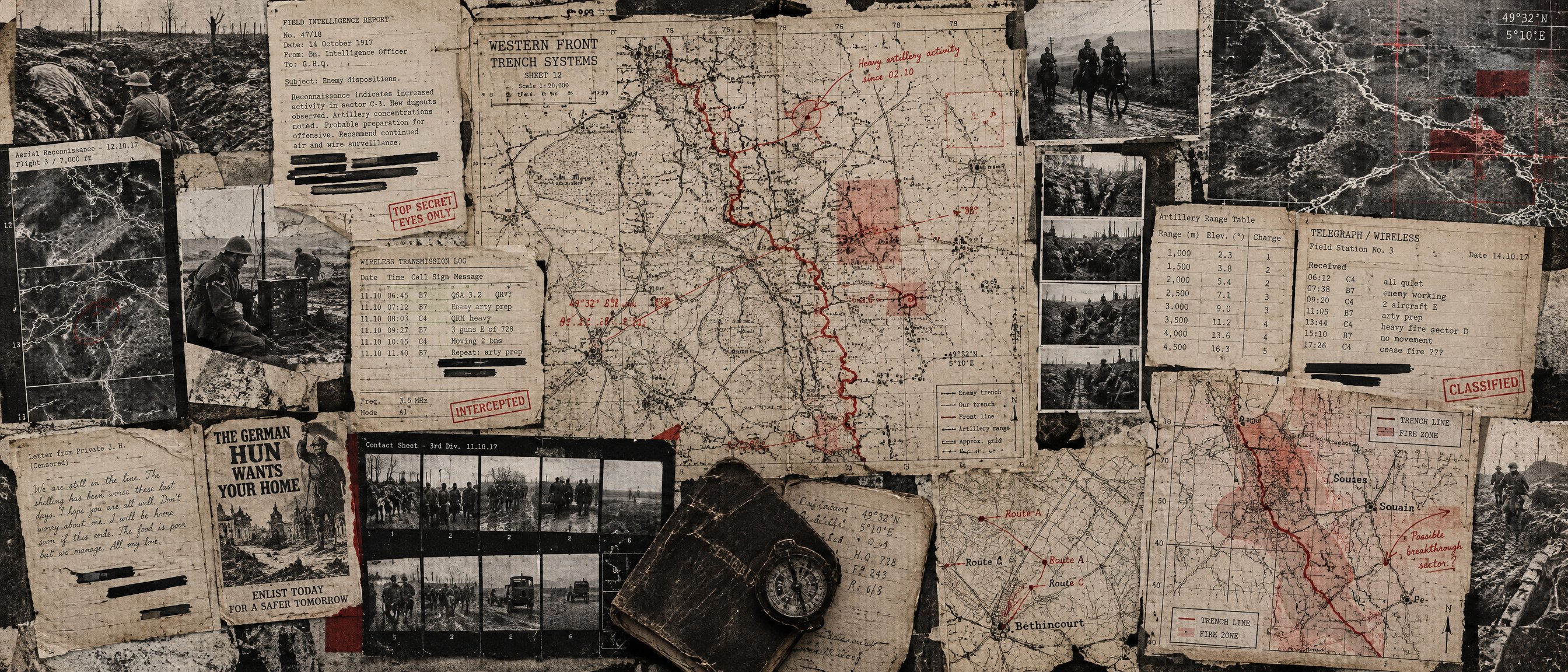
Illustration, not an archive object
By the end: Tell a symbol that is doing the persuading from one that states a real affiliation, by covering it and asking if the argument changes. About 8 minutes.
What it is
Definition
Borrow prestige or stigma from a respected or hated symbol and paste it onto the message.
The tell
Flags, clergy, science-looking charts, or enemy uniforms doing rhetorical work the argument cannot.
Not this
Relevant institutional affiliation stated as a fact.
Transfer works by adjacency. A message is placed next to a symbol the audience already feels strongly about, and the feeling flows across.
It is one of the Institute for Propaganda Analysis's 1937 devices, and it formalizes a move as old as religious and national iconography: pairing a message with a flag, a cross or an enemy uniform.
Illustration, not an archive object How it works
The sender puts the message beside a flag, a monument, a uniform, a lab coat, a university seal or a masthead. Nothing argues that the symbol's owner backs the claim. The link is only placement.
There are three forms:
- Positive transfer borrows prestige: a soldier's face on a war-bond appeal.
- Negative transfer borrows stigma: an opponent shown beside an enemy uniform or a hated flag.
- Institutional mimicry borrows the look of a trusted source, such as a news outlet's logo and layout.
The sender bets that in a quick glance at a poster or a few seconds of video, most people will not separate symbol from message.
Why it works on people
Pairing a neutral thing with a liked or disliked one can shift feelings about it. This is called evaluative conditioning (Staats and Staats 1958). Large reviews find the effect real but modest.
Bold claims have not always held up. Gorn's 1982 pen-and-music result was not reproduced by Kellaris and Cox (1989), and a flag-priming result (Carter, Ferguson and Hassin 2011) did not replicate in the Many Labs project (Klein et al. 2014).
The safer summary is that symbols change how people feel about what sits beside them in the moment. When people are rushed, respected symbols work as peripheral cues (Petty and Cacioppo 1986), and the halo effect (Thorndike 1920) describes the same spillover.
Same device, different stakes (1 of 3)
Three real objects from the archive. The technique is the same in each; the setting, the choice the audience had and what was at stake are not.
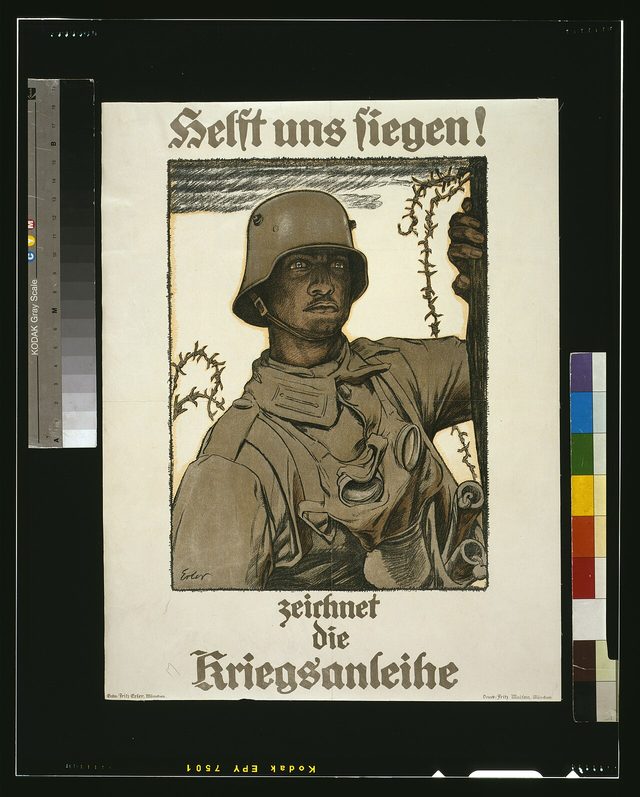
Helft uns siegen! Zeichnet die Kriegsanleihe (Help Us Win! Subscribe to the War Loan) · 1917 · Imperial German government war-bond campaign; artist Fritz Erler · Full record Notice: A steel-helmeted German infantryman stares out above 'Help us win!'. The viewer's respect for the soldier is meant to attach to the war-bond ask, and 'winning' is left undefined. This is positive transfer in a wartime government loan appeal; readers are asked to buy bonds. Posters of this kind were common fundraising propaganda on every side of the First World War.
Same device, different stakes (2 of 3)
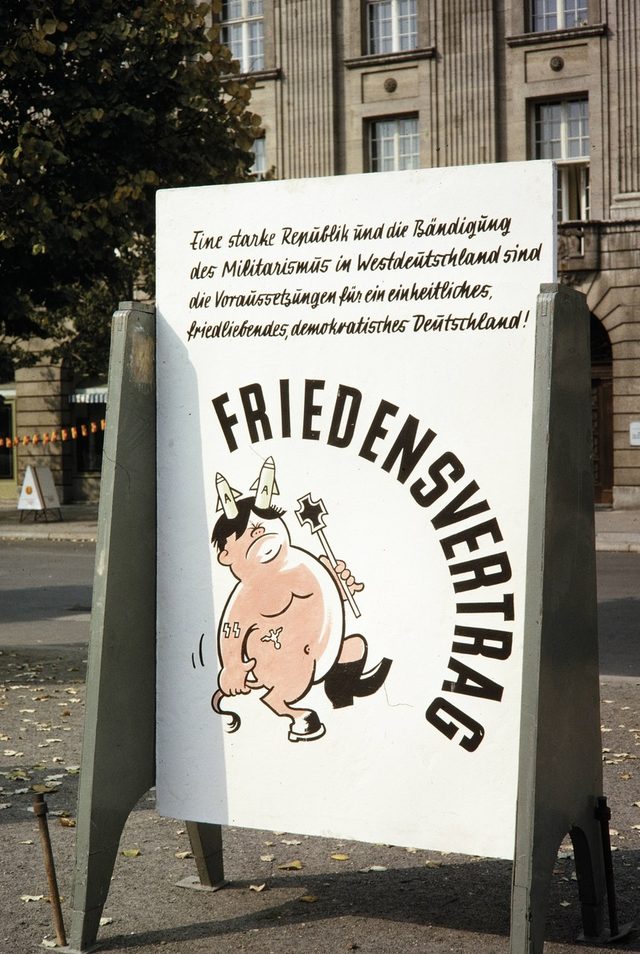
FRIEDENSVERTRAG: East Berlin street board on a German peace treaty · 1961 · East German (GDR) public display in East Berlin; no issuing body printed on the board · Full recordContent note: Cartoon caricature of a West German militarist figure marked with SS runes and an Iron Cross mace. Notice: An East Berlin street board pairs the word for peace treaty with a cartoon figure wearing rockets marked 'A' as horns, SS runes on the chest and a mace bearing an Iron Cross. Nazi symbols are pasted onto West German militarism without naming anyone. This is negative transfer, and it asks for no purchase. The board names no issuer; the archive notes that similar boards were run by the state and the ruling SED. This lesson judges the technique, not the treaty question.
Same device, different stakes (3 of 3)
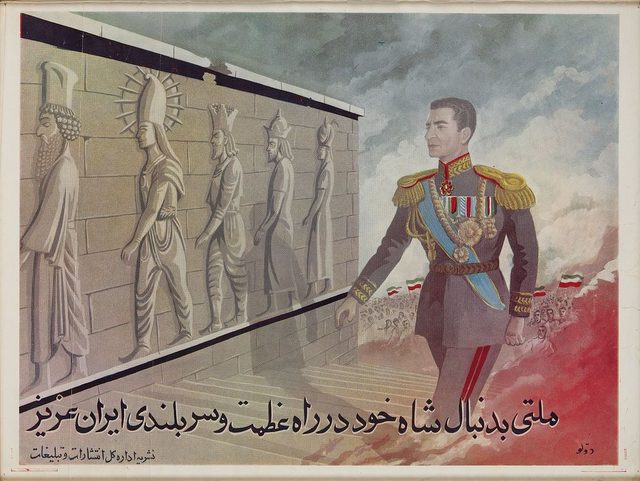
Melati bedonbal-e shah-e khod (A Nation Following Its Shah): Pahlavi government poster · 1965 · General Directorate of Publications and Propaganda (Edareh-ye Kol-e Entesharat va Tabligat), Imperial Government of Iran; artist signed 'Davallou' · Full record Notice: A painted poster shows the Shah in full-dress uniform beside a Persepolis relief of Achaemenid dignitaries, with flag-bearing crowds behind. The ancient relief lends royal prestige to the sitting monarch, and the slogan offers 'greatness' and 'honour' instead of a specific claim. It comes from a state publications office and asks for no money or action. The date is approximate.
Check yourself
A serving officer, in uniform and with the national flag behind, gives an official briefing on her own unit's operations. Is that transfer?
Show the answer
No. The symbol is relevant because its owner produced the message. It would become transfer if the flag or uniform implied an endorsement, a source or a moral standing the facts do not support. Right. The FRAME definition excludes relevant institutional affiliation stated as a fact. The test is whether the argument changes when the symbol is removed.
Spot it in the archive
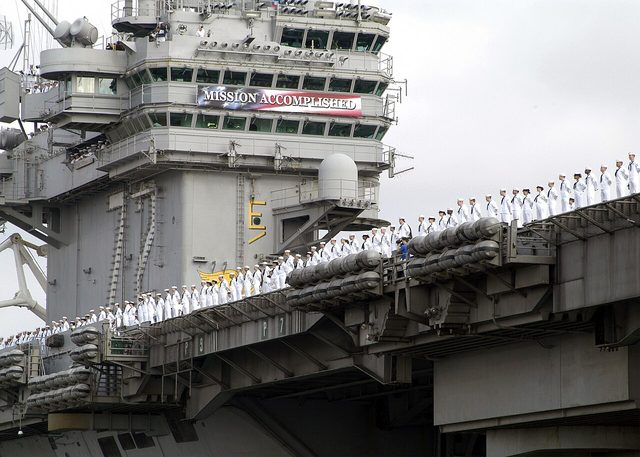
'Mission Accomplished' banner on USS Abraham Lincoln · May 2, 2003 · U.S. government (White House staff with the U.S. Navy) · Full record Sailors man the rails of an aircraft carrier under a large banner, the day after a president landed aboard in a flight suit and announced the end of major combat operations in a war. Which technique is doing the work?
The carrier, crew and banner lend the look of military victory to the speech. The war went on, with U.S. combat operations until 2010. The White House said its staff made the banner at the Navy's request, and in 2008 the president said it had sent the wrong message.
Show the answer
Transfer The carrier, crew and banner lend the look of military victory to the speech. The war went on, with U.S. combat operations until 2010. The White House said its staff made the banner at the Navy's request, and in 2008 the president said it had sent the wrong message.
How to spot it, and what next
- Cover the symbol in your mind. Do the words alone still make a case?
- Does the owner of the symbol actually stand behind the claim? A flag does not endorse a product, and a news logo on a clip does not prove the outlet made it.
- Is the symbol relevant to the subject, such as religious imagery on a financial appeal or military hardware at a domestic speech?
- For anything wearing a known brand, can you find the item on the brand's own site or channel?
Read the full page: Transfer in the technique library · All 169 examples in the collection