Area: Emotion and fear · Evidence: moderate (How we rate the evidence). The psychological effects of personal nostalgia are well documented, though largely by one research network; the link between collective nostalgia and political attitudes rests mostly on correlational surveys.
In brief
Nostalgia is a sentimental longing for the past. For individuals it is mostly a pleasant, comforting emotion that people turn to when they feel lonely or uncertain. When it is shared by a group, as longing for a nation's or community's "better days," it strengthens group identity, and studies of national nostalgia link it to wariness of outsiders. Political slogans from every part of the spectrum invoke a lost golden age and promise to restore it.
What the research shows
Nostalgia was once treated as a medical disorder, a kind of homesickness. Modern research, led by Constantine Sedikides and Tim Wildschut, has recast it as a common and mostly positive emotion. In a 2006 series of studies, Wildschut and colleagues analyzed people's written accounts of nostalgic memories [1]. The memories usually featured the writer with close others at important life events, and often followed a "redemption" pattern in which a difficult start led to a good outcome. Negative mood and loneliness triggered nostalgia, and experimentally induced nostalgia raised positive mood, self-regard and feelings of social connection. A 2008 review summarized the evidence that people experience nostalgia frequently, across ages and cultures, and that it serves to steady the self in unsettling times [2].
Nostalgia can also be collective: longing for a past shared with fellow group members. Wildschut and colleagues found in 2014 that inducing collective nostalgia strengthened group members' positive feelings toward their group, their willingness to support it, and their intentions to act on its behalf [3].
At the national level, Anouk Smeekes, Maykel Verkuyten and Borja Martinovic surveyed native Dutch respondents and found that national nostalgia, longing for the country's "good old days," was associated with the belief that the country belongs first to those who were there first, which in turn predicted opposition to Muslims' rights to express their religion publicly [4]. Smeekes, Wildschut and Sedikides later argued that national nostalgia has become a "master frame" for populist radical right parties across Europe [5].
Political scientists Justin Gest, Tyler Reny and Jeremy Mayer introduced the idea of "nostalgic deprivation": the gap between how people see their own group's social, political and economic standing now and how they believe it was in the past [6]. In surveys in the United States and Britain, people who felt that their group had lost status relative to an earlier time were more likely to support candidates and parties the authors classify as radical right, including Donald Trump and the UK Independence Party.
Has it held up?
The findings on personal nostalgia are consistent across many experiments, questionnaire studies and countries, which supports a moderate-to-strong rating for that core. Two cautions keep the page at moderate. First, a large share of the work comes from one international research network, and independent replications are fewer. Second, the political findings [4][5][6] are mostly correlational: they show that nostalgic feelings and certain attitudes go together, not that nostalgia causes those attitudes. People who already hold restrictive views may also be more likely to describe the past fondly.
The political direction of nostalgia is also not fixed. Most recent research has focused on the radical right, but the geographer Alastair Bonnett has documented a long tradition of nostalgia on the left, from early socialists' idealized pre-industrial communities to later movements' longing for lost solidarity [7]. The finding that nostalgia is tied to exclusion comes from studies of national nostalgia specifically, and should not be generalized to all nostalgia.
How it shows up in political messaging
- "Make America Great Again." Ronald Reagan's 1980 campaign used the line "Let's make America great again." Donald Trump applied to trademark "Make America Great Again" shortly after the 2012 election and made it the slogan of his 2016 campaign [8]. The word "again" does the nostalgic work.
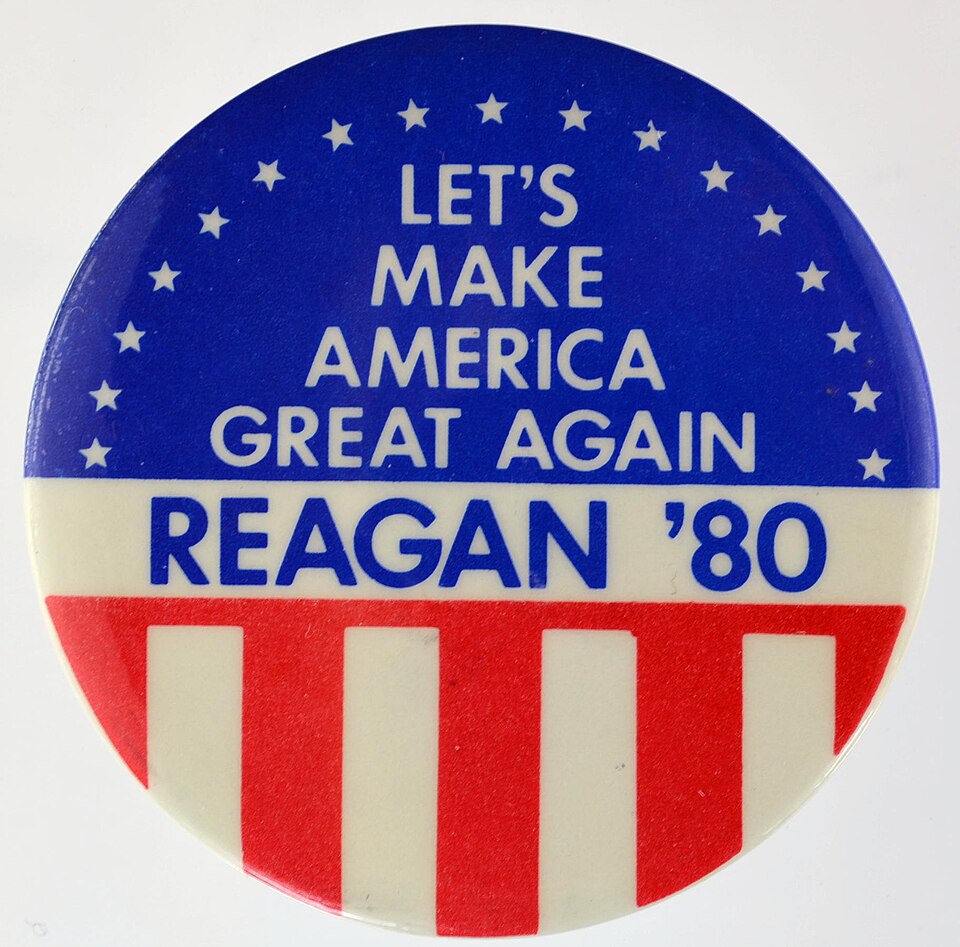
Campaign button, Ronald Reagan presidential campaign, 1980: "Let's Make America Great Again / Reagan '80." Source: Wikimedia Commons. Public domain per Commons (text and simple shapes only).

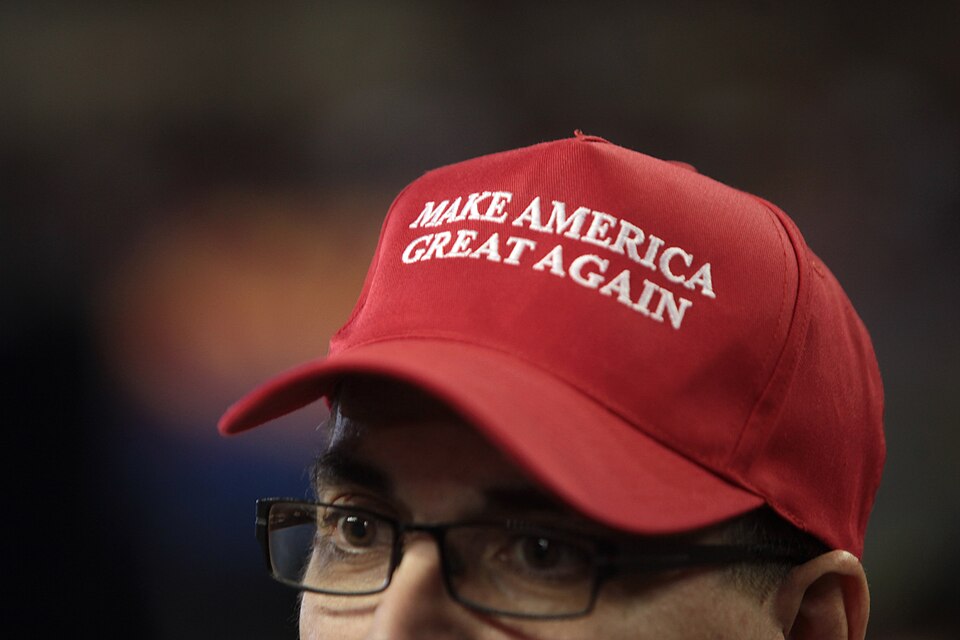
A "Make America Great Again" cap at a Donald Trump campaign rally, Arizona Veterans Memorial Coliseum, Phoenix, 18 June 2016. Photo: Gage Skidmore. Source: Wikimedia Commons. CC BY-SA 2.0.
.jpg)
- "Take back control." The official Leave campaign's slogan in the 2016 EU referendum implied a restoration of sovereignty the country had once had. Harold Clarke, Matthew Goodwin and Paul Whiteley's study of the vote documents the campaign's themes and the voters it reached [9].
- Soviet and East German nostalgia. In a 2005 address to the Russian parliament, Vladimir Putin called the collapse of the Soviet Union "a major geopolitical disaster of the century," in the Kremlin's official English translation; the phrase is often translated as "the greatest geopolitical catastrophe of the century" [10]. In reunified Germany, Ostalgie, nostalgia for everyday life in the former East Germany, became both a consumer trend and a political sentiment; the anthropologist Daphne Berdahl traced how East German products and memories were revived in the 1990s [11].
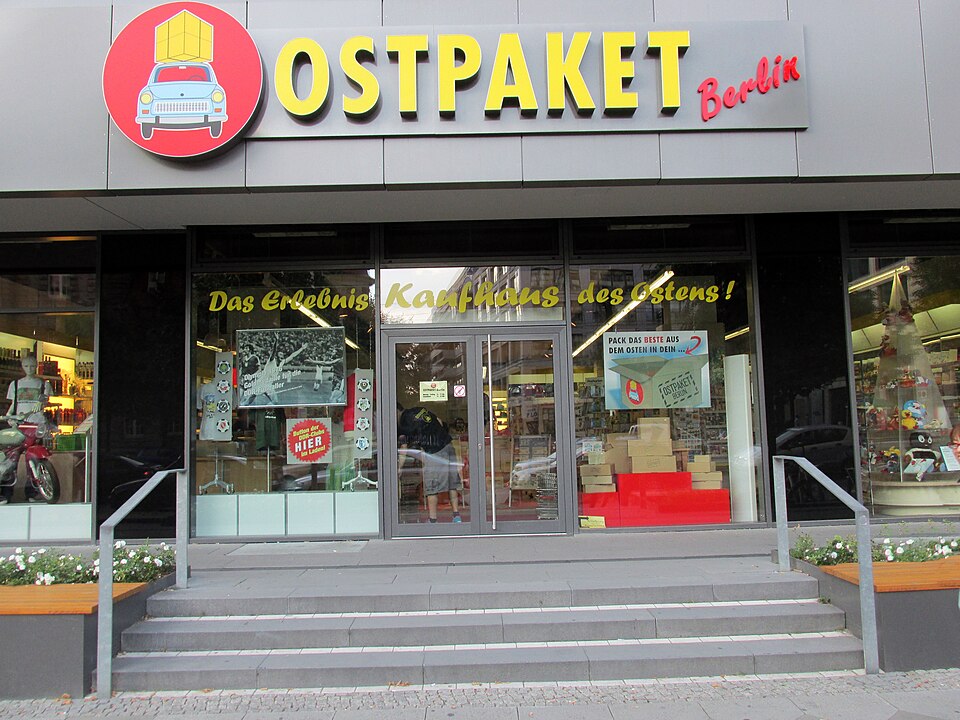
Shop front on Spandauer Straße, Berlin-Mitte, reading "Ostpaket Berlin" and "Das Erlebnis Kaufhaus des Ostens," a store selling East German-brand goods. Photo: fotogoocom (via Panoramio). Source: Wikimedia Commons. CC BY 3.0.

- Left-wing nostalgia. Ken Loach's 2013 documentary The Spirit of '45 celebrated the 1945 Labour government's nationalizations and the founding of the National Health Service as a lost era of solidarity to be recovered [12]. Bonnett traces this kind of longing across the history of the radical left [7].
How to spot it
- The message refers to a golden age without saying when exactly it was or who it was golden for.
- Words like "again," "restore," "take back" or "return" carry the argument.
- Present problems are blamed on a broad change, a lost era or a group (newcomers, elites, corporations), rather than on specific causes.
- Old imagery (period photographs, vintage design, wartime symbols) is used to transfer warm feelings onto a present-day proposal.
- The past is presented as uniformly better, with its costs and exclusions left out.
Persuasion or manipulation?
Nostalgia can honestly remind people of real things they valued, such as secure jobs, strong communities or a service that once worked, and ask how to rebuild them. Honest use is specific: it says what was better, for whom, and what concrete change would bring it back. It tips into manipulation when the past is invented or airbrushed, when the golden age is left vague so everyone can project onto it, or when the story of decline is used to cast a group of people as the reason things got worse.
Archive techniques that lean on this
- Glittering generalities — Glittering generalities: "great," "again" and "control" name a restored virtue without defining it.
- Transfer — Transfer: warm feelings about a remembered past are carried over to a present-day candidate or cause.
Related topics
- Hope appeals — Hope appeals
- Social identity — Social identity
- In-group favoritism — In-group favoritism
- Narrative transportation — Narrative transportation
- Affect heuristic — Affect heuristic
Sources
- Wildschut, T., Sedikides, C., Arndt, J., & Routledge, C. (2006). Nostalgia: Content, triggers, functions. Journal of Personality and Social Psychology, 91(5), 975–993. https://doi.org/10.1037/0022-3514.91.5.975
- Sedikides, C., Wildschut, T., Arndt, J., & Routledge, C. (2008). Nostalgia: Past, present, and future. Current Directions in Psychological Science, 17(5), 304–307. https://doi.org/10.1111/j.1467-8721.2008.00595.x
- Wildschut, T., Bruder, M., Robertson, S., van Tilburg, W. A. P., & Sedikides, C. (2014). Collective nostalgia: A group-level emotion that confers unique benefits on the group. Journal of Personality and Social Psychology, 107(5), 844–863.
- Smeekes, A., Verkuyten, M., & Martinovic, B. (2015). Longing for the country's good old days: National nostalgia, autochthony beliefs, and opposition to Muslim expressive rights. British Journal of Social Psychology, 54(3), 561–580.
- Smeekes, A., Wildschut, T., & Sedikides, C. (2021). Longing for the "good old days" of our country: National nostalgia as a new master-frame of populist radical right parties. Journal of Theoretical Social Psychology, 5(2), 90–102.
- Gest, J., Reny, T., & Mayer, J. (2018). Roots of the radical right: Nostalgic deprivation in the United States and Britain. Comparative Political Studies, 51(13), 1694–1719.
- Bonnett, A. (2010). Left in the past: Radicalism and the politics of nostalgia. Continuum.
- Tumulty, K. (2017, January 18). How Donald Trump came up with "Make America Great Again." The Washington Post.
- Clarke, H. D., Goodwin, M., & Whiteley, P. (2017). Brexit: Why Britain voted to leave the European Union. Cambridge University Press.
- Putin, V. V. (2005, April 25). Annual address to the Federal Assembly of the Russian Federation. President of Russia. http://en.kremlin.ru/events/president/transcripts/22931
- Berdahl, D. (1999). "(N)Ostalgie" for the present: Memory, longing, and East German things. Ethnos, 64(2), 192–211.
- Loach, K. (Director). (2013). The Spirit of '45 [Documentary film].
Images
| Image | Source | Licence |
|---|---|---|
| Reagan 1980 campaign button | Wikimedia Commons, Reagan campaign, 1980; photo via Old Politicals | Public domain per Commons (text and simple shapes only) |
| MAGA cap, Phoenix, 18 June 2016 | Wikimedia Commons, Gage Skidmore | CC BY-SA 2.0 |
| Ostpaket / Kaufhaus des Ostens, Berlin | Wikimedia Commons, fotogoocom (Panoramio) | CC BY 3.0 |
Image gaps
- The 2016 Leave campaign "Take back control" material, a photograph of Vladimir Putin's 2005 address to the Federal Assembly (kremlin.ru photographs are CC BY 4.0 but none was located for this event) and The Spirit of '45 (2013): not hosted.