Area: Emotion and fear · Evidence: mixed (How we rate the evidence). Hope is far less studied than fear; the existing experiments are promising but small, often correlational, and sometimes find no effect on behavior.
In brief
A hope appeal tries to move people by showing them a better future that is possible but not guaranteed, and a path to it. Campaigns across the political spectrum rely on hope at least as much as on fear. The research base, though, is much thinner than for fear appeals: there is no large meta-analysis of hope appeals, and the studies that exist suggest hope works mainly when people also believe they can do something to reach the goal.
What the research shows
Psychologists have defined hope in two related ways. C. R. Snyder's influential "hope theory" treats hope as a way of thinking about goals: believing one can find routes to a goal ("pathways") and summon the motivation to use them ("agency") [1]. Communication researchers treat hope as an emotion. Amber Chadwick's persuasive hope theory proposes that hope arises when people see a future outcome as important, as consistent with their goals, and as possible but uncertain [2]. In a study of climate change messages, she built appeals to raise those appraisals and found support for most of the predicted links between the appraisals, feelings of hope, and people's efficacy beliefs and intentions to act.
The most direct link to the fear research comes from Robin Nabi and Jessica Gall Myrick [3]. They argued that the efficacy part of a fear appeal (the "here is what you can do" section) works partly by producing hope. Reanalyzing two existing data sets on sun-safety messages, they found that hope and self-efficacy interacted to predict people's intentions to protect themselves. See Fear messaging for why efficacy matters.
In politics, Ted Brader's experiments with campaign ads, run during a real election, compared versions of the same ad with different music and images [4]. Ads cued with enthusiasm (hopeful, uplifting music and imagery) increased viewers' interest in participating, such as volunteering and voting, and strengthened their existing preferences. Ads cued with fear were better at changing minds. Marion Just, Ann Crigler and Todd Belt, working with campaign survey data, argued that hope about a candidate shapes how voters appraise that candidate and is a central emotion in vote choice [5].
In intractable conflict, Smadar Cohen-Chen, Eran Halperin and colleagues found that Jewish Israelis who believed that conflicts in general can change reported more hope about the Israeli-Palestinian conflict and more support for concessions [6]. In a later series of five studies, inducing the perception that the world is changing, without mentioning the conflict, increased hope and, through it, support for compromise [7].
Has it held up?
Less is known than for most topics in this library, and the evidence rating reflects that. There is no meta-analysis of hope appeals comparable to the several that exist for fear. Many studies measure feelings of hope and correlate them with attitudes rather than randomly assigning people to hopeful messages, which makes cause and effect hard to separate. Some tests find that hopeful messages change emotions but not behavior: Jessica Ettinger and colleagues showed Americans short online climate change videos framed around hope or around doom [8]. Each video produced the emotion it aimed for, but neither changed viewers' risk perceptions, their intentions to change behavior, or their willingness to take part in climate activism.
Two conclusions seem reasonably safe. First, hope and efficacy are closely linked, so a hopeful message without a credible path may simply feel good. Second, in politics, positive emotional appeals appear better at mobilizing people who already agree than at persuading those who do not [4]. Both claims rest on a handful of studies and should be treated as provisional.
How it shows up in political messaging
- United States, 1984 and 2008. Ronald Reagan's Republican re-election campaign ran "Prouder, Stronger, Better," widely known as "Morning in America" after its opening line "It's morning again in America," which showed weddings, new homes and people going to work over soft music, and asked why anyone would want to return to the past [9]. In 2008 Shepard Fairey's red, beige and blue portrait of Barack Obama over the single word "HOPE" became the defining image of the Democrat's campaign; the original collage is now in the Smithsonian's National Portrait Gallery [10].
- Chile, 1988. In the plebiscite on whether General Augusto Pinochet should remain in power, the opposition "No" campaign's television spots were built around the jingle "Chile, la alegría ya viene" (Chile, joy is coming), promising a happier future rather than dwelling on the dictatorship's abuses [11].
- Soviet Union. Posters of the Lenin and Stalin eras showed factories, bountiful harvests and heroic workers building a radiant socialist future, pairing present effort with a promised reward [12].
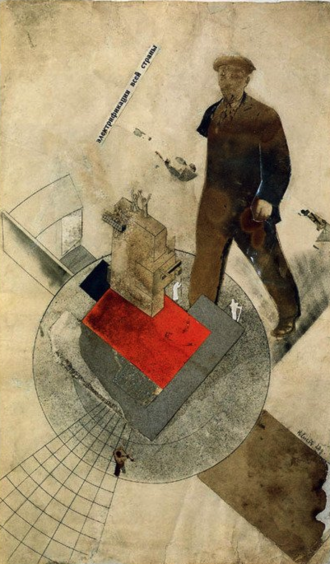
"Elektrifikatsiia vsei strany" (Electrification of the Entire Country), photomontage design by Gustav Klutsis, 1920: a figure of Lenin over a power-station drawing. Source: Wikimedia Commons. Public domain.
_Electrification_of_the_Entire_Country.png)
- Weimar Germany, 1932. A Nazi election poster showed a crowd of exhausted, unemployed Germans under the words "Unsere letzte Hoffnung: Hitler" (Our last hope: Hitler) [13].
- Wartime morale. The Westinghouse factory poster We Can Do It! offered workers confidence and capability rather than threat, a hope-and-efficacy message later adopted as an emblem of wartime women's labor.

"We Can Do It!," Westinghouse factory poster, 1943. From the FRAME gallery: We Can Do It!
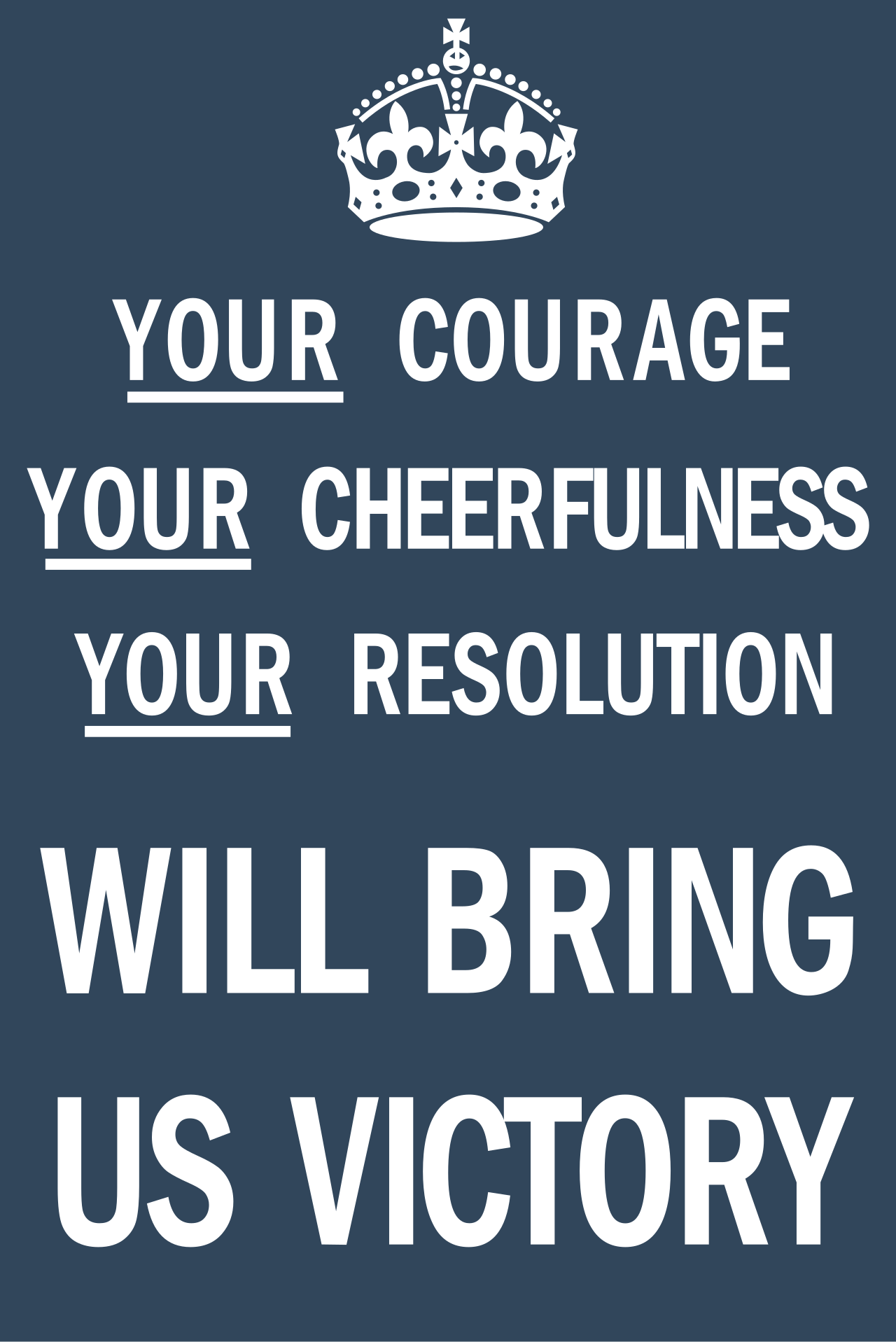
"Your Courage, Your Cheerfulness, Your Resolution Will Bring Us Victory," British Ministry of Information poster, 1939. From the FRAME gallery: Your Courage, Your Cheerfulness, Your Resolution Will Bring Us Victory
How to spot it
- The future is described vividly, but the route from here to there is vague or missing.
- A single word ("hope," "change," "renewal") carries the message, with little stated about specific policies.
- The messenger is presented as the only path to the better future.
- Present costs or tradeoffs are left out, or framed as proof of the future's value.
- The message aims to energize supporters rather than answer the doubts of skeptics.
Persuasion or manipulation?
Hope is one of the most constructive tools available to a writer: it can counter paralysis, and the research suggests it works best when paired with a real, concrete path that readers can take. Honest use names the goal, states what it would take to get there, and is candid about uncertainty and cost. Hope becomes manipulative when the promised future is unachievable or undefined, when it serves only to transfer good feeling onto a leader or party, or when it is used to justify present harm in the name of a future that never arrives.
Archive techniques that lean on this
- Glittering generalities — Glittering generalities: virtue words such as "hope" and "change" invite approval without specifying content.
Related topics
- Fear messaging — Fear messaging
- Nostalgia — Nostalgia
- Affect heuristic — Affect heuristic
- Narrative transportation — Narrative transportation
- Social identity — Social identity
Sources
- Snyder, C. R. (2002). Hope theory: Rainbows in the mind. Psychological Inquiry, 13(4), 249–275. https://doi.org/10.1207/S15327965PLI1304_01
- Chadwick, A. E. (2015). Toward a theory of persuasive hope: Effects of cognitive appraisals, hope appeals, and hope in the context of climate change. Health Communication, 30(6), 598–611. https://doi.org/10.1080/10410236.2014.916777
- Nabi, R. L., & Myrick, J. G. (2019). Uplifting fear appeals: Considering the role of hope in fear-based persuasive messages. Health Communication, 34(4), 463–474. https://doi.org/10.1080/10410236.2017.1422847
- Brader, T. (2005). Striking a responsive chord: How political ads motivate and persuade voters by appealing to emotions. American Journal of Political Science, 49(2), 388–405. https://doi.org/10.1111/j.0092-5853.2005.00130.x
- Just, M. R., Crigler, A. N., & Belt, T. L. (2007). Don't give up hope: Emotions, candidate appraisals, and votes. In W. R. Neuman, G. E. Marcus, A. N. Crigler, & M. MacKuen (Eds.), The affect effect: Dynamics of emotion in political thinking and behavior (pp. 231–260). University of Chicago Press.
- Cohen-Chen, S., Halperin, E., Crisp, R. J., & Gross, J. J. (2014). Hope in the Middle East: Malleability beliefs, hope, and the willingness to compromise for peace. Social Psychological and Personality Science, 5(1), 67–75.
- Cohen-Chen, S., Crisp, R. J., & Halperin, E. (2015). Perceptions of a changing world induce hope and promote peace in intractable conflicts. Personality and Social Psychology Bulletin, 41(4), 498–512. https://doi.org/10.1177/0146167215573210
- Ettinger, J., Walton, P., Painter, J., et al. (2021). Climate of hope or doom and gloom? Testing the climate change hope vs. fear communications debate through online videos. Climatic Change, 164, Article 19. https://doi.org/10.1007/s10584-021-02975-8
- Museum of the Moving Image. The Living Room Candidate (online archive of US presidential campaign commercials; 1984 Reagan "Prouder, Stronger, Better" entry). https://www.livingroomcandidate.org/commercials/1984/prouder-stronger-better
- National Portrait Gallery, Smithsonian Institution. Barack Obama (Shepard Fairey, 2008, hand-finished collage).
- Hirmas, M. E. (1993). The Chilean case: Television in the 1988 plebiscite. In T. E. Skidmore (Ed.), Television, politics, and the transition to democracy in Latin America. Woodrow Wilson Center Press and Johns Hopkins University Press.
- Bonnell, V. E. (1997). Iconography of power: Soviet political posters under Lenin and Stalin. University of California Press.
- Library of Congress. Unsere letzte Hoffnung-Hitler (Mjölnir, 1932, political campaign poster). https://www.loc.gov/pictures/item/92510229/
Images
| Image | Source | Licence |
|---|---|---|
| Klutsis, "Electrification of the Entire Country," 1920 | Wikimedia Commons, Gustav Klutsis | Public domain (1920 work; artist died more than 70 years ago) |
| We Can Do It!, 1943 | FRAME gallery, We Can Do It! (provenance in the entry) | See entry |
| Your Courage, Your Cheerfulness, 1939 | FRAME gallery, Your Courage, Your Cheerfulness, Your Resolution Will Bring Us Victory (provenance in the entry) | See entry |
Image gaps
- Shepard Fairey's 2008 "HOPE" portrait, the 1984 "Prouder, Stronger, Better" ("Morning in America") advertisement and the 1988 Chilean "No" campaign spots: in copyright or not verified as open; not hosted. The 1932 Nazi poster "Unsere letzte Hoffnung: Hitler" (Mjölnir) is held by the Library of Congress and by the Landesarchiv Baden-Württemberg (whose photograph carries a CC BY 4.0 statement), but the designer died in 1980, so the underlying artwork was not confirmed public domain and it is linked, not hosted.