George Creel
Illustration, not an archive object
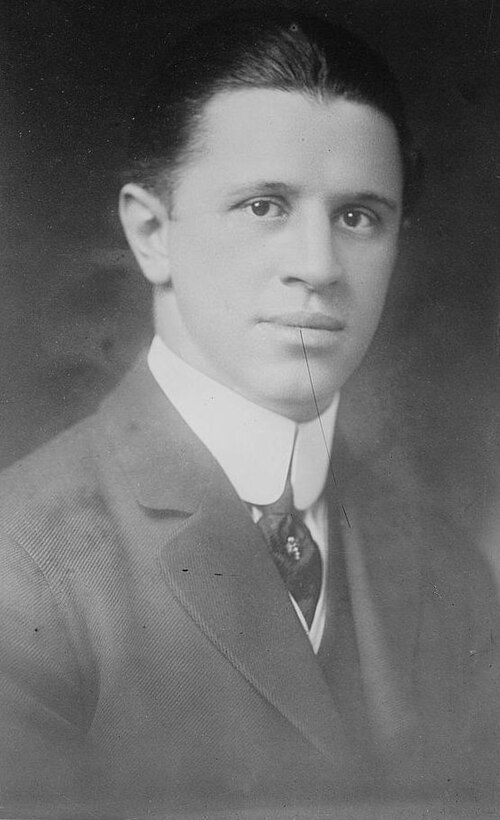

Chairman of the Committee on Public Information (1917-1919) · United States
On the regime page: Wilson administration
8 quotes, oldest first. Filter with other speakers.
“In all things, from first to last, without halt or change, it was a plain publicity proposition, a vast enterprise in salesmanship, the world's greatest adventure in advertising.”
Creel's own account of the Committee on Public Information, the federal agency created by executive order in April 1917 to publicise the American war effort at home and abroad. The sentence sums up how he described its method.
George Creel, How We Advertised America (New York: Harper & Brothers, 1920), chapter 1, "The 'Second Lines'", p. 4 Source
“We did not call it propaganda, for that word, in German hands, had come to be associated with deceit and corruption. Our effort was educational and informative throughout, for we had such confidence in our case as to feel that no other argument was needed than the simple, straightforward presentation of facts.”
From the opening chapter of Creel's 1920 history of the Committee, written after the war to answer charges that it had manipulated opinion.
George Creel, How We Advertised America (New York: Harper & Brothers, 1920), chapter 1, "The 'Second Lines'", pp. 4-5 Source
“Nothing, it seemed to me, was more dangerous, for people did not need less criticism in time of war, but more. Incompetence and corruption, bad enough in peace, took on an added menace when the nation was in arms. One had a right to hope that the criticism would be honest, just, and constructive, but even a blackguard's voice was preferable to the dead silence of an iron suppression.”
Creel describes why he opposed a statutory press-censorship bill that was before Congress when he was appointed in April 1917. The Committee instead ran a voluntary censorship agreement with the press; the Espionage Act of June 1917 and the Post Office under Burleson restricted the press by other means.
George Creel, How We Advertised America (New York: Harper & Brothers, 1920), chapter 2, "The 'Censorship' Bugbear", p. 17 Source
“We wanted to reach the people through their minds, rather than through their emotions, for hate has its undesirable reactions. We wanted to do it, not by over-emphasis of historical appeal, but by unanswerable arguments that would make every man and woman know that the war was a war of self-defense that had to be waged if free institutions were not to perish.”
Creel explains the intended approach of the Committee's pamphlet and publication programme, in a chapter that describes the series of printed tracts it produced for domestic and foreign distribution.
George Creel, How We Advertised America (New York: Harper & Brothers, 1920), chapter on "The Fight for the Mind of Mankind", p. 100 Source
“A chief offense of the Committee was its attitude in regard to "atrocity stories." From the very first we held that unprovable accounts of "horrors" were bound to result in undesirable reactions, for if the Germans could manage to refute one single charge, they would straightway use it to discredit our entire indictment.”
Creel recounts disputes with members of Congress, including Senator Poindexter, who accused the Committee of circulating German propaganda because it had issued denials of exaggerated atrocity reports.
George Creel, How We Advertised America (New York: Harper & Brothers, 1920), chapter on "Relations with Congress", p. 56 Source
“Never was a country so thoroughly contra-espionaged! Not a pin dropped in the home of any one with a foreign name but that it rang like thunder on the inner ear of some listening sleuth!”
Creel's description of the wartime surveillance apparatus, including the Justice Department's Bureau of Investigation, military and naval intelligence and the American Protective League of volunteers. He goes on to give figures for enemy aliens detained and prosecutions under the Espionage Act.
George Creel, How We Advertised America (New York: Harper & Brothers, 1920), chapter on "The 'Americanizers'", p. 168 Source
“As a consequence, their patriotism was a thing of screams, violence, and extremes; they outjingoed the worst of the jingoes, and their constant practice of extreme statement left a trail of anger, irritation, and resentment.”
Creel criticises the volunteer patriotic societies that sprang up after April 1917, which he says sought newspaper publicity. The example he gives next is a National Security League speaker's remarks about the University of Wisconsin.
George Creel, How We Advertised America (New York: Harper & Brothers, 1920), chapter on "The 'Americanizers'", p. 181 Source
“Under the pressure of tremendous necessities an organization grew that not only reached deep into every American community, but that carried to every corner of the civilized globe the full message of America's idealism, unselfishness, and indomitable purpose.”
Creel's summary of the Committee on Public Information's growth, directly after his statement that the work was a "plain publicity proposition". Written after the committee closed in 1919.
George Creel, How We Advertised America (New York: Harper & Brothers, 1920), chapter 1, "The 'Second Lines'" Source