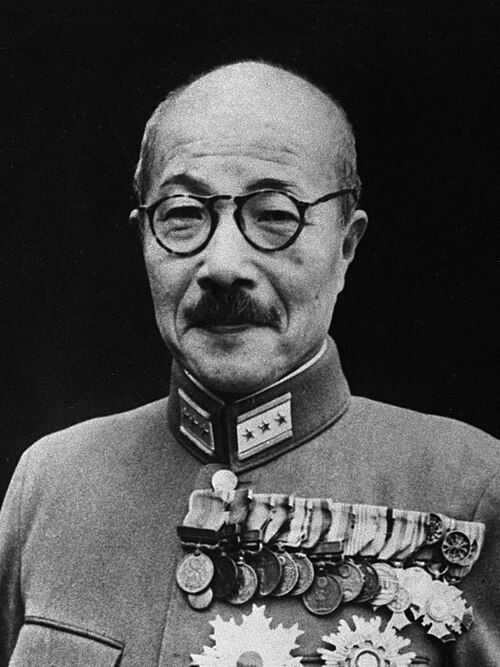
Hideki Tōjō
Illustration, not an archive object
.jpg)
Prime Minister and Army Minister of Japan · Japan
On the regime page: Empire of Japan, 1937 to 1945
9 quotes, oldest first. Filter with other speakers.
Content note: Instruction against surrender. The words are shown as they were said or written. Why
“If alive, do not suffer the disgrace of becoming a prisoner; in death, do not leave behind a name soiled by misdeeds.”
Original (Japanese)
生きて虜囚の辱を受けず、死して罪禍の汚名を殘すこと勿れ。
English: Field Service Code (Senzinkun), official English translation by the Tokyo Gazette Publishing House, 1941
Code of conduct for the Imperial Japanese Army issued over the War Minister's name and distributed to troops. Tojo was Army Minister in the cabinet of Prime Minister Konoe at the time.
Field Service Code (Senjinkun), Army Order No. 1, issued 8 January 1941 by War Minister Tojo, section 8 "Honour"; English translation by the Tokyo Gazette Publishing House, 1941, reproduced on rikukaigun.org Source
“America and Britain are undergoing a continuous change due to defeats suffered in this war and are carrying out vicious propaganda by constantly accusing our country of brutal acts.”
English: Foreign Broadcast Monitoring Service, Federal Communications Commission (US monitoring-service translation of the Tokyo broadcast). Original-language text not found.
Address by the Prime Minister to the Diet two weeks after the Battle of the Coral Sea, referring to Allied accounts of Japanese conduct in the occupied territories.
Address at the opening of the Imperial Diet, Tokyo, 27 May 1942, English translation by the Foreign Broadcast Monitoring Service, Federal Communications Commission, as published on ibiblio.org (Hyperwar) Source
“Australia has become the orphan of the Pacific Ocean. Especially only recently in the Coral Sea battle carried out on the northern tip of Australia the American and British sea power has been crushed, and now there is no one before us to defend Australia.”
English: Foreign Broadcast Monitoring Service, Federal Communications Commission (US monitoring-service translation of the Tokyo broadcast). Original-language text not found.
From the same address, in a section on the southwestern Pacific that goes on to refer to a statement to Australia's leaders made at an earlier Diet session.
Address at the opening of the Imperial Diet, Tokyo, 27 May 1942, English translation by the Foreign Broadcast Monitoring Service, Federal Communications Commission, as published on ibiblio.org (Hyperwar) Source
Content note: States that Indian civilians would be exposed to military destruction. The words are shown as they were said or written. Why
“As long as there remains British and American military facilities in India, Japan is strongly determined to completely destroy them. As a result, it is truly unavoidable that the people of India are exposed to such a misfortune. At this time the people should be inspired with courage and destroy, wipe out the British and American forces.”
English: Foreign Broadcast Monitoring Service, Federal Communications Commission (US monitoring-service translation of the Tokyo broadcast). Original-language text not found.
From the Prime Minister's remarks on India after the failure of the Cripps mission, as Japanese forces were in Burma.
Address at the opening of the Imperial Diet, Tokyo, 27 May 1942, English translation by the Foreign Broadcast Monitoring Service, Federal Communications Commission, as published on ibiblio.org (Hyperwar) Source
“However, in order to establish a structure of a united people literally, the Imperial Rule Assistance Association was formed and was followed by the organization of the Imperial Rule Assistance Political Society.”
English: Foreign Broadcast Monitoring Service, Federal Communications Commission (US monitoring-service translation of the Tokyo broadcast). Original-language text not found.
Radio address on organising the population for the war effort, describing the creation of the Imperial Rule Assistance Association (1940) and the Imperial Rule Assistance Political Society (1942).
Broadcast on the consolidation of the nation's total effort in the prosecution of the Greater East Asia War, Osaka, 27 July 1942, English translation by the Foreign Broadcast Monitoring Service, Federal Communications Commission, as published on ibiblio.org (Hyperwar) Source
“The primary requisite of public service behind the home front is truly the support given by the people to the men and officers of the Imperial army, and the spirit of the people behind the home front must be equivalent to the spirit of the armed forces carrying out military operations and overwhelming the enemy.”
English: Foreign Broadcast Monitoring Service, Federal Communications Commission (US monitoring-service translation of the Tokyo broadcast). Original-language text not found.
From the same broadcast, on what the government expected of the civilian population.
Broadcast on the consolidation of the nation's total effort in the prosecution of the Greater East Asia War, Osaka, 27 July 1942, English translation by the Foreign Broadcast Monitoring Service, Federal Communications Commission, as published on ibiblio.org (Hyperwar) Source
“In order to destroy and eradicate American and British power of domination from the face of the earth, military strength must be increased without mention but we must utilize every material available to crush the remaining power of British and American and must consolidate the entire strength of the nation concentrated on the ultimate objective of the war.”
English: Foreign Broadcast Monitoring Service, Federal Communications Commission (US monitoring-service translation of the Tokyo broadcast). Original-language text not found.
From the same broadcast, in the passage preceding the Prime Minister's list of what the government expected of the people.
Broadcast on the consolidation of the nation's total effort in the prosecution of the Greater East Asia War, Osaka, 27 July 1942, English translation by the Foreign Broadcast Monitoring Service, Federal Communications Commission, as published on ibiblio.org (Hyperwar) Source
“I have portrayed the reasons and the causes leading up to the Pacific War, asserting with strong convictions from a thorough knowledge of the facts that the fruitless and devasting war that broke out on December 8, 1941 was absolutely provoked by the allied powers to force America into the European conflict, and that it was an unavoidable war of self-defense insofar as my country was concerned.”
Closing summary of the defendant's sworn affidavit in his own defence before the Tokyo tribunal. The prosecution case against him was that the war was a planned war of aggression.
Affidavit of Tojo Hideki (Individual Defense, Def. Doc. 3000; Exhibit 3655), sworn 19 December 1947 and read to the International Military Tribunal for the Far East, 26-30 December 1947; English text as scanned on the Internet Archive ("Tojo Affidavit"), final section, pp. 242-245 Source
“The query as to whether or not the war was a just one considered from the viewpoint of international law and the responsibility for defeat are two different matters clearly distinguishable. The former is a problem between foreign countries and a legal one, but I believe firmly and will contend to the last that it was a war of self-defense and in no manner a violation of presently acknowledged international law. Never at any time did I ever conceive that the waging of this war would or could be challenged by the victors as an international crime or that regularly constituted public officials of the vanquished nation would be charged individually as criminals under any recognized international law or under alleged violations of treaties between nations. As to the other question, the responsibility for defeat, I feel that it devolves upon myself as Premier. The responsibility in that sense I am not only willing but sincerely desire to accept fully.”
Final paragraphs of the affidavit, on the legality of the war and on responsibility for the defeat.
Affidavit of Tojo Hideki (Individual Defense, Def. Doc. 3000; Exhibit 3655), sworn 19 December 1947 and read to the International Military Tribunal for the Far East, 26-30 December 1947; English text as scanned on the Internet Archive ("Tojo Affidavit"), final section, pp. 242-245 Source
Often attributed, not verified
These words circulate under Hideki Tōjō’s name but could not be traced to a source. They are listed so readers can check them, not as Hideki Tōjō’s words.
“One must sometimes jump, with eyes closed, from the stage of the Kiyomizu Temple.”
Reported in later histories drawing on Konoe's memoir and postwar accounts. The Japanese original and a named translation of the primary record were not read here, and the English wording varies. Not published.
“No Japanese subject could go against the will of His Majesty the Emperor.”
The exchange is documented in histories of the trial, but the transcript of the cross-examination was not read here, so the exact words as recorded are unverified. Not published.
“I am resolved to dedicate myself, body and soul, to the country, and to set at ease the august mind of our Sovereign.”
The text was found only on a personal website with no citation. A UPI report of 7 December 1941 carries the English rescript as read by Tojo, but the address text itself was not found in a cited primary or scholarly source. Not published.