Shigenori Togo
Illustration, not an archive object
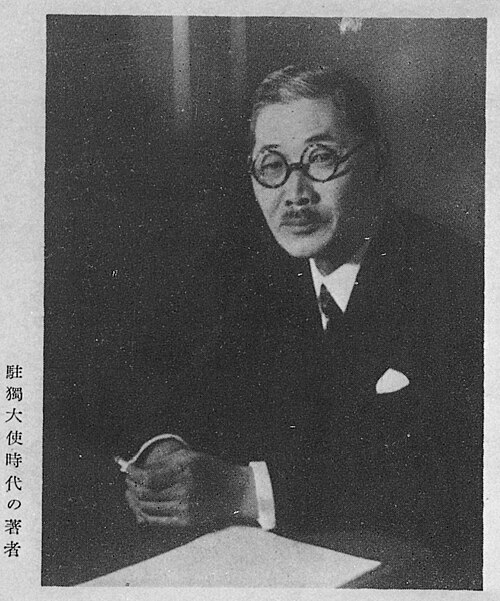

Foreign Minister of Japan (1941-42, 1945) · Japan
On the regime page: Empire of Japan, 1937 to 1945
5 quotes, oldest first. Filter with other speakers.
“It is extremely deplorable, however, that malicious propaganda should be let loose by some third powers representing Japan as harboring aggressive designs toward those regions. I have not the slightest doubt that the peoples of East Asia, understanding the real intentions of Japan, will cooperate with our country for the establishment of a new order in East Asia.”
English: English text as published in the New York Times, 18 November 1941, reproduced on ibiblio.org (Hyperwar). Original-language text not found.
First major foreign-policy address after Togo took office in the Tojo cabinet, delivered while the Japanese-American talks continued and three weeks before the attacks of 7-8 December 1941.
Address by Foreign Minister Shigenori Togo to the Imperial Diet, Tokyo, 17 November 1941, New York Times, 18 November 1941, as reproduced on ibiblio.org (Hyperwar) Source
“Should an occasion arise such as might menace the very existence of the empire or compromise the prestige of Japan as a great power, it goes without saying that Japan must face it with a firm and resolute attitude. For my part, I am taking charge of negotiations with a firm resolve regarding this point.”
English: English text as published in the New York Times, 18 November 1941, reproduced on ibiblio.org (Hyperwar). Original-language text not found.
From the same address, in a passage on the state of the talks with the United States.
Address by Foreign Minister Shigenori Togo to the Imperial Diet, Tokyo, 17 November 1941, New York Times, 18 November 1941, as reproduced on ibiblio.org (Hyperwar) Source
Content note: Warns of automatic action after a deadline. The words are shown as they were said or written. Why
“It is awfully hard for us to consider changing the date we set in my #736. You should know this, however, I know you are working hard. Stick to our fixed policy and do your very best. Spare no efforts and try to bring about the solution we desire. There are reasons beyond your ability to guess why we wanted to settle Japanese-American relations by the 25th, but if within the next three or four days you can finish your conversations with the Americans; if the signing can be completed by the 29th, (let me write it out for you — twenty ninth); if the pertinent notes can be exchanged; if we can get an understanding with Great Britain and the Netherlands; and in short if everything can be finished, we have decided to wait until that date. This time we mean it, that the deadline absolutely cannot be changed. After that things are automatically going to happen. Please take this into your careful consideration and work harder than you ever have before.”
English: Translation by the US Army and Navy signal intelligence services (intercepted Purple/'Magic' message), printed as Joint Committee Exhibit No. 1 in Pearl Harbor Attack Hearings, Part 12 (US Government Printing Office, 1946). Original-language text not found.
Cable to the two ambassadors in Washington moving the deadline for a Japanese-American agreement from 25 November to 29 November 1941. It was intercepted and read by US codebreakers.
Tokyo to Washington, 22 November 1941, #812, Purple, Army translation 25138, in Pearl Harbor Attack Hearings, Part 12 (Joint Committee Exhibit No. 1), p. 165 Source
Content note: Confidential warning of imminent war. The words are shown as they were said or written. Why
“Say to them that lately England and the United States have taken a provocative attitude, both of them. Say that they are planning to move military forces into various places in East Asia and that we will inevitably have to counter by also moving troops. Say very secretly to them that there is extreme danger that war may suddenly break out between the Anglo-Saxon nations and Japan through some clash of arms and add that the time of the breaking out of this war may come quicker than anyone dreams.”
English: Translation by the US Army and Navy signal intelligence services (intercepted Purple/'Magic' message), printed as Joint Committee Exhibit No. 1 in Pearl Harbor Attack Hearings, Part 12 (US Government Printing Office, 1946). Original-language text not found.
Instruction to the Japanese ambassador in Berlin to inform Hitler and Ribbentrop in confidence that war with Britain and the United States might come very soon. Sent after the Imperial Conference of 1 December 1941 and read by US codebreakers.
Tokyo to Berlin, 1 December 1941, #985 (part 1 of 3), Purple, Army 25552, in Pearl Harbor Attack Hearings, Part 12 (Joint Committee Exhibit No. 1), p. 204 Source
Content note: Describes misleading public statements before the attack. The words are shown as they were said or written. Why
“The date set in my message #812 has come and gone, and the situation continues to be increasingly critical. However, to prevent the United States from becoming unduly suspicious we have been advising the press and others that though there are some wide differences between Japan and the United States, the negotiations are continuing.”
English: Translation by the US Army and Navy signal intelligence services (intercepted Purple/'Magic' message), printed as Joint Committee Exhibit No. 1 in Pearl Harbor Attack Hearings, Part 12 (US Government Printing Office, 1946). Original-language text not found.
Internal cable to the embassy, six days before the attack, describing what the Foreign Ministry was telling the press about the talks. Read by US codebreakers.
Tokyo to Washington, 1 December 1941, #865, Purple, in Pearl Harbor Attack Hearings, Part 12 (Joint Committee Exhibit No. 1), p. 208 Source