Fumimaro Konoe
Illustration, not an archive object
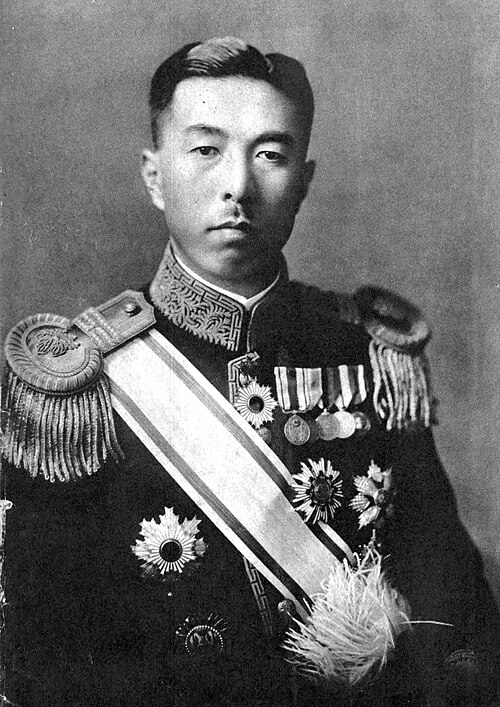

Prime Minister of Japan · Japan
On the regime page: Empire of Japan, 1937 to 1945
9 quotes, oldest first. Filter with other speakers.
“In sending troops to North China, of course, the Government has no other purpose, as was explained in its recent statement, than to preserve the peace of East Asia. I cannot but hope most fervently that reconsideration and self-discipline on the part of the Government and people of China will make speedily possible a fundamental adjustment of Sino-Japanese relations.”
English: Domei English text, as printed in the Japan Advertiser, 28 July 1937, and reproduced in FRUS. Original-language text not found.
Policy address by the newly appointed Prime Minister three weeks after the Marco Polo Bridge incident, when Japanese troops were being sent to North China.
Administrative address to the 71st session of the Imperial Diet, Tokyo, 27 July 1937 (Domei English text, extract), in Papers Relating to the Foreign Relations of the United States, Japan, 1931-1941, vol. 1 (Washington: Government Printing Office, 1943), doc. 250, p. 336 Source
“As the nation is aware, the Chiang regime is the Government which has dared to destroy the Yellow river embankments and does not care about sacrificing thereby in the muddy flood the lives of hundreds of thousands of innocent fellow-nationals. Such an outrageous and cruel act will never be permitted by man or Heaven. There is no reason why such a Government should last.”
English: English text of the statement as printed in FRUS. Original-language text not found.
Anniversary statement issued while Japanese forces were advancing on Hankou. It refers to the breaching of the Yellow River dikes in June 1938.
Statement by the Japanese Prime Minister (Prince Konoye), 7 July 1938, first anniversary of the China Incident, in Papers Relating to the Foreign Relations of the United States, Japan, 1931-1941, vol. 1 (Washington: Government Printing Office, 1943), doc. 323, p. 468 Source
“Once war is begun, even if the actual battlefield may be across the sea, the nation must have the tense feeling that all its land at home is also a battlefield. Not only those who carry guns and bayonets, but also those who till the soil, spin yarn, strike their hammers, or work at their desks—young and old, men and women, in fact, all the nation—must have the realization that they are actual fighters.”
English: English text of the statement as printed in FRUS. Original-language text not found.
Call to the whole population to regard itself as engaged in the war, from the same anniversary statement.
Statement by the Japanese Prime Minister (Prince Konoye), 7 July 1938, first anniversary of the China Incident, in Papers Relating to the Foreign Relations of the United States, Japan, 1931-1941, vol. 1 (Washington: Government Printing Office, 1943), doc. 323, pp. 468-469 Source
“It is China’s cooperation and not conquest that Japan sincerely desires. Japan desires to build up a stabilized Far East by cooperating with the Chinese people who have awakened to the need of self-determination as an Oriental race.”
English: Domei English translation, as printed in FRUS. Original-language text not found.
Broadcast on the day the Japanese Government issued its statement announcing a "new order in East Asia", after the capture of Canton and the Wuhan cities.
Radio speech, Tokyo, 3 November 1938 (Domei translation), in Papers Relating to the Foreign Relations of the United States, Japan, 1931-1941, vol. 1 (Washington: Government Printing Office, 1943), doc. 330, p. 479 Source
“If the true object of Japan in conducting the present vast military campaign be fully understood, it will be plain that what she seeks is neither territory nor indemnity for the costs of military operations. Japan demands only the minimum guarantee needed for the execution by China of her function as a participant in the establishment of the new order.”
English: English text released by the Japanese Foreign Office, as printed in FRUS. Original-language text not found.
Statement setting out Japan's basic policy towards China, issued as the war entered its second year.
Statement by the Prime Minister, Tokyo, 22 December 1938 (English text released by the Japanese Foreign Office), in Papers Relating to the Foreign Relations of the United States, Japan, 1931-1941, vol. 1 (Washington: Government Printing Office, 1943), doc. 332, p. 483 Source
“The Japanese Government are resolved, as has been clearly set forth in their two previous statements issued this year, to carry on the military operations for the complete extermination of the anti-Japanese Kuomintang Government, and at the same time to proceed with the work of establishing a new order in East Asia together with those far-sighted Chinese who share in our ideals and aspirations.”
English: English text as printed in FRUS. Original-language text not found.
Opening sentence of the third statement on policy towards China, issued after the fall of Wuhan and Canton. The statement goes on to set out terms for a settlement with Chinese who would join Japan in an anti-Communist arrangement.
Statement by the Prime Minister, Tokyo, 22 December 1938, in Papers Relating to the Foreign Relations of the United States, Japan, 1931-1941, vol. 1 (Washington: Government Printing Office, 1943), doc. 332 Source
“Our country is firmly determined to set up a Greater East Asian order by eliminating those who continue their resistance against us and by collaborating with those who make common cause with us.”
English: English text as published in Tokyo Gazette, March 1941, via ibiblio.org (Hyperwar). Original-language text not found.
Prime Minister's policy address four months after the Tripartite Pact. The sentence follows a passage about British and American aid to the Chongqing government.
Address to the 76th session of the Imperial Diet, Tokyo, 21 January 1941, English text in Tokyo Gazette, March 1941, via ibiblio.org (Hyperwar) Source
“From the point of view of preserving our national polity, what concerns your subject most is not the defeat itself, but the possibility of a communist revolution accompanied by the defeat.”
English: English translation as reproduced in HIST 341 course materials, University of Texas at Austin (translator not credited on the page). Original-language text not found.
Written memorial submitted to the Emperor by the former Prime Minister, arguing for an early end to the war.
Memorial to the Throne ("Konoe Memorial"), 14 February 1945, English translation as reproduced on the University of Texas at Austin HIST 341 course materials page Source
“The greatest obstacle to the termination of war is the existence of the clique in the military who brought about the current crisis from the time of the Manchurian Incident. They have lost confidence in pursuing the war to a successful end, but insist on resisting the enemies in order to save face.”
English: English translation as reproduced in HIST 341 course materials, University of Texas at Austin (translator not credited on the page). Original-language text not found.
From the same memorial, on the obstacle to ending the war that Konoe identified inside the military.
Memorial to the Throne ("Konoe Memorial"), 14 February 1945, English translation as reproduced on the University of Texas at Austin HIST 341 course materials page Source
Often attributed, not verified
These words circulate under Fumimaro Konoe’s name but could not be traced to a source. They are listed so readers can check them, not as Fumimaro Konoe’s words.
“The Imperial Government will not deal with the National Government.”
The statement is real and well documented, but the English wording in circulation varies ("cease to deal with", "will not deal with") and I did not locate the primary English text in the FRUS Japan 1931-1941 volume 1 documents checked, nor the Japanese original. Not published.